About Elizaphanian

Rector of West Mersea

Rambo


Astonishingly, viscerally violent – virtually misanthropic. If this was an episode in a TV series it would have been quite a good one, but not quite enough plot for a whole movie. Much better than 2 or 3, but not a patch on First Blood, which remains one of my favourite films ever. 3.5/5

40FP(18): John 12.44-46

44 Then Jesus cried out, “When a man believes in me, he does not believe in me only, but in the one who sent me.
45 When he looks at me, he sees the one who sent me.
46 I have come into the world as a light, so that no one who believes in me should stay in darkness.

Why is this a favourite passage?
I see this as the basic claim of Christianity – in Jesus we see God.

As will become clear as this series goes on, John is my favourite gospel (even though I accept it is less historically ‘straight’ than the others). This passage comes at what is effectively the mid-point of the book, the turning point of the gospel as a whole. Up until this time John has been describing Jesus’ public ministry – the signs of power that Christ accomplished to give a witness to his nature, so, the turning of water into wine, overturning the tables in the temple, the feeding of five thousand, the raising of Lazarus and so on. From this point Jesus’ public ministry is complete, and the remainder of the gospel has two elements – Jesus teaching the disciples in what is called the ‘farewell discourse’, and then the story of Holy Week. So this text is a hinge – it looks back to Christ’s public ministry, and forward to his teaching of the disciples.

I would pick out three elements from the text. The first is that there is continuity between the Father and the Son – Christ is the way to the Father. If this wasn’t true then Christianity would be idolatrous – the raising up of a creature to the rank of creator.

The second is verse 45 which underlies the theology of icons, as used in the Eastern Orthodox churches. Think of looking through Christ, as you look through a window – for Christ is wholly transparent to God, when you look at him, you look at the one who sent him.
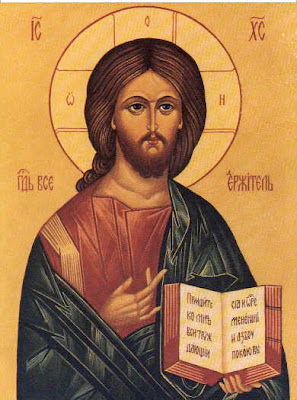
Finally we have the ‘mission statement’ from Christ – I have come into the world as light, that no-one who believes in me should stay in darkness. Christ illuminates our lives; he shows us the nature of God and of humanity – and so our own nature becomes clearer as a result. Our way becomes clearer, a way which Christ shows to us in his own life. The question is whether we turn towards the light or away from the light. The Christian calling as disciples is to trust in the light so that we might become children of light – and then we will be transparent to God too; living icons of the Father.

Gratuitous TBTE, with links


Taken last week. Time to catch up on some links that I’ve found interesting:

The Velvet Reformation, about Rowan.
Related: Why Christians should support gay marriage.
Rowan’s speech on the environment, which I don’t think I agreed with but need to do a more detailed analysis, hopefully before the eschaton.
A strong family and a small state belong together.
The financial crisis does have a conservative solution.
After capitalism.
A defence of Pope Benedict on contraception.
There is no rise in sea levels.
One of the very clever people who are sceptical of AGW.
A farm for the future.
Scientist contracts Ebola.
And finally a story that put a smile on my face: the Lego renaissance.

40FP(17): Jeremiah 20.7-9

7 O Lord, you have enticed me, and I was enticed;
you have overpowered me, and you have prevailed.
I have become a laughing-stock all day long; everyone mocks me.
8 For whenever I speak, I must cry out, I must shout, ‘Violence and destruction!’
For the word of the Lord has become for me a reproach and derision all day long.
9 If I say, ‘I will not mention him, or speak any more in his name’,
then within me there is something like a burning fire shut up in my bones;
I am weary with holding it in, and I cannot.

Why is this a favourite passage?
Simply because I identify with it so strongly! The English translations tend to minimise the shocking language being used here – I understand that the language is actually that used to describe seduction and rape, a complete overpowering of the person’s own choices. That is certainly how I experienced my own vocation. It becomes a compulsion – a word that must be spoken, that fidgets under the skin until it is released; and then, when it is, the world mocks (and I end up being known as the Vicar who hates Tesco, or – and this is more accurate – the one who is worried about Peak Oil and all that it implies). Which is fair enough, you don’t become a clergyman unless you are prepared to put up with being a figure of ridicule. It just means that passages like this one speak directly to how I experience God and my present condition – and that’s why it’s a favourite passage.

40FP(16): Psalm 127

I’m way behind with these!

1 Unless the LORD builds the house, its builders labor in vain.
Unless the LORD watches over the city, the watchmen stand guard in vain.
2 In vain you rise early and stay up late,
toiling for food to eat— for he grants sleep to those he loves.

3 Sons are a heritage from the LORD, children a reward from him.
4 Like arrows in the hands of a warrior are sons born in one’s youth.
5 Blessed is the man whose quiver is full of them.
They will not be put to shame when they contend with their enemies in the gate.

Why is this a favourite passage?
Although the second half of the psalm might seem to run against it, I see this as one of the most explicit and practical psalms describing what it means to trust in God. The first two clauses emphasise a common Psalmic theme of trusting only in God rather than our own strength (or the strength of a horse, or princes or anything else). This is the practical outworking of idolatry – whenever we put our final trust in something other than God it ends up not just failing but betraying that trust. The next clause is one that challenges me often when we read this psalm in the Daily Office, and it is a more personal attack on idolatry – the idolatry of autonomy (a very common one today). Those who believe in God need to allow him to be God, to actually be in charge of heaven and earth – and therefore believers need to worry less (as Jesus taught).

The Psalm then seems to change gear with its recommendation of having children young, with the very practical consequence of having able bodied men to support you if – as a middle aged man – you end up in an argument ‘at the gate’. I can recognise the practicality of this, but how it links with the foregoing is not yet clear to me.

Great psalm though.