About Elizaphanian

Rector of West Mersea

The sin of grumbling

So having resolved to stop complaining, I confess to regressing in recent days.

Complaining is a sin. Perhaps not a major one like pride or greed but it is probably worse than lust which is what much of our Anglican Communion kerfuffles revolve around. It’s born ultimately from two things: a frustrated sense of entitlement, and a lack of faith.

The frustrated sense of entitlement is triggered when reality and expectation start to diverge in a significant manner. It is ‘My God My God why have you forsaken me?’ Yet we are not promised an easy life, we are in fact promised the opposite: “God blesses you when people mock you and persecute you and lie about you and say all sorts of evil things against you because you are my followers.” Christians have no grounds for a sense of entitlement. It’s all grace, it’s all gift, and the appropriate response is thanksgiving and the counting of blessings. I resolve to improve, and my penance is to say the General Thanksgiving every morning until my heart is turned.

The lack of faith is even deeper. Faith and doubt are not opposites, faith and fear are opposites, and grumbling and complaining are centred in a fear of not achieving our heart’s desires, a lack of trust in God’s goodness and provision for us. It is the desire to achieve our own ends, and not surrender to God’s intentions for us. It is the Israelites running from the Egyptians and not listening to Moses saying ‘The Lord shall fight for you and ye shall hold your peace’. I resolve to improve, and my penance is to sing this hymn each morning until my heart is turned:

Forth in thy Name, O Lord, I go,
my daily labor to pursue;
thee, only thee, resolved to know
in all I think or speak or do.

The task thy wisdom hath assigned,
O let me cheerfully fulfill;
in all my works thy presence find,
and prove thy good and perfect will.

Thee may I set at my right hand,
whose eyes mine inmost substance see,
and labor on at thy command,
and offer all my works to thee.

Give me to bear thy easy yoke,
and every moment watch and pray,
and still to things eternal look,
and hasten to thy glorious day.

For thee delightfully employ
whate’er thy bounteous grace hath given;
and run my course with even joy,
and closely walk with thee to heav’n.

(Wesley. Of course)

Alive and kicking

Yes, I know, there is more to a good blog that just continually posting YouTube videos but in the words of a good book recommended to me by my dear departed friend F**k it

You lift me up to the crucial top, so I can see
Oh you lead me on, till the feelings come
And the lights that shine on
But if that don’t mean nothing
Like if someday it should fall through
You’ll take me home where the magic’s from
And I’ll be with you

Pray for the Church of England

I’m feeling a bit sad this afternoon.

A fellow priest, close to me, and very important to me, dropped dead of a heart attack last Thursday. I discovered this a few minutes before taking a 9.30 Communion service this morning. In God’s strange provision I had material on hand for offering up an intention for the mass, which I found tremendously helpful

Everlasting God, our maker and redeemer,
grant us, with all the faithful departed,
the sure benefits of your Son’s saving passion and glorious resurrection,
that, in the last day, when you gather up all things in Christ,
we may with them enjoy the fullness of your promises;
through Jesus Christ your Son our Lord,
who is alive and reigns with you,
in the unity of the Holy Spirit,
one God, now and for ever. Amen

Life is so short and so precious, and poised to end at any moment. It really is a frightening waste and blasphemy to spend our time on anything other than what God is calling us to do. And yet – doing just that is hardly straightforward.

I think it’s called carrying our cross.

It’s also called working for the church.

We are called to love the church, and I believe that completely – but it needs to be a clear-sighted love, for only such love might resource the cleansing of blemishes and the enabling of holy work. It is not ‘my country right or wrong’ – for if we are destined to judge the angels surely we can exercise some form of discrimination with regard to our own internal life?

At General Synod we hear that by 2020 the Church will be dead (good analysis of underlying trajectory here, the Synod story contains all sorts of assumptions). We have lots of schemes and ideas and we run around chasing our tails because we have lost sight of the one thing needful. We’re in a complete funk about sexuality – whether it’s homosexuality or the gender of the episcopate – a subject on which Jesus said very little. We forget this, because we’re not sat at his feet. When we do respond to promptings of the Spirit we don’t follow through on them. I believe that the Church of England is living through a period of chastisement – that we are being pruned in order that we might become more fruitful – but I am less and less confident that the established CofE is a part of the fruitful future (whereas I AM convinced that Anglican theology is part of that future).

It is the response to the pruning which is so dispiriting. We spill our blood keeping the show on the road, when God is more and more clearly asking us to change the show (not the content but the form). If we are to be the Church of England we need to recognise that England is not what it was, in so many diverse and mutually contradictory ways. I think there is a reason why I don’t know many happy incumbents, for incumbency drives out priesthood – we are the shamanic cruise directors on the proverbial sinking ship. The church – this beloved institution – has become monstrously abusive and doesn’t even realise it.

Father forgive her, for she knows not what she does.

We no longer know what we are here for. We don’t know what we are doing or why we are doing it. We have become entangled in the worship of Mammon and are choking. With you is my contention O Priest!!!

What I want is to know the gladness and sadness of the gospel and to share the conversation of God with others and for others. Please pray for the Church of England, that she might be recalled to her vocation, that she might remember her beauty in the sight of God.

And pray for me, a sinner too.

In the meantime, I shall listen to Mr Mumford:

Because I need freedom now
And I need to know how
To live my life as it’s meant to be

And I will hold on hope
And I won’t let you choke
On the noose around your neck

And I’ll find strength in pain
And I will change my ways
I’ll know my name as it’s called again

On the reassurance of Angelina Jolie

Ok, let’s start with a controversial thesis: Angelina Jolie is gorgeous

Next part of the argument: her father isn’t so much

But the family resemblance is clearly there.

This is something I’ve noticed – daughters can often resemble their fathers, whilst still being gorgeous.

I call this ‘the reassurance of Angelina Jolie’.

Priesthood

Some good stuff here (via Justin)


“Mission Priests don’t confuse faith in the Gospel with a soft assent to its social principles or moral utility. Rather, they know the veracity of the Gospel through first-hand experience. For many, faith was strengthened when they changed careers and entered seminary. Enduring the patronizing and petty atmosphere of “theological school” clarified the eyes of their soul. Facing down and even defeating parish antagonists and persecutors revealed the strength of the Gospel and cemented their conviction once and for all…
“Mission Priests are fearful. They fear losing their communion with God by being caught up in the things of this world. They worry about losing their courage in the coercion and compromise of ecclesiastical politics…

“Finally, the Mission Priest refuses to conform to false expectations of a priestly personality type imposed by others. God has called him — not the Parish Council, not a benefactor, not his boyhood parish priest, not even the Bishop. And God made us different. Each priest has a distinct role and service in the Church. In the end, only God may judge his faithfulness.”

I also liked this reminder of one of my favourite books (and the writer could have written the above): 
Most pastoral work actually erodes prayer. The reason is obvious: people are not comfortable with God in their lives’…‘And so pastors, instead of practicing prayer, which brings people into the presence of God, enter into the practice of messiah: we will do the work of God for God, fix people up, tell them what to do, conspire in finding the shortcuts by which the long journey to the Cross can be bypassed since we all have such crowded schedules right now. People love us when we do this…”

The Collar

I struck the board, and cried, “No more;
                         I will abroad!
What? shall I ever sigh and pine?
My lines and life are free, free as the road,
Loose as the wind, as large as store.
          Shall I be still in suit?
Have I no harvest but a thorn
To let me blood, and not restore
What I have lost with cordial fruit?
          Sure there was wine
Before my sighs did dry it; there was corn
    Before my tears did drown it.
      Is the year only lost to me?
          Have I no bays to crown it,
No flowers, no garlands gay? All blasted?
                  All wasted?
Not so, my heart; but there is fruit,
            And thou hast hands.
Recover all thy sigh-blown age
On double pleasures: leave thy cold dispute
Of what is fit and not. Forsake thy cage,
             Thy rope of sands,
Which petty thoughts have made, and made to thee
Good cable, to enforce and draw,
          And be thy law,
While thou didst wink and wouldst not see.
          Away! take heed;
          I will abroad.
Call in thy death’s-head there; tie up thy fears;
          He that forbears
         To suit and serve his need
          Deserves his load.”
But as I raved and grew more fierce and wild
          At every word,
Methought I heard one calling, Child!
          And I replied My Lord.

(George Herbert – found via here)

Evil suffers a (small) setback

This is going to be a bit of a rant, and I’ll probably wish I hadn’t written it tomorrow… BUT

I’m glad the News of the World is shutting down. I generally see the tabloid newspapers as being a physical embodiment of many of the worst aspects of human nature (and not just because I’ve been bitten by them, it long predates that). To put that in a less wordy fashion, I think the tabloids are evil. I think they serve the Enemy. And now, for one brief and no-doubt temporary moment, the bright white light of public scrutiny has been turned on to those who have caused or colluded in wickedness and we are revolted by what we see. Thank God we still have some moral substance in us.

No doubt there were good and conscientious Germans who worked hard for the Nazi regime and never personally murdered a Jew, but who were out of a job when the camps shut down. Yes, an extreme analogy, but the difference is only one of scale. Never forget that the Nazis were enabled to pursue their policies because they had first whipped up the scapegoating process, and it is precisely that evil scapegoating process that the tabloids specialise in.

So I am glad of heart. I don’t care that this will be cynically manipulated by Murdoch and that we will soon have the Sun seven days a week. For one brief moment evil has suffered a setback. Today is a good day.

Contrary to Scripture?

John Richardson left a comment on my Jeffrey John post arguing that JJ “teaches a position contrary to Scripture”. I don’t believe this to be true – or, rather, I believe that this way of characterising the debate begs the question at issue.

Take the eating of shellfish, which is described as an abomination in Leviticus 11. This prohibition is overturned in the New Testament, most especially through Peter’s vision and the subsequent discussion in Jerusalem (Acts 11).

Does this change represent a change of detail or a change of method? That is, is this simply a case of amending a law code, leaving everything else as it stands – and, therefore, the ‘structure of righteousness’ as it stands? Or is this a demonstration of a new kind of authority, ie accepting ‘it seems good to the Holy Spirit and to us’ as of higher authority than the written law? So the gathered church has the authority to determine what is acceptable to God and what is not?

To say that JJ’s teaching is ‘contrary to Scripture’ is to assume the first to be the case. That is, at the very least, a debatable point – but what I want to emphasise here is that arguing in the way that JJ does is NOT ‘contrary to Scripture’, it is to interpret Scripture in a different way, one which is at least as grounded in the long Christian tradition as the post-Reformation emphases. Does anyone else find it odd that the Christian tradition that has most emphasised ‘sola gratia’ is the one that is most insistent on a legalistic understanding of Scripture in this debate?

Jeffrey John

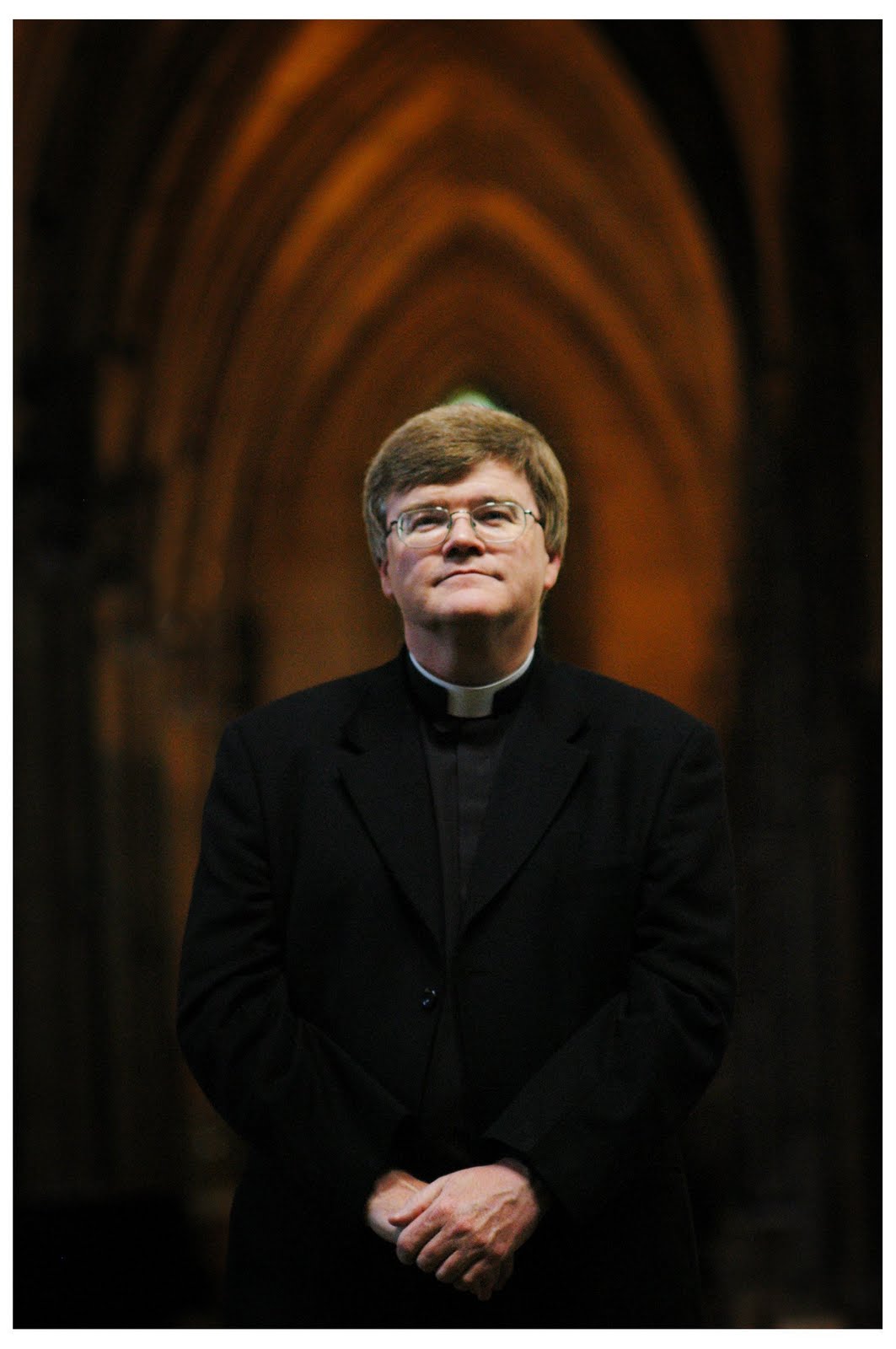
Came across this picture at Ruth Gledhill’s blog, and thought it very striking.

I greatly admire Jeffrey John. He is someone who has immense gifts which he has given to the church in loving service. In return he has been betrayed, abused and calumnied – and he has not given up. He continues to serve the church with loyalty, grace and dignity. He’s an example to all of us, and a bit of a hero for me. I hope that one day the CofE can get over itself sufficiently to let him exercise a greater degree of leadership.

I read this yesterday, and I suspect it lies behind John’s approach –

“I’m sure there are ministers who are treated abominably by churches, just as I am sure that there are churches that are treated abominably by ministers, but the former, at least, has never been my experience. We have so many continuing and precious friendships from both these churches and, indeed, from so many other churches that in less prominent ways have been part of our story. I have little patience with ministers who moan about churches: Jesus loved the Church and gave himself up on the Cross for the Church (Eph 5.25); the Church is precious to him and the Church should always be precious to us.” (John Colwell, ‘Why have you forsaken me?’)