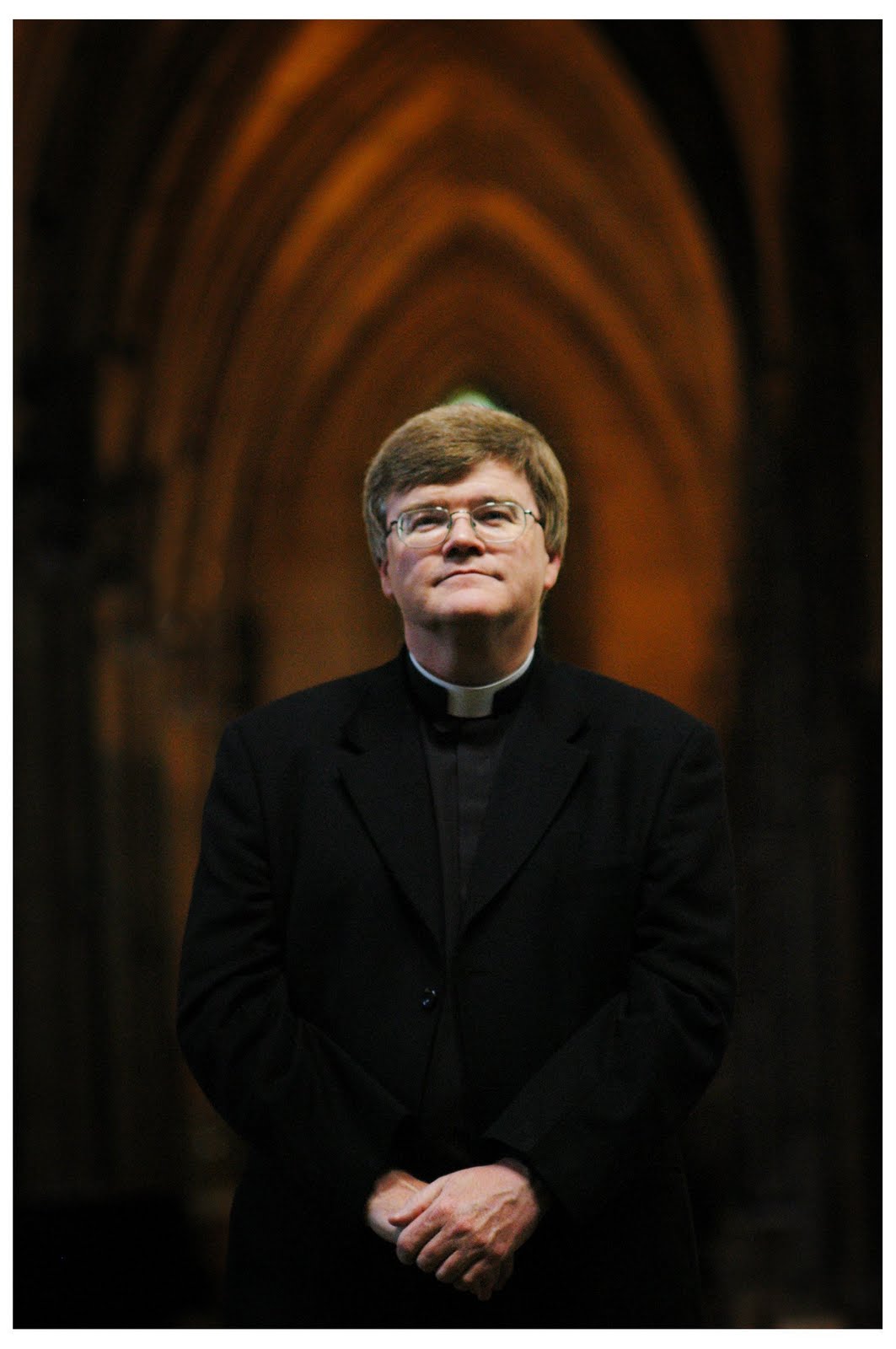
Jeffrey John

Came across this picture at Ruth Gledhill’s blog, and thought it very striking.

I greatly admire Jeffrey John. He is someone who has immense gifts which he has given to the church in loving service. In return he has been betrayed, abused and calumnied – and he has not given up. He continues to serve the church with loyalty, grace and dignity. He’s an example to all of us, and a bit of a hero for me. I hope that one day the CofE can get over itself sufficiently to let him exercise a greater degree of leadership.

I read this yesterday, and I suspect it lies behind John’s approach –

“I’m sure there are ministers who are treated abominably by churches, just as I am sure that there are churches that are treated abominably by ministers, but the former, at least, has never been my experience. We have so many continuing and precious friendships from both these churches and, indeed, from so many other churches that in less prominent ways have been part of our story. I have little patience with ministers who moan about churches: Jesus loved the Church and gave himself up on the Cross for the Church (Eph 5.25); the Church is precious to him and the Church should always be precious to us.” (John Colwell, ‘Why have you forsaken me?’)

You were always on my mind (confessions of an introvert parish priest)

One way in which it is possible to discern truth is that it is something that sets you free. The peacock just can’t be kept down forever…

So I was listening to this song, shortly after a particular conversation about my ministry, and I thought ‘this is it!’

Maybe I didn’t treat you
Quite as good as I should have
Maybe I didn’t love you
Quite as often as I could have
Little things I should have said and done
I never took the time
You were always on my mind

Long term readers of this blog will know that I have struggled much with the nature of parish ministry. I think there are problems associated with the nature of the work itself; and then there are problems that are peculiar to me.

The problems that are associated with the nature of the work itself have been thoroughly considered elsewhere, and, really, that book needs to be read by anyone interested in the topic.

So this is about me. There are some things I’m good at, and there are some things I’m definitely not good at – and something I’m becoming comfortable accepting is that one of the things that I’m not good at is something close to being essential in a parish priest.

What is the difference between having a conversation with someone in the Rectory, who has come to discuss something important, and having that same conversation with someone in their own home? Well, one I find straightforward, I enjoy doing it (I think I’m reasonably good at it) and the other – well, there’s the rub. I find it difficult to go out and be with people in their own homes.

I realise that in order to go out I need an excuse and a structure. So, for example, I find it straightforward to take Holy Communion to the housebound. I enjoy that, I find it a very fulfilling element of my ministry, there’s never any ‘issue’ with this – because I have an excuse for going there, and there is a structure for what to do when I’m there. It’s as if I need a comfort blanket, something to fend off all the shyness and insecurity and fear of rejection. Something to hide behind.

Now this is a bit of a problem when you’re the parish priest and people have a natural expectation that the priest will be happy to just call in and talk. I wonder whether the George Herbert stuff was (in part) just a smoke screen – I couldn’t quite articulate what the deepest problems were and fastened on a superficial explanation as an interim place to stand.

It has given rise to some problems, and I’m sure it’s why there has been an “incredibly vicious campaign” against me in the town (not my words, although I don’t doubt the truth).

You always wanted me to be something I wasn’t
You always wanted too much, oh, oh
Now I can do what I want to – forever
How am I gonna get through?

I think if I was more of a natural people-person, someone who was able to press the flesh and talk the small talk and socialise and schmooze then many of the problems would have been dealt with more readily. I just can’t do that – even just thinking about it is exhausting, and I have enough of an issue with tiredness as it is. The fundamental issue is one of introversion (this is quite a good article if you’re unfamiliar with that jargon. Though I disagree that hell is other people. Hell is the school playground when you’re waiting for your children to emerge). I used to think it was deafness, and how that links in I’m not sure – whether one came first or whether they were formed together, I don’t know. I am quite profoundly introverted and… I’m OK with that. This is how God made me. What it means, however, is that there are always going to be times when the shoe pinches. Times when the expectations and desires clash rather strongly. Or to put it differently, I’m coming to accept that the answer to this question that I posed is ‘No’.

And there are implications to that acceptance.

And that’s alright.

I want to run, I want to hide
I want to break down the walls that hold me inside
I want to reach out, and touch the flame
Where the streets have no name

(By the way, the use of Pet Shop Boys videos is by way of extending a middle finger in the direction of a certain unmentionably awful tabloid newspaper that got caught up in the campaign and who thought that liking the Pet Shop Boys was conclusive proof of my general inadequacy. As one kind person put it ‘anyone who has been monstered by the Daily [Flail] is alright by me….’)

Chauffeur or Mechanic?

I’ve been thinking about ministry, and what sorts of ministry are possible in different circumstances, and came up with this analogy:

Some parishes are like well-conditioned cars. The fundamentals are in place and working, and what is needed from an incumbent is to keep the parish moving in an established direction, making sure that the passengers are comfortable and looked after (‘feed my sheep’). Call this the ‘chauffeur’.

Other parishes are like cars that have broken down. They need someone to come in and examine the engine – possibly taking it apart and putting it back together again – in order that the parish can then get back to forward motion – which is, after all, what the car is for. Call this the ‘mechanic’.

If a chauffeur is appointed to a parish needing a mechanic, then the incumbent will be criticised for drift and inertia, for letting things slide.

If a mechanic is appointed to a parish needing a chauffeur, then the incumbent will be criticised for reckless meddling and needless controversy.

A bad chauffeur will keep the show on the road at the expense of necessary maintenance, storing up problems for the long run.

A bad mechanic will perpetually tear up the plant by its roots and prevent long-term growth in both numbers and knowledge of God.

Of course, both parishes and incumbents are mixtures, but I think the contrast can do helpful work.

For myself, I think I am temperamentally more of a mechanic than a chauffeur, although I can do both (and the church which seems to be most healthy at the moment is the one where I have hardly had to do any mechanical work at all). I think I’ve done some good mechanical work here – despite the occasional engine blow-up – and whilst there are definitely some mechanical issues remaining, my sense is that the chauffeur skills are going to be needed more in the future.

(Question – what is the engine in a church? and what are the other essential bits, like the transmission and the exhaust…)

Of course, the Church of England as a whole is – in my ever so humble opinion – a broken down car at the moment, however effective it seemed to be at that wedding the other day…

Seminary obituary?

Several people have linked to this interesting article, asking whether seminary education has a future. I haven’t got time to write a full response – maybe after Easter – but I want to point out three sources of tension:

– there is a tension between forming priests and training theological academics. The latter has a part to play in the former but if the distinction is ever obscured then it is the training for the priesthood which comes off worse;

– there is a tension between academic theology and mystical theology, between an intellectual enterprise that can be pursued by people of any faith and of none, and the intellectual enterprise which is pursued within a self-reflective community of faith. It is essential for priests to be thoroughly trained in the latter, the former is much less essential;

– there is a tension between the residential formation of priests, allowing for the overview and shaping of a whole person, and the non-residential training of priests which, by default, must end up concentrating on what can be assessed at a distance. The latter is not the same as the former.

As with many things, I can’t help but feel that the CofE suffers from confused thinking, backing into situations that it hasn’t planned for and then becoming bewildered by the consequences.

More anon.

Do CofE parishes want – can they cope – with introvert incumbents?

Thinking out loud…

Interesting moment in my therapy this morning, when we got to talking about introversion (lest there be any doubt, “My name is Sam and I am an introvert” [grin]). Did a quick Google search when I got back and was reminded of this interesting article from The Atlantic.

Do you know someone who needs hours alone every day? Who loves quiet conversations about feelings or ideas, and can give a dynamite presentation to a big audience, but seems awkward in groups and maladroit at small talk? Who has to be dragged to parties and then needs the rest of the day to recuperate? […] Leave an extrovert alone for two minutes and he will reach for his cell phone. In contrast, after an hour or two of being socially “on,” we introverts need to turn off and recharge. My own formula is roughly two hours alone for every hour of socializing.

I was recently reminded of my first thinking about Killing George Herbert, and what parishes actually want. For one way of describing what is wanted – at least, what people tell me that they want, ie ‘this is what we would like you to do'(!) – is to say ‘the parish wants an extrovert’. Someone who is comfortable – no, someone who is enthused and inspired by the social whirl, who will happily be active in seeking conversations, in ‘being visible’ – and, therefore, someone who gains energy from such things. Which is, of course, a possible description of hell for the introvert.

My therapist commented that this was a particularly CofE difficulty. In the Roman Catholic and Orthodox churches it is much more straightforward to serve as an introvert, not least because the expectation is that a person will seek the priest, not that the priest will seek the people. Introverts can be brilliant when a person knocks at the door and seeks specific and particular help (presumably that’s why so many introverts are called to the ministry) but when the dynamic is the other way around (eg “visiting”) then it runs quite strongly against the grain. It’s also why – at least for me – I find liturgy so essential. It’s probably an exaggeration to say evangelical = extrovert, anglo-catholic = introvert, but there’s _something_ there!

I had thought that my deafness was a large part of why I find socialising so draining – which is probably one factor – but I have now come across half-deaf people who don’t worry about group gatherings half so much, so personality does have a lot to do with it.

One final thought – in chatting to some old friends from my curacy at the weekend (I was in London for a big do) – the comment was made that all a parish needs is to know that they are loved. I think that’s true – and certainly something to aspire to – but it does run both ways. There is something here about parishes becoming big enough (in every sense) to be able to accommodate the diversity of priests that pass through, cultivating a flexibility of expectation and valuing the good things about a priest, putting up with the bad. Truth be told, Mersea is pretty good at that… but I know of many colleagues where that hasn’t been true.

More anon.

Seeking a Christian England

So – we live in a secular society, not a Christian one. Nice to have it laid out so clearly by the judiciary. It grates that these judgements are so philosophically ill-grounded – but I’ve discussed that in more detail before.

“…if such a thing should be, the crimes of that nation will probably begin in infringement on Apostolical Rights ; she will end in persecuting the true Church ; and in the several stages of her melancholy career, she will continually be led on from bad to worse by vain endeavours at accommodation and compromise with evil.”

Should Christians be worried about this? Given that the church was (arguably) at its healthiest when working within the avowedly pagan Roman Empire, one would suspect not. Yet surely it is understandable for a Christian to want not to suffer so much? In a way, it will make Christian witness rather clearer. This isn’t a point about homosexuality so much as a broader point about how a distinctive Christian life is possible in a secular society. For example, take issues at the beginning and end of life. At what point will a Christian doctor be disbarred, or restricted from practicing in certain areas, if they, eg, refuse to terminate a baby’s life, or refuse to administer euthanasia? Will Christians be allowed to teach differently to the secular world-view? Will parents be forbidden from teaching Christian doctrine in those areas where it clashes with secular assumptions? “That’ll never happen!” Right.

“How may a man best reconcile his allegiance to God and his Church with his duty to his country, that country, which now, by the supposition, is fast becoming hostile to the Church, and cannot therefore long be the friend of God?”

I think what’s really running around my mind is whether it is legitimate to seek to make England a Christian nation (I leave off the possible ‘once again’ as it begs too many questions). There are, of course, all sorts of potential idolatries here – I have read my Hauerwas – but there is also an idolatry in quietism. If we, as Christians, are inevitably committed to questions of social justice then we are also inevitably political creatures – which, logically, and under God with all due humility, must mean seeking to so order our political arrangements in such a way that abundant life can flourish – and that “abundant life” is irreducibly Christian in character, not secular. We are therefore in necessary tension with any secular state.

There are several threads that I want to knit together:

– the internal collapse of the Church of England, culturally and theologically (symbolised by the abandonment of the BCP, however sensible that step was);
– the death of England more broadly;
– the on going threat of Islamisation, and the sometimes unhealthy political reaction to it;
– the way in which the Anglican Communion will split, and how TEC may be a better vehicle for the Anglican theological spirit than a Covenantised CofE; and finally
– the unhealthy nature of Anglo-Catholicism within the CofE (reactionaries contending with liberals), compared to the initial flowering of Anglo-Catholicism sparked by a political controversy.

I just wonder if there is a ‘sweet spot’ lurking here that would mean the project of seeking a Christian England would be blessed. Watch this space.

“What are the symptoms, by which one may judge most fairly, whether or no a nation, as such, is becoming alienated from God and Christ?
And what are the particular duties of sincere Christians, whose lot is cast by Divine Providence in a time of such dire calamity?”

Blessing a processional cross

Something I had to do at short notice on Sunday, and this was what I scribbled on the back of the envelope:

Holy Father,
it is through his death on the cross that your Son leads us into life;
we ask you to bless this cross (+) that we who lift it high and follow it
may be inspired and encouraged by his example
and enabled by grace to walk in his footsteps;
this we ask, in the name of Christ our Lord. Amen

Some brief guidance for intercessors

With a large tip of the hat to Doug, whose ‘Leading Common Worship Intercessions’ was invaluable.

Firstly, my thanks to you for agreeing to take on this ministry. Prayer is probably the most important element of Christian life as it is the foundation for everything else that we do, and intercessions – which are all about enabling people to pray – are a central element of our gathered worship. So herewith some hints and tips for how to lead intercessions.

Most important, expanding on the above because it is worth emphasising, is this: intercessions are about leading people in prayer, not praying in front of other people. The intercessor must therefore always have in mind the effect that what they say will have on people who are engaged in addressing themselves to God. Anything which distracts the person praying from that process is therefore a mistake. Here are some examples:

  • providing new information, or even giving too much information at all! The intercessions are not the notices, nor are they a television news bulletin;
  • nor are the intercessions a sermon, a place to engage in argument, or even a place to give views – praying for the situation in the Middle East is fine, praying for the Israelis (or Palestinians) to stop being such evil people – this is not fine;
  • if you are quoting a prayer by a famous saint, you don’t need to give acknowledgements – simply say the prayer in the way that it was intended;
  • being too long or too wordy, so that the people praying end up thinking about the intercessor rather than about God – keep things as simple as possible. As a general rule ten seconds of silence is more effective than a hundred words;
  • using a complex response which people find difficult to join in with.

So if these are things to avoid, what are the things to do? Firstly, remember that we do not know how to pray, but the Spirit prays through us – in other words, our task is to join in with something that is already going on, that has been going on for thousands of years. When we pray we are jumping into a stream that is already flowing, we don’t need to initiate the process. When we pray we are standing on the shoulders of giants.

If you are due to lead the intercessions, take some time to look at the readings set for the day, most especially the gospel lesson, and see if you are inspired to touch on particular themes (and trust your inspiration). Look at the prayer list in the black folder; I would not recommend reading out all the names left on the cross in the porch, but reading out all the names in our community who need praying for (the second list) is good. Catch the news headlines from the day before to see if there are any topical worldly issues that people may wish to bring before God.

Classic patterns (full texts available from Sam)
A five-fold pattern: Church, world, local community, the sick, the dead.
A three-fold pattern: world, church, individuals.
(These are addressed to God)
Bidding prayers (eg 9 Lessons, Good Friday) – these are addressed to the congregation, who pray in the silence and response.
Patterns can be used as a platform from which to jump off creatively, eg to include sung responses.

Suggested reading:
Leading Common Worship Intercessions, Doug Chaplin
Leading Intercessions, Raymond Chapman

Mourinho’s bitter legacy

So Rafa has been sacked. Well how do you follow the special one? Similar problems with Avram Grant and Big Phil.

Is it not the case, though, that a true measure of greatness is less how much success you are able to drive through by force of personality and talent, but rather how much success others are able to enjoy once you have gone?

In other words, rather than be proud of a large catch of fish, is it not better to leave a legacy of many fishermen?

(I’m not doubting Mourinho’s innate ability, just saying that he needs to stay somewhere for the long run.)