Falling in love with Frankenstein


This is a sketch for a much longer essay about science fiction. Click ‘full post’ for text.

One of the dominant themes of Modern culture is the Frankenstein conceit – what you might think of as the ‘mad scientist’, or, more profoundly, the Faustian bargain. A man (and it normally is a man) is so consumed by his rational intellectual pursuits that he unwittingly provokes disaster and his own death.

As I see it, this is the way in which humanity’s soul has digested and absorbed the impact of the Enlightenment. The Enlightenment project is precisely that which has elevated one element of our human nature falsely above the others; it has insitutionalised asophism; and thus we are in the midst of ecological crisis. The devil has come to collect his due.

Being a fan of sf, especially visually, I am struck by the way in which this theme has been subverted and then overcome within the world of fiction and film. I see this as a creative analogue of the way in which the Enlightenment project has itself been undone from within. (This is, I believe, why there is such an efflorescence of angst-ridden writings from the humourless atheists like Dawkins and Hitchens et al – they are aware in their bones that they are being left behind.)

Three examples of this shift:
1. The Matrix trilogy. The first Matrix was pure Frankenstein – the intellectual products of humanity turn against their creators and destruction follows; human liberty and salvation lie in battling against the machine. However, the second two films explored something more creative – the machine is not monolithic, it has variety (and therefore more dramatic interest of course) – there is a possibility of an alliance between human and mecha.

2. Battlestar Galactica, the new series. Whereas in the original series we are facing highly efficient automata (rational products of Enlightenment) now the cylons are riven with their own competing needs and desires. The Cylons are now just like us; we can even breed with them.

3. The Sarah Connor Chronicles. The original Terminator film is a real classic, and a classic description of the Frankenstein – a totally remorseless source of death and destruction ‘it absolutely will not stop until you are dead’. With the films a little first, but now much more with the series, we have much more creative ambiguity. This crystallised for me in the recent episode where Summer Glau starts to learn ballet. A vision of beauty – and whether it is human or mecha falls by the wayside.

(I’ve also been put in mind of this by recently finishing Dan Simmons’ Hyperion cantos, but I’ll write about them separately.)

I believe that what we have in this medium – film and television science fiction – is the creative resolution of the human conflict created by the Western idolatry of reason. As our society moves beyond the Enlightenment, so too does our fiction. Robots who are pure products of reason are no longer very interesting – the robots need to have more to them – and this is simply a mirror for how we see ourselves. In other words, there is more to humanity than the remorseless application of reason.

I find this encouraging and exciting.

Put that in your bong and toke it

Recent arrivals to this blog may not be familiar with this site, which is truly one of my favourites – and another example of sophisticated atheism at work, along with a a warped and wonderful sense of humour….

The project that the writer has embarked on is an important one. I hope his book gets published soon. His next book, that is.

The Christian Duty to Boycott Tesco


And if you want cheap food well here’s the deal:
Family farms are brought to heel
by the hammer blows of size and scale,
Foot and mouth the final nail
in the coffin of our English dream
that lies out on the village green;
While agri-barons, CAP in hand
Strip this green and pleasant land
Of meadow, woodland, hedgerow, pond
What remains gets built upon
No trains, no jobs
No shops, no pubs
What went wrong?
What went wrong?
(from the song ‘Country Life’ by Show of Hands)

It would surely be impossible to argue that God is uninterested in the way that humanity engages in economic activity, and we can see this in two Scriptural forms: specific injunctions against particular practices and more general injunctions in favour of social justice, obedience to God and, as Jesus put it, “You cannot serve both God and Mammon”. Examples of the former are found in Deuteronomy 25.13 (“Do not have two differing weights…”) and Isaiah 5.8 (“Woe to you who add house to house and join field to field till no space is left and you live alone in the land.”); examples of the latter are the repeated prophetic calls to look after the widows and orphans, with the promise of divine chastisement if these calls are ignored.

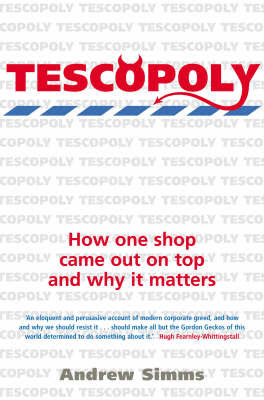
This is the context in which I read “Tescopoly” by Andrew Simms, a very thorough overview of the way in which Tesco functions as a monopolist: one who has joined all the fields together until it is left alone in the land. In many ways Tesco is simply a highly efficient corporation, a (rare) example of world-class management in a British company. Yet it is precisely the fact that it is so efficient, so effective in accomplishing its aims, that it has had such dispiriting and impoverishing effects on our communities.

Simms details the ways in which, through the use and abuse of its dominant market position, Tesco actively harms those who supply it with goods, those who work within its walls, and the communities within which it finds itself operating. For example, Tesco consistently pays its suppliers less than the industry average, it is consistently late in paying invoices presented to it, especially by the smallest suppliers, and, through the exercise of essentially bullying tactics, it is able to ‘borrow’ more than £2bn a year from its suppliers for free. Internationally it suppresses wages in the third world and strips communities of their dignity (I was astonished to read that in a farm in Zimbabwe children are taught to sing “Tesco is our dear friend” in order to impress the visiting potentates.)

My own concern is primarily with the impact on local communities in England, and here Simms marshalls fascinating evidence. For every £1 spent in a supermarket more than 90p leaves a local community; whereas the impact of a ‘local box scheme’ (ie locally produced and delivered vegetables) is quite the reverse – for every £1 spent, £2.50 is generated in local wealth. In terms of jobs, supermarkets undermine a community further: it takes £95,000 worth of sales in a supermarket to sustain a single job, the figure for smaller stores is £42,000. Beyond this, the supermarkets, especially Tesco, support the use of casual and unlicensed labour leading to what is effectively a modern form of serfdom. Put simply the arrival of a supermarket chain in a town sucks money and livelihoods away from the local area in order to agglomerate capital for shareholders. Supermarkets impoverish communities in terms of income, social life and common civility.

At this point a common defence is to claim that this is the operation of ‘the free market’, and that if the market chooses to support Tesco, and people benefit from its cheap prices, then we shouldn’t interfere. Such a response is either naively ill-informed or else the expression of an understanding already corrupted by an anti-Christian value system. No sane person advocates a wholly unrestrained free market, or else bin Laden would have been able to purchase nuclear weapons long ago, and so the question becomes: is it right for the free market to operate here, in these circumstances? Is the operation of a free market in this context something that will foster and support our social values or will those values and goods be undermined by the free market? In other words, higher values are applied. Yet, of course, particularly with regard to Tesco: what does it mean to talk about a free market when we have at best an oligopoly and at worst, in so many areas, a monopolistic environment? Simms points out that in 81 of the 121 British postcode areas Tesco is the dominant grocer, and is the number 2 in a further 24 areas. The operation of the free market is considered by the government to be inhibited whenever one trader gets more than 8% of the market – and Tesco has vastly more than that, in some areas going beyond 50%. In such a situation invoking ‘the free market’ functions as a ritualistic response in which all other considerations are subordinated to the one dominant value of Mammon. In other words, it is simply the expression of idolatry.

As such it is not something that the living God will allow to endure in perpetuity, and indeed, the ways in which this system will collapse can already be discerned. The operation of the supermarkets are dependent upon the ready supply of cheap and abundant fossil fuels, especially oil, which allow for the worldwide transport of food and the complicated logistics and processing undertaken by the corporations in this country. As a result of the worldwide peaking of oil supplies such energy is becoming increasingly scarce and expensive, and we will all be required to change our patterns of life and consumption with, most particularly, a return to the patterns of local food production that obtained before the last half of the twentieth century. This will come as a shock to the economic system and an ecological truth will then be applicable: the most efficient organisms, which are most finely tuned to a particular environment, are the most vulnerable when that environment changes. There is a trade-off between efficiency and resilience, and the ‘just-in-time’ model of food distribution which works well in our present context will be insupportable in the world we are moving into.

We live today in a society which has abandoned the Scriptural concern with social justice, and which has given itself over to the worship of Mammon. Consequently we have left ourselves open to the judgement proclaimed by the prophets. We must repent of such choices and turn once again to the living God: it is the duty of all Christians to boycott Tesco.

(A version of this article has appeared in the journal ‘Gospel and our Culture’)

UPDATE: I must be right, because Simon Heffer disagrees with me.

A brief post on politics


Al raises a number of political points, which right now I don’t have the time to go into in great detail – though I have done before and will do again. For those interested in pursuing, this post is probably the clearest: Why I am a Conservative and what I mean by that.

For my views on poverty go here.
For my views on the right way to react to Islamist terrorism go here.

I would reiterate that at this moment in time my political stance is a fairly dark shade of green; I just don’t see that as eclipsing the traditional left/right classifications, and even if we do achieve a relocalised steady-state economy, those traditional political arguments will still be there.

Cloverfield, Obama and Islamists

I got woken up by one of the kids in the middle of the night a few days ago, and couldn’t get back to sleep. I was thinking about Cloverfield and the review I posted of it. Whilst I still think that it was dramatically flat, further reflection makes me wonder if it may function – possibly unwittingly – as a parable of the United States at this time.

What I have in mind is this: there is a clear invoking of 9/11 in Cloverfield, and the incomprehensible nature of the monster is quite a good proxy for the failure to understand Islamic terrorism. Here is a monster that is laying waste to Manhattan, causing the pyroclastic flow of ash to run down the city streets.

If the monster is terrorism, what is the response of the lead characters? (By the way, if I had been more emotionally invested in them, this would probably never have occurred to me.) Well, they play out a romantic script. This is not a monster movie where the hero saves the day. This is a monster movie where the hero tries to save the life of someone who was once his girlfriend. The hero is playing out a script, inculturated through a million love songs, about what is important and valuable in contemporary life. Choose life. Your identity is found in romantic engagement. All politics is corrupt, life-destroying and, worst of all, boring. So the only intelligible choice within this value system is: save the maybe-girlfriend. This has all sorts of nobility possible within it – but as a response to the devastation being wrought, it misses the point.

Which is why I wonder whether Cloverfield is a parable for the United States at the moment, most especially in the hopes swirling around Obama. Consider the video of ‘Yes we can’:

This is very moving, even inspiring. I think Obama is a gifted orator. It’s just that the sight of all the pop stars and pretty actresses exclaiming ‘yes we can’ is so reminiscent of the hero in Cloverfield choosing to rescue the maybe-girlfriend. This is not a cowardly choice but it is a choice which rather ignores the context of the monster flattening skyscrapers. It is also a choice which places the friends who follow into danger and ends up taking their lives. Not in order to slay the monster, but in order to preserve the integrity of the romantic ethos within which the hero is playing out his drama. It is not that the hero doesn’t care for, even love his friends. It is that the horizon for his choices doesn’t include the monster. It is not a factor in his thinking.

Whenever there is a time of stress there is a desire to avoid facing up to the nature of the problem. The United States is facing increasing stresses at the moment and it seems to me that Obama represents an avoidance of the existential issue. He is drawing on the rhetoric of hope and change. He looks the part: JFK (or maybe Bobby?) reincarnate, come to save the States from themselves. Someone who can redeem the people from their mistakes and make them feel better about themselves. And he seems to have integrity, not least through his consistent opposition to the wars in Iraq and Afghanistan. Yet that seems to be precisely the problem: Obama doesn’t recognise the existence of the monster.