The argument from authority and CAGW

Here is a classic quotation from John Gummer, for whom I used to work (as a civil servant): “No reasonable person would ignore expert opinion and wager his children’s future on the contrarian views of people who are not peer reviewed.”

This is an appeal to authority – to ‘expert opinion’ which has been ‘peer reviewed’. Now, in straightforward philosophical terms, this argument is an error, it is the epitome of a text-book mistake. Appealing to authority is only as effective as the authority itself which is being cited and conveys no additional weight. In the absence of other consideration it can have some use, certainly it makes for a much more efficient life if the vast majority of our understandings can be developed by those who do things professionally. However, where those authorities themselves are in dispute, where their findings are contentious, then a proper response is not to retreat to ‘authority’ but to engage in the substantial issues.

So, with respect to Global Warming, the emphasis upon ‘consensus’, ‘expert opinion’, ‘peer review’ and all the rest of it makes sense in so far as those things themselves stand up to scrutiny. Where they do not – where, for example, the IPCC is shown to be systematically unscientific and corrupt, where the process of peer review is so problematic, where the predictions made are so at variance with observation – then the argument from authority is not simply mistaken, it is pernicious.

This is not the only field where appeal to authority causes problems, it is simply a very salient issue at the moment given our weather. Having authorities does not absolve us from the responsibility to think for ourselves. Most of all, having authorities does not absolve the church of the responsibility to think for itself on the major issues of the day. I am more and more persuaded that most of the problems with the Church relate to it having given up on the intellect – as if it feels it has lost the battle for intellectual credibility and now tries to justify itself to the world through its acceptance of social progressivism and works of peace and justice. See, we’re nice people, now you don’t need to be so horrible to us by pointing out our intellectual nakedness!

We need to be much more robust. We need to once more believe that theology is the queen of the sciences, and therefore all other knowledge is subordinate to the knowledge of the living God. Doubtless many will instantly cringe at such a cry – that is the depth to which we have fallen. If we concede this, we concede all.

We don’t worship the creeds

In the song ‘Armageddon Days’ by The The there is the line: “The world is on its elbows and knees, we’ve forgotten the message, and worship the creeds”. What I want to do in this article is explain why it’s a mistake to ‘worship the creeds’.

The first point to make is a simple historical one. The creed that is presently used in church services dates mostly to the fourth century AD and the Council of Nicaea, although there were still significant changes made for another 150 years or so after that. In other words, Christianity experienced its greatest success and most transformative influence upon the world before the creeds were agreed, and certainly a long way before they were ever thought of being used in worship. There is therefore no sense in which any particular creed is essential to Christianity. Creeds are not essential, but they are helpful.

Helpful in what way? Well, they are a little bit like the instructions that come with a Lego set. They are a guide to how things fit together. In just the same way that Lego instructions, if followed carefully, allow for the particular toy to be built so that it looks like the picture on the front of the box, so too do the creeds, if followed carefully, allow us to look like the ‘picture’ on our boxes; that is, they enable us to look like children of God, to look like Jesus.

The word ‘creed’, after all, comes from the Latin word ‘credo’ which means ‘I believe’. The creeds are a summation of doctrinal beliefs, the things that a particular church believes about God in general and about Jesus in particular. Doctrines, moreover, are simply the medicine for the soul that a particular church has understood. The word doctrine is related to the word doctor for a very straightforward reason. The creeds might well be understood as a sort of ‘gymnasium for the soul’. That is, once the different elements are understood and accepted, then the soul will be healed of various afflictions and then the world and the individual’s place within the world will be seen correctly.

The creeds, in other words, aim beyond themselves. They are a tool that are used to create a healthy soul. In just the same way that the Lego instructions are not what you buy Lego to play with – you buy the Lego to play with the bricks – so too the creeds are not what you become a Christian to play around with. You become a Christian in order to enjoy life in all its fullness. The creeds are a particular tool to enable that to happen. The creeds are like the proverbial finger pointing at the moon – don’t focus on the finger!

There is something distinct about Christianity in having a role for creeds in this way, as it makes Christianity vulnerable to falsification in a way that other religions are not. Christianity does make particular historical claims, in particular that Jesus lived, was tortured by the state, died and was raised on the third day. If the resurrection was demonstrably proved false then Christianity would collapse. I say ‘demonstrably proved false’ in order to try and avoid the generalised, hand-waving, scientistic ‘such things can never happen’ sort of objection. More than this, if evidence emerged to show that Jesus was simply not the sort of person that is portrayed in the gospels, if there was evidence that he was significantly immoral in some way then, again, Christianity would collapse.

Having said that, there is a a potential misunderstanding here, and I need to deploy a Wittgenstein quotation to clarify. Wittgenstein once wrote: ‘Christianity is not based on a historical truth; rather, it offers us a (historical) narrative and says: now believe! But not, believe this narrative with the belief appropriate to a historical narrative, rather: believe through thick and thin, which you can do only as a result of a life. Here you have a narrative, don’t take the same attitude to it as you take to other historical narratives! Make a quite different place in your life for it.’

To be a Christian is not simply to believe that certain things took place in history – even the demons believe, and they tremble. It is to pursue the life that those events witness to. It is to structure one’s life around what is revealed by them. To have, for example, a modern film crew with scientific support sent back in time to the third day after the crucifixion, and join St Thomas in physically inspecting the risen Jesus in such a way that all possible objections were overcome – this, of itself, would not generate Christian faith. This, of itself, would simply reveal a curious fact about the world. The leap of faith does not come here, in the believing in certain facts. No, the leap of faith comes when, in the light of what such events reveal about the nature of the world, a person chooses, for example, to take the risk of forgiving.

Which is where the really essential point about the creed becomes clear. The creeds are like Lego instructions, or a recipe for a meal, or any other particular tool. They are used for a particular purpose. Where that purpose is lost sight of and forgotten, the tools can be used for the wrong purposes, or used mistakenly. So with the creeds, whereas their original purpose is to help a particular person become more like Christ, where that spiritual aim is lost, the creeds become vulnerable to being used as a shibboleth, a way of discriminating between an ‘in-group’ and an ‘out-group’. In other words, if you’re ‘one of us’ then you will say the same things as the majority. You will be assimilated, resistance is futile and so on. They become an instrument of power, not a vessel for liberation.

This is why the song that I quoted at the beginning of the article is called ‘Armageddon Days’. Where a society has lost sight of the spiritual and has reduced human beings to more or less productive and efficient economic units, political struggle and war is not far behind. The song continues: “If the real Jesus Christ were to stand up today, He’d be gunned down cold by the CIA. For the lights that now burn brightest behind stained glass will cast the darkest shadows upon the human heart. For God didn’t build himself that throne, and God doesn’t live in Israel or Rome. God doesn’t belong to the Yankee dollar and God doesn’t plant those bombs for Hezbollah. God doesn’t even go to church, and God won’t send us down to Allah to burn. God will remind us what we already know, that the human race is about to reap what it’s sown. Islam is rising, the Christians mobilizing. The world is on its elbows and knees, it’s forgotten the message and worships the creeds. Armageddon days are here… again.”

It’s all about the symbolism

josh cagw ice
I have long thought that the green movement made a huge strategic mistake by going ‘all in’ on global warming as the goad to try to change human behaviour. Sadly, after several rounds of ‘double or quits’, even the smallest events get used against the narrative. It’s time for those who are persuaded of the reality of the Limits to Growth to accept that the political argument about global warming has been lost, for at least another generation, and try and find a more productive way to communicate important truths. Hint: it won’t involve Chris Huhne.

Honi soit qui mal y pense

The story goes that in the 14th Century, the King of England, Edward III was at court and dancing with his first cousin, Joan of Kent. Her garter slipped down to her ankle and there was sniggering amongst the courtiers at her embarrassment. The King then placed the garter around his own leg saying ‘Honi soit qui mal y pense’ – shame be to him who thinks evil of it. In other words, show some humanity and respect, when you laugh in this context you are simply displaying a lack of nobility. Edward III then founded the Order of the Garter in 1348 in order to uphold this ideal of chivalry.

How far we have come from then: a society where human nature was clearly just the same as ours, but where the institutions and leaders of society sought to uphold a more honourable way of life. I have been reflecting on this in the light of the revelations about phone hacking carried out by the News of the World. The revelations first surfaced with regard to celebrities like Sienna Miller. This did not cause great controversy – there was no great outcry at the plight of a ‘celebrity’ – one might say that we enjoyed seeing their garters fall to the floor. Yet the lack of courtesy and kindness revealed there is also the reason why we had journalists contacting Gordon Brown to ask for his reaction to his son’s cystic fibrosis before the doctors had even confirmed that diagnosis to the parents.

Put simply the last few decades of our national life have seen a steady erosion of all the values and virtues that we had previously held up for emulation. When someone tries to stand up for those values – as with a recently notorious potential mother-in-law – they are exposed to vicious ridicule and derided as an archaic prig. Quite obviously those standards were not always maintained in practice but there is all the difference in the world between striving for greatness, recognising the difficulty of making steady progress, and giving up the attempt out of despair or moral laziness. Virtue is its own reward and there is nobility in the attempt, even if it fails.

We have exchanged that culture for one of prurience. Prurience is the delight in seeing somebody’s garter fall to the floor, enjoying the humiliation and embarrassment that follows. Prurience is what leads the tabloids to build people up and then tear them down; to turn a natural and desirable display of human ability and talent into a celebrity freak show.

I wonder when these changes really began to take hold in our national life. Any complex phenomenon like this clearly has many causes but, for want of a better symbol, I think of the Profumo scandal in 1963. Here there were at least some significant national interests at stake and yet we can see the prurient interests of the press emerging in all their smutty boorishness. The deference and respect for a social order – which is all that might protect those whose garters drop – is exploded by a ‘Well he would, wouldn’t he?’

Criminal behaviour has to be investigated, and that is the fig leaf behind which the press has perpetrated their recent moral barbarities, but the fuel keeping things going has been our own interest in scandal and gossip, our own inability to accept the exercise of authority by anyone who isn’t a moral paragon and saint. As our society used to be a Christian one there was a general and tacit acceptance that ‘all have sinned and fallen short of the glory of God’. Whilst this did not excuse immoral behaviour it did at least minimise the sense of scandal when something untoward happened, and it gave a realistic edge to the desire to do better. What we have nowadays is a far more idealistic delusion that we are in a position to cast the first stones at the latest celebrities and politicians to find themselves in the stocks of public disgrace.

If we really believe that what the News of the World did – and indeed, what the rest of the journalistic profession has been up to – is seriously morally wrong then we need to examine ourselves rather than simply enjoy the novelty of seeing journalists get a rare come-uppance. We live in the society that we choose for ourselves and it is possible to choose a different way of life. It is possible to choose a society that shuns gossip and scapegoating, to not engage in a conversation geared around ‘did you hear about…?’ and ‘isn’t it shocking…?’ To not purchase the newspapers that profit from human misery, to turn off the television shows that glamourise immorality. To not laugh when someone’s garter drops to the floor but instead to set our hearts on things above.

(Originally written July 2011, but only posted on a now-moribund blog)

Bertrand Russell’s Decalogue

I quite like these…

1: Do not feel absolutely certain of anything.

2: Do not think it worthwhile to produce belief by concealing evidence, for the evidence is sure to come to light.

3: Never try to discourage thinking, for you are sure to succeed.

4: When you meet with opposition, even if it should be from your husband or your children, endeavor to overcome it by argument and not by authority, for a victory dependent upon authority is unreal and illusory.

5: Have no respect for the authority of others, for there are always contrary authorities to be found.

6: Do not use power to suppress opinions you think pernicious, for if you do the opinions will suppress you.

7: Do not fear to be eccentric in opinion, for every opinion now accepted was once eccentric.

8: Find more pleasure in intelligent dissent than in passive agreement, for, if you value intelligence as you should, the former implies a deeper agreement than the latter.

9: Be scrupulously truthful, even when truth is inconvenient, for it is more inconvenient when you try to conceal it.

10. Do not feel envious of the happiness of those who live in a fool’s paradise, for only a fool will think that it is happiness.

(From here, via Facebook. Relevant to Andrew Brown’s latest too.)

Politics and the transcendent dimension

I want to make the argument that, not only do religious people have a right to engage in the political process but that, without religious people involved in politics, without the religious dimension being accepted as legitimate, the political process itself breaks down and inevitably corrupts. I want to make that argument by talking about ‘the transcendent’.

So what is ‘the transcendent’? Well, for my purposes here, I want to describe it simply as ‘that to which we are accountable’. In Christian terms, obviously, it is God, but the core understanding is in common across the different religious traditions. In all of them there is a sense that there is a higher authority than any person’s own particular judgement, and that the path of spiritual growth, of personal maturity, lies in learning to conform the individual will to that transcendence.

Where there is no such accountability – where there is no such sense of the transcendent – then there are no external brakes or restraints on the exercise of individual will. The political conversation devolves into a simple struggle for power, and whoever swings the biggest gun wins. This, it seems to me, accurately describes our existing political arrangements. We suffer from being governed by a class that, collectively, does not acknowledge any wider accountability. That is clearly not the case on an individual level – there are many religious people who exercise political authority – rather, it is a point about the cultural assumptions that dominate the political discourse as a whole. To bring this out dramatically, we only need to consider Alastair Campbell’s infamous ‘we don’t do God’ comment. We don’t do God; we don’t do the transcendent.

Why does there need to be such accountability? Surely I am not not arguing that those who accept the transcendent are somehow ‘better’ or ‘more virtuous’ than those who don’t? At an individual level, no. This is a red herring. Any one individual person may be more or less ethical and righteous, capable of acting honourably and without fear or favour. It is perfectly possible for the language of the transcendent to become empty, a way of disguising all sorts of internal horrors. Jesus said of the Pharisees that they were whitewashed tombs – the language of the transcendent was there, but the internal character that such language was supposed to reflect was markedly absent.

What I am wanting to focus on is the nature of the broader culture within which individuals operate. I believe that one sort of culture – one which acknowledges a role for the transcendent – allows for a different sort of political discourse, and a better sort, than one that does not. Take the decision to invade Iraq in 2003. People of good will can disagree on the merits of that particular decision, but was our dialogue helped or hindered by the absence of ‘doing God’? After all, the salient feature of our foreign policy environment since 9/11 is surely that we need to find a way to engage with and overcome those who ‘do God’ in a particularly virulent fashion. Is it possible to work out a way of engaging with Islamist terror without having a conversation about how and why such religious based terrorism is wrong? And can it be done without coming up with some alternative sense of the transcendent to set against that of the terrorists? I don’t believe so. After all, a specific part of the Islamist critique of our society, which they see as corrupt, soft and decadent, is precisely this loss of any sense of the transcendent, any sense that there is a higher authority than our own choices. They see this as a weakness, and they are emboldened by it.

What a sense of the transcendent allows for is the cultivation of a proper humility within our political culture, a sense that ‘we might be very wrong about this’. This is what seems to me to be most lacking. Our political culture seems to run on a tacit acceptance that the political contest is simply about different varieties of bureaucratic managerialism – a ‘we will run the business better than that lot’ sort of argument. So the political debates become ones about marginal efficiency, and the capacity to raise our long term growth rate by half a percentage point. The environment in which we now live – where there are existential questions for our nation to address, including the challenge of Islamist terrorism, the financial bankruptcy of our institutions, the exhaustion of natural resources – these are not challenges that can be met by managerialism!

Why is humility important? Humility is not self-abasement, it is not about being “ever so ‘umble”. It is about having a true recognition of our place in the world, of our own position and capacity – no more and no less. The language links with that of ‘humus’, that is, the earth. Those who are humble are earthed, they are well grounded in reality. In other words, those who are humble have, by definition, a more accurate understanding of the way that the world works. Blessed are the pure in heart, for they shall see God. They are, therefore, as a direct consequence, better able to make good decisions, decisions that are more likely to have the intended effect. Those who lack humility are those who are misled about their place in the world; they therefore have a distorted understanding of reality; and they therefore make decisions accordingly.

A political culture which lacks a sense of the transcendent, therefore, lacks this capacity for humility. It will inevitably over-reach itself. It will believe that it has a greater capacity for influencing events than is the truth, and this will lead to increasingly dire consequences. For examples of this, simply read our devilish press. The political actors within such a system do what is right in their own eyes, and the nihilist zombies lead the lemmings over the cliff. Yes, lots of mixed metaphors there, but I’m sure you get the gist.

Religion, politics, comedians and fools

Look at that comedian Russell Brand, he must be having a laugh. Who is he to think he can talk about politics? Doesn’t he know that you have to be qualified in order to have a political opinion? You need to be a professional politician, otherwise your views are illegitimate. Get back in your box and go back to amusing the masses – leave the political issues to your wise masters. Everything is fine. Go back to sleep…

It has been fascinating watching the reaction to Russell Brand’s recent political interventions – his editing of an edition of the New Statesman, his interview with Jeremy Paxman. Clearly he has struck a nerve; something that comes from having the nerve and keeping his nerve I guess. I have particularly enjoyed his emphasis upon the spiritual side of politics. Consider this: “Total revolution of consciousness and our entire social, political and economic system is what interests me, but that’s not on the ballot.” Yes, me too. In other words, it is the interplay of the spiritual and the political that most commands attention, and it is the rigid separation between the two that has blighted both.

The nature of the crises that we face – the loss of democratic legitimacy, the collapse of faith in the political process, especially amongst the young, the collapsing ecology driving the collapsing economy – these things cannot be addressed effectively unless they are considered from a wholly human point of view. By ‘wholly human’ I mean one that draws upon an analysis grounded in a full humanity – not one that simply sees us as interchangeable fleshly cogs within the military-industrial complex. There is more to being human than simply being a convenient source of purchasing power, provisioning the onward march of industrialism.

We need to have the revolution of values about which Brand talks, one which actually places us within a wider human and ecological context, and where the virtues of personal freedom and the free market are deployed in order to serve the wider human interest. This can be done; indeed, for much of human history, it was done. Sadly, we are at the tail end of many decades of ideologically driven institutional change which has turned much of our rich human ecology and culture into an ashy wasteland. It is only in this context that the fool can come and speak the truth, because his foolishness is what enables him to slip past the established guardians of acceptable political opinion.

What, after all, is the principal role of the fool? The court jester, the one who is given unique powers of truth-telling, the one person who can speak truth unto power – the antidote to the sycophancy and closed-loop thinking processes which so deform any institution that has remained static for too long; and, surely, that is a description that applies to our political process.

We are in very interesting times. The governing narratives that have dominated our political and cultural life for nearly three centuries have exhausted themselves and no longer have the moral capital to command our assent or our energies. We are in a period that is post-secular, for the rejection of the divine bankrupted itself long ago. We are in a period that is post-growth, for the abundant and cheap supplies of energy and other resources on which such growth depended have now been drawn down. We are in a period that is post-modern, for the assumptions about progress and an ever-improving path of development have been shown to be simply bad theology in fashionable dress.

We simply will not be able to understand our world or improve our condition unless we re-integrate our spirituality and our politics. We will not be able to assess the worth of any particular political project – or any particular politician come to that – unless we have some standard or reference against which that assessment can be made. What is that standard or reference? Well, that is the conversation that we need to be having. Is it the case that we still believe a constant search for economic growth is the answer to our problems? I doubt that many people believe that to be so, but I really wish that someone would tell that to our political masters so that they don’t spend quite so much time with their ritual incantations about a ‘return to economic growth’ which actually end up making people more miserable, not to mention the impact upon the wider ecology on which we all, ultimately, depend for our lives let alone our livelihoods.

The separation of the political and the religious is, in fact, a particular quirk of North-Western European Protestant culture. In any other society the idea that these things can be separated would be ridiculed for the folly that it is, yet in our society it remains the default assumption of “common sense”. There are particular reasons for this – principally the way in which the supposedly religious wreaked great violence upon each other in our civil war – yet the root issue is that one particular political grouping excluded the religious from the political sphere in order to more thoroughly establish their own powers, to make our world safe for the corporation. This is why, in this country, it is seen as not quite the done thing for the religious to speak out on political matters; why there is still a frisson when the Archbishop criticises Wonga, for example.

Yet it is because the Archbishop is being true to his own vocation that he has to speak out. Even the most random reading of the Bible will reveal some of the thousands of verses dedicated to social justice. It is simply not possible to be a Christian and not to have a political concern. That is not to determine what form that political concern takes – that was the mistake of those who slaughtered in our civil war – but it is to insist that the religious and the political cannot be separated, that these spheres interact with each other and cannot be coherently understood on their own. The time for that separation has passed, and it now falls to this generation to work out a new understanding, and a new pattern of life. That, at least, is my belief, and my passion, and what I shall seek to be continually and foolishly true to.

Of Statistics, Scoundrels and Scandalmongers

Some readers may recall an article of mine discussing climate change, and especially something called the ‘Hockey Stick’. This was a graph designed to show temperatures over the last thousand years, with an abrupt and decisive upturn of temperatures in the twentieth century – in other words, a graph that looked like a hockey stick. This was featured on the cover of a report prepared by the International Panel on Climate Change some years ago, and milked for maximum publicity.

Sadly, the graph was laughably and lamentably incorrect. Indeed, it was not just incorrect, it was a statistical artefact produced by manipulating the underlying temperature records in a certain way, according to a particular method. One critic even put random information from a telephone directory into the same system, in order to demonstrate that no matter what information was put in, a ‘hockey stick’ graph would result.

After this became widely known, there was a leak of correspondence from the Climate Unit at the University of East Anglia in Norwich, which shed much light on how the hockey stick graph had come to be formed. In sum, a group of scientists were so committed to the overall story of catastrophic global warming that they actively sought to suppress alternative points of view, not simply in their own research but also through manipulating the ‘peer review’ process. If there was information that didn’t fit the story that they were committed to, then it had to be eliminated. So much for the scientific method. (For those who wish to explore this question further, the best guide remains Andrew Montford’s ‘The Hockey Stick Illusion’.)

I think of this story whenever I see statistics being used to advance a particular agenda, and it was especially brought to mind by the recent ‘Endpiece’ in these pages, which purported to show how “the world’s least religious nations are the most moral, peaceful and humane”. Where to begin shooting the fish in this particular barrel? Let me just emphasise the fundamental logical point. Even if we grant for the sake of argument that the presently secular countries are more humane places, that only establishes a correspondence, not a causation. For the Endpiece writer to justify their conclusion they would need to show that the greater social welfare in these countries was caused by non-religious activity; indeed, to be a really strong case, the writer would need to show that the secular is better at promoting social welfare than the religious. Ideally, the writer would point to all the ways in which the cultivation of social welfare was taught in secular institutions, thereby bringing out into the open precisely what is understood by ‘social welfare’ in the secular view, and contrast this with the understanding of ‘social welfare’ that is taught by the religious institutions. The greater the contrast, the more likely that the writer’s point can be justified.

Of course, I think the project is doomed from the start. Given the way in which Christian thinking has informed progressive practice over the last several centuries (health care, education, the abolition of slavery to mention just a few) and continues to do so (who are the people running the food banks?) the disentangling of Christian social practice from a supposedly secular social practice seems to me like the definition of tilting at a windmill. We need more secular Sancho Panzas to provide the requisite commentary on these Quixotic endeavours, rather than leaving it to Christians like me.

Talking of tilting at windmills with tired old tropes, I feel I should say something about Alan Shillum’s article in the last issue. Mr Shillum was responding to my claim that a culture of vindictive accusation and blame has become prevalent in our national print media. In saying that, I don’t believe that I am very far from the national consensus – informed as it has been by the investigations into such joyous activities as the hacking of Milly Dowler’s phone. Notice, however, the grounds on which Mr Shillum seeks to defend the press – he argues from numbers, as if might made right, essentially saying ‘we’re more important than the churches, so shut up’. Mr Shillum claims “many more people on Mersea buy and read the Mail on Sunday than collectively attend the island’s churches”, and then asserts that there are “5,000 readers every Sunday just on this little island”. Given that there are only about 8,000 residents on the island, of all ages, that’s a pretty impressive rate of media penetration! If we assume that those under the age of 18 generally don’t read printed newspapers – which I think is a conservative guess – Mr Shillum clearly believes that just about every adult on the island does so; and people believe that we Christians are the delusional ones.

Let’s stick to the boasting about numbers though, in particular whether it is true that “many more” people read the Mail on Sunday than attend the churches. If we compare purchasing the paper to actually attending a church on a reasonably regular basis, then I don’t see much difference. The two Anglican churches on the Island have a combined membership of around 260; if we add to that the members of other churches then “about 500” applies to both the Daily Mail and the active Christian church. Ah, but there are three readers for every purchaser! Well, how many believers are there for every member? If the last census is to be believed, something like 70% of Mersea residents claim a Christian affiliation (down from 80% in 2001 – but then, newspaper circulations seem to have halved over the same period).

The thing is, might does not make right. Even if it were true that the newspapers had ten times as many dedicated supporters as all the churches in England, it would not make their behaviour righteous. Indeed, the notion that it could is part of the problem with the overweening arrogance and disregard for ethical and truthful conduct displayed so despicably by the press in recent years. Hopefully the Leveson inquiry and the various trials will lead to a new code of journalistic ethics and a renewed vitality and integrity in journalism. Heaven knows we need the whistle-blowers, as I have argued in these pages before. We can’t do without a free press – it is one of the “foundational freedoms” that I described a few weeks ago – which is why those activities which bring the press itself into question are doubly damaging.

We need, as a culture, to become much more humble about the truth – and quite possibly, writers of opinion columns in newspapers need to take especial care to cultivate that particular virtue. Part of what this means is being open about our own perspectives, the biases that we bring to our arguments. When this is open and well understood then it is easier for others to point out the errors of fact or logic that may enable the conversation as a whole to journey closer to the truth. It is only when there is a culture of openness and transparency that the social welfare is built up. There is no such thing as a completely unbiased perspective; there is only the question of whether a particular tradition has the internal capacity to critique itself. Without that, all that is left is the power struggle.

So what are my biases? Hopefully, unlike an anonymous author, my biases are obvious. I’m a committed Christian, someone who accepts the stories about Jesus as being essentially eye-witness testimony, and who accepts Jesus as the human face of God. Flowing directly from that, I’m a humanist; I’m in favour of all that leads to the full flourishing of each and every human being on this planet, and for generations to come. Flowing directly from that, I am profoundly sceptical of the power that is wielded by the ‘principalities and powers’ that dominate our public life, amongst which I include not just the government but also the other big beasts, such as industries, unions, media and, yes, the institutional churches. What I would like to be is a gadfly, or, perhaps, the small child pointing out when the Emperor is naked. Speaking of which…

Night of the nihilist zombies

One of the contemporary successes in popular culture is the TV series “The Walking Dead”, based upon the excellent graphic novel by Robert Kirkman. What is it that makes zombies so popular, across the age range? Generally considered to have taken their modern form under the influence of the film director George Romero, zombies can be found in all sorts of surprising places, from children’s games where they fight plants to serious works of academic theology (eg “The Gospel of the Living Dead” by Dr Kim Paffenroth).

I believe that popular culture functions as a mirror to contemporary behaviour. So, for example, the Frankenstein stories take off at the same time that scientific research starts to reveal immense power; the vampire stories, especially Dracula, are driven by the Victorian taboos about sexuality. So what are the zombies saying about us?

Well what are zombies? They are creatures who are superficially human – two arms, two legs, hands, eyes and so on. They also, classically, exhibit some similar behaviours, most famously shopping in Romero’s ‘Dawn of the Dead’. Yet this similarity is undercut by a monstrous hunger for eating normal human beings. In other words, zombies are consumers par excellence – and this, I believe, is the clue to what they mean.

For we live in a profoundly materialist culture. The one who dies with the most toys wins. We are encouraged by a vast advertising and marketing industry to think that the meaning of our lives can be displayed through our purchases, because we’re worth it. This materialist culture rests, of course, upon a materialist philosophy, the idea that we are ultimately nothing more than physical atoms bouncing off each other in random fashion. In other words, beneath our disordered culture of materialism lies a profound nihilism – a loss of meaning, a gaping hole in the fabric of our culture where the sacred used to be.

To my mind, therefore, the zombies represent nothing more than the foot-soldiers of nihilism, those for whom nothing matters, nothing has meaning. Of course, rather like zombies themselves, I’m not sure that a genuine nihilist has ever existed. We might hear rumours of fabulous creatures in far off islands, but in the mundane reality of our day to day existence, a genuine nihilist is as rare a creature as the fairies that dwell at the bottom of our gardens. After all, what would it take to be a real nihilist – to rigorously adhere to the notion that nothing has meaning? It would mean not simply that the big pictures that had previously provided meaning have to be discarded – so no Christianity or Buddhism or Stoicism or anything like that. No, all notions of better and worse need to be discarded, for those are quintessentially value judgements, and without meaning there is no value, and without value there is no meaning. A proper nihilist must be dedicated to the notion that there can be no discrimination between good and evil, and as a consequence, cannot be relied upon to serve anything which is good or resist anything which is evil.

What I find most sinister about the nihilist zombies is their unconscious innocence, the way that they function as useful idiots for the corporate machine. After all, the way in which the modern economy functions is by seeking to turn us into excellent consumers. Those patterns of resistance to consumerism all assert, even if only by a negative rebellion against the bad, a positive sense of what it means to be human, that there are elements of human life that cannot simply be reduced to a materialist analysis. Nihilist philosophies, however, are deployed as a type of universal solvent attacking the basis of resistance. There is a reason why capitalist culture does not like the local and particular – a reason why, for example, the EU wishes to standardise all the weights and measures across diverse peoples. It is because these local quirks and customs stand in the way of the great idol of material efficiency, and that is the only acceptable ground for behaviour within the corporate state.

Which is why the Walking Dead are such a powerful metaphor. Human beings live within a meaningful world in the same way that fish live within water, it is an essential element of our natures. Those who reject meaning are like fish proclaiming their independence of water (and doubtless the Darwinians will proclaim – but that is how evolution took place! See what wonderful things have come from fish who walked on land! Maybe so, but that is a meaningful claim not a nihilist one). I can’t help but see nihilism as an arrested stage of development; it is the teenage protest against the parent and their culture, a necessary first step in the establishment of a new personal identity, but one that rapidly becomes sterile unless further steps of genuine commitment are taken. So you are no longer simply the child of your parents? Excellent – what are you then?

Part of becoming an adult is the process of developing a code of behaviour to which we are committed, a code of behaviour which represents something larger than our own particular and temporary desires, something more creative than our base biological appetites. All the wisdom traditions of the world offer ways in which a person can pursue such a code and thereby become more truly themselves – that, after all, is what a wisdom tradition is. In our dealings with one another, what we most wish to find out about another person is what their guiding code might be, for that will tell us where and how we might be able to work together, where we might find a common purpose and meaning, where it is possible to establish trust. With a nihilist there is always a sense that at any point they might turn and seek to start turning you into their next meal – for what is there to stop them other than your own capacity to resist? There is no consciousness, and there is no conscience.

Nihilism is the code of the zombie, and we are living through the night of the living dead. How can we resist? How can we support the human against the undead plague? It’s all a metaphor of course – but metaphors are the way in which human beings share meaning. The nihilist will cry ‘It’s all meaningless’ and when we hear such cries we need to translate it to uncover the fundamental truth: ‘I am an undead servant of corporate capitalism! You will be assimilated!’

Aim for the head.

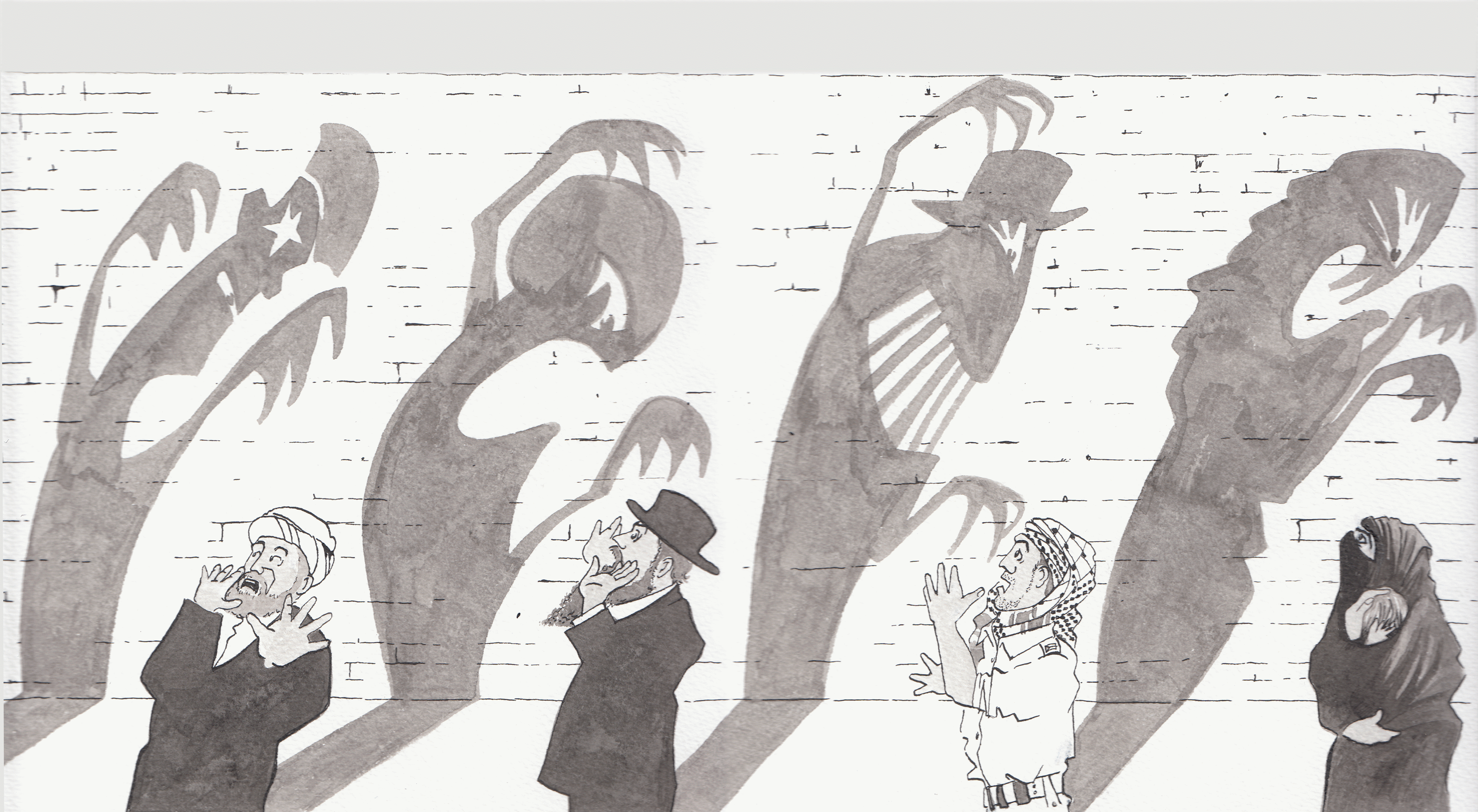
APAATW1: The Shadow of Terror

The Picture (click for full size):

Shadow of Terror

Image (c) Natalie Eldred and Sam Norton, 2013

The Thousand Words:
The roots of this image lie in the experience I had at the Sunday morning worship at Greenbelt in 2009 and in much that has been spoken about Israel at Greenbelt since then. It seemed to me that those in authority at Greenbelt were only focussing in upon one aspect of the tragic situation in the Middle East. That is, the viewpoint that was being put across was a binary one – Israel is an aggressive occupying state, whereas the Palestinian community is the martyred innocent. This seemed to me to be incredibly shallow, and it continued to vex me.

I wanted to explain how I saw the situation, and an image formed in my mind. Not being in any sense a capable artist, it remained there, unspoken for several years, until a chance conversation with my artist friend Natalie Eldred at the Dark Mountain Festival provoked the possibility that it might take shape, that there was a potential collaboration here. So, over the last few weeks, we have been chatting about this image, working out how to get what was in my head in some more communicable form – and now here it is (and I feel like a child who has woken up on Christmas morning).

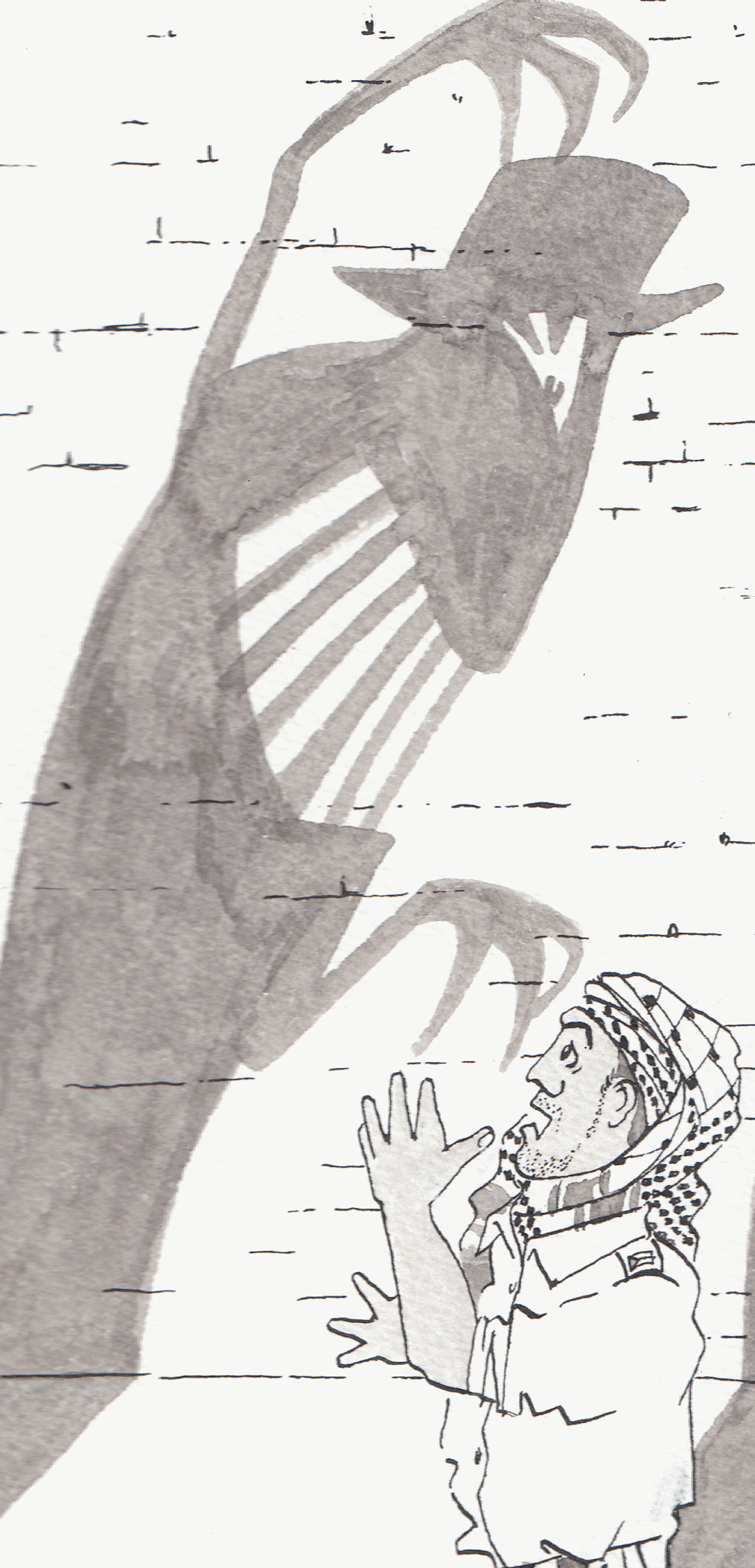
Simply put, there is a cascade of terror – a pecking order – whereby each state and actor is reacting in fear to something bigger than them, and through their reactions, they in turn cause those smaller than them to cower in fear. The idea that it made any sort of sense to separate out one of the actors in the complexity as especially worthy of blame seemed not just impractical but impious. There is a paradox here. At one and the same time I wish to affirm both an innocence in all the actors involved, and a comprehensively shared guilt. In other words, what I most want to do is remove the possibility of a scapegoat. All are implicated.

The sequence could be extended, especially the left. The first shadow is that cast by the United States. Uncle Sam could be shown reacting in horror to “the Islamic World”, then they in turn could be shown reacting in horror to “scientific modernity and the Enlightenment” – and that in turn could be shown reacting in horror to “untamed nature” (thinking of the Baconian programme to ‘rape’ the natural world and master it). An alternative would be to show the scientists reacting against the Inquisition, and then a papacy reacting against – what? Their own shadow?

The other side occasioned some thought and conversation. I originally wanted to have a homosexual man on the right hand side but we agreed that it would be visually easier to convey the same point by showing a woman. In any case, the point that I wanted to make was that there are minorities in the Middle East – women, gays, Christians – whose only safe haven in the area lies in Israel. I do not wish to say that Israel is an entirely virtuous place – it isn’t – but it does have some very important virtues, that are worth affirming, and the overall picture is much more complicated than the Greenbelt analysis seems to allow.

Put simply, the Greenbelt analysis only seems to show this:

greenbelt on israel

and I want to insist that we Christians must have a wider focus – a focus wide enough to include our own fears, and the shadows that they cause to fall.

~~

Natalie has described the process of working up the cartoon over on her blog. It has been a real education and privilege for me to see this happen, to see the artistic process up close, and a source of great joy to see one of the things that had seemed trapped inside my head come to life on the page. Humbling too, to see some awesome talent at work.

(Yes, I know this isn’t a thousand words. It’s a figure of speech…)