TBTM20100201


This is great: “There’s a big difference between the task of trying to sustain “civilisation” in its current form – supermarkets and all – which is what “sustainability” has largely come to mean, and the task of holding open a space for the things which make life worth living. I’d suggest that it’s this second task, in its many forms, which remains, after we’ve given up on false hopes. (Note that this doesn’t mean organising a campaign against supermarkets, which is the default mode of a lot of what’s called activism.)”
That resonated a very great deal with me!

This is why the church is irrelevant to our crisis

“In my experience, there are at least two things essential to any viable community that the vast majority of Americans find completely unacceptable. The first is an accepted principle of authority; the second is a definite boundary between members and nonmembers.”
John Michael Greer on great form.

This is something I’ve been thinking about a very great deal recently – and is likely to form a big part of my talk at the conference next month – and I see it as the legacy of cultural Protestantism, ie the emphasis upon private judgement. There are very great positive aspects to this – nobody should come between the believer and God – but there are also very great downsides. It underlies the ‘ten thousand things’ which is the modern Western church; it is the theology which undergirds world-raping consumerism; it is why the church can teach all it likes about how bad the world has become but will never be able to act as a coherent body and do something about it.

As JMG points out, nothing will change because people don’t want it to change. They don’t want it to change because that is how their value system has been structured – and that value system is one reproduced every week in our western church, reproduced, for example, whenever there are arguments about worship and people ‘getting something’ from it. It is why my teaching about Tesco has been the most controversial (and practically repudiated) thing I’ve ever said in church. It is part of what needs to die – what God will destroy – in order that our hearts of stone might be replaced by flesh.

I keep thinking of Moses in the desert. One aspect of the ten commandments isn’t their specific content, but simply the fact that a community accepted them as their boundary and identity. We have far more equivalents of the 10 commandments than we need – I even came up with my own one here – but what is missing is any sense that a community can be bound over by such a structure. Which is one reason why I’m thinking about getting the church to study the Rule of St Benedict for a while…

/rant

Bradwell (1): why there is a problem

One of the issues on Mersea at the moment is the proposed installation of a new nuclear reactor at Bradwell, just across the water from us. As you can imagine, this has raised a lot of strong emotions. What I want to do in a series of posts is explore some of the different aspects to this question before, eventually, coming off the fence on the issue myself. Part of the reason for writing is, of course, to work out exactly what I think.

So why is the government looking to build new nuclear power stations? Because it has belatedly realised that there is a looming energy crisis and, if it doesn’t build new power stations, a lot of people will be trying to function without electricity in the near future.

One of those nice colourful pictures that I like so much:

This shows the amount of nuclear generating capacity that is expected to go ‘off-line’ over the next decade or so. Simply to maintain a power supply equivalent to what we have today we need to find some 8GW of generation capacity. Of course, the ‘equivalent to what we have today’ understates the issue. I’ve talked about the gas situation here, but it is also worth mentioning that a number of coal-fired power stations are due to close by 2015 due to European legislation. Even if we ignore the problematic nature of depending on fossil fuels over the coming decades, we are facing a shortfall of generating capacity. Which is why the Government indicated in 2006 that they would look to build some new nuclear power stations, as part of the requirement to generate some 25GW of new capacity.

This is the first reason why the government is looking at expanding the number of nuclear power stations.

Where does our energy go?

Just doing a little research on how much energy the UK uses, and where it goes – with a view to wondering what we are going to be able to hang on to. This is where we get our energy from (here)

Units are Million tonnes of oil equivalent
Coal: 37.9
Oil: 74.4
Gas: 93
Nuc: 11.9
Hydro: 1.1
Imports: 0.9
Renewables: 5.3

Total: 224.4

On an individual basis this works out at 3,814kg per head (here)

The fossil fuel elements of that are going through the peaking process, so we can expect them first to become more expensive, then to become increasingly scarce (over what I would guesstimate as a twenty year period, see my post on UK gas supply here).

Balance of payments questions
It has to be said that the UK is not best placed to withstand a constrained energy context. We import most of what we use and we are running out of ways to pay for it. This graph is from this post:

End use:

source
This is where household fuel goes:

Some rapid tentative conclusions from the household level:

  • the most significant thing we can do to reduce our energy consumption and prepare for the shift is to insulate our homes;
  • normal electrical use (eg TV, internet, fridge) is small beer compared to the two heating functions;
  • therefore I’m still mildly optimistic that my geeky gadgets have a future, especially if the government succeeds in building new nuclear
  • this is also why combined heat and power is important

This is where the transport fuel goes (source):

Rapid tentative conclusions:

  • by far the greatest share goes to private transport;
  • there is massive wastage in private transport; therefore
  • there is a lot of room for comparatively painless squeezing (eg carsharing) as an initial reaction to stress;
  • in the longer run private transport (electrical?) is likely to be the preserve of the wealthy
  • I’m sure there will be a lot of efficiency gains in the wider transport sector but in part that will be through shifting to slower modes of transport (eg the canals)
  • we’re not going to be flying in green beans from Kenya anymore; though we may well still import chocolate
  • I think the truck sector will shrink the most
  • there will be much less road transport on the other side of the bump – this will be a very good thing

I don’t know much about the industrial use, so I’ll find out more about that.

Of course, all I’m doing here is thinking about an energy descent action plan. Which is what the Transition Town movement is for. Next step might be to find out more information about Mersea and how these broad patterns apply locally.

Copenhagen was (mostly) irrelevant

I know I said I wasn’t going to post anything further about AGW – and, really, this isn’t – at least not in the same way. For the purposes of this post I’m going to assume that the mainstream consensus (ie disregarding the extremist forecasts) is basically true, and, in particular, that the models have some connection to reality.

Click ‘full post’ for text.

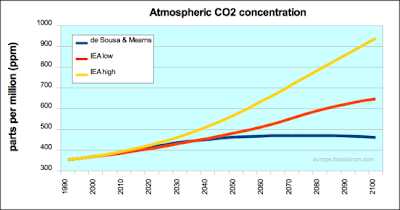
The first point is to do with the amount of fossil fuel resources available, and the way in which the IPCC overestimates how much there is. I’ve linked to these articles before, but as I suspect the links are often not followed I’m going to set out some of the key claims. (The graph above is taken from this post which is one of the key ones).

The point is a simple one: the IPCC, in their reference scenarios, use estimates of the availability of fossil fuel derived from the IEA which are seriously implausible. The most recent article spelling out why is here. I quote: “Our conclusion is that the assumptions of coal use that the IPCC recommended that climate researchers refer to in calculating their future horror scenarios are completely unrealistic. The question is why at all these gigantic volumes of carbon dioxide emission are to be found among the possible scenarios. The IPCC bears a great responsibility for the fact that thousands of climate researchers around the world have dedicated years of research to calculating temperature increases for scenarios that are completely unrealistic. The consequence is that very large research resources have been wasted to little benefit for us all.” Aleklett points out that the burning of even as much coal as there is is unlikely, due to the political context (Montana in the US) and the lack of local need (Siberia).

The second point is the one underlying the graph above: if human society continues to burn all the fossil fuels that are available, ie including Montana and Siberia, until they are economically exhausted (ie the net return on energy is close to 1:1) then carbon dioxide in the atmosphere will peak at around 480ppm in the second half of the twenty-first century. According to the MAGICC model used at the Oil Drum, this translates into around 1.7ºC above 1990 levels.

The third point that I would make is that ceteris paribus makes morons of us all. The human economic system is dynamic, and, especially in the more free-market oriented societies, there is room to respond to changed circumstances. What I take this to mean is that a) peak oil and associated limits will cause havoc to our economies well in advance of our accessing all the coal, b) the truth of the Limits to Growth perspective will by then be unavoidable for all except the most wilfully obtuse, c) we will as a human community either shift towards sustainable habits of life or we will slaughter ourselves fighting for what is left – in either case the coal will not be accessed.

Which makes me think that the rather extravagant boondoggle proposed in Copenhagen was somewhat besides the point. Moreover, I can’t help but feel that the doom and gloom being put about is counterproductive. It is as if the Victorian clerical cliche of ‘You’re going to burn in hell’ has been resurrected in a green dress; it turned people away then and it is turning people away now. The truth is that we are not in control of the system (any complex system) and we need to leave room for God to be God, and to avoid continuing the intellectual, scientistic and technocratic hubris that drove us into this mess in the first place.

What we need to do is to prepare for the great dislocation. Over the next ten to fifteen years we are going to be jettisoned from the sinking luxury liner and we need to get ready for a much simpler existence in the lifeboat. We need to ask ourselves what is worth saving from our present cornucopia, and work to save what we can. Doing that properly requires rather more prayer and listening to God than is presently in display. I am more and more persuaded that it also requires the adoption of a Ninevite attitude if the lifeboats in their turn are not to sink.

I’ll write something more about the nature of these choices in due course.
On deciding about socio-political engagement

Paul asked a challenging and intriguing question in this comment thread, which I felt deserved a longer response: How do I, as a priest, assess whether and how far to engage politically, including socio-politically?

I have two principal concerns. First, before I was nobbled by God, I was set upon a political career, and the good Lord made it quite clear to me that this was not the path I was called to follow. My path is in the church, and so any time I start to feel an inclination towards active political engagement lots of bright red alarms start flashing and bells start ringing. Second, the Tesco experience, ie when I spoke out against the setting up of a new Tesco Express on Mersea. I still boycott the store, as part of a personal and essentially private witness, but taken as a whole the experience was (and is) dispiriting. It felt like throwing pebbles at a bulldozer, where the bulldozer wasn’t just the Tesco machine, it was the way in which the community tacitly supported the process, not caring (or not caring to know) why it was wrong. Lots of people who I respect simply thought that I was barking mad to be objecting to it (many even proudly declared their shareholdings in Tesco). It has made me more wary of speaking out; not to the extent of not being prepared to do so again, primarily in realising that I have a limited amount of “outspokenness capital” to use, and it would do no good whatsoever to expend it all tilting at windmills.

These two together became sharp for me when considering the question of Transition Towns. I was involved in the setting up of Transition Island Mersea but took a conscious decision to step back from a direct involvement in running things when it seemed that there were plenty of people able and willing to take things forward. The principal fruit achieved so far was the setting up of the Food, Drink and Leisure festival, which showcased local products. I also believe that the local council has started to take things on board. However, it also seems clear that a great deal is still possible, and the issues are very salient on Mersea because we are so close to Bradwell power station, which is on the list for siting a new nuclear power station. I keep mulling over whether to write some articles about the overall energy situation and possibly, eg, argue for some form of local CHP in the town.

A further factor is the way my thinking has been sharpening up about what exactly the Christian community is called to do in our present context. To that end, it might help to explain, or recap, the context for my recent chewing over of material related to global warming, but which is really rooted in two earlier posts: on being Christian not green and Why bother saving the planet? I feel that the current state of the science with respect to global warming functions as a Rorschach test – people will see in the plethora of data support for conclusions that they already hold. I think that what has happened in me over the last eighteen months or so is a gradual disengagement from some nominally ‘green’ positions in pursuit of a more substantial Christian perspective. In other words, I’ve just been digging deeper to try and get at the roots of the present crisis – with the hopeful consequence of knowing the way forward that much more clearly. I think the time for prevention has passed us by, but there are still many things we can do to ease the pain of the long descent. That way forward still has a great deal in common with the green perspective, but they are not the same.

My thinking at the moment is that the Christian church needs to be strengthened in its understanding of discipleship; to understand that being a Christian is a doing not just a saying; and that this is what the priest/pastor/teacher is called to do. I am not at all arguing that there should be no Christians in political careers – I believe the opposite rather strongly – it is more that the shape of the priestly vocation (perhaps: MY priestly vocation) is becoming clearer to me. I am not called to be engaged in the political sphere in any active sense (though I suspect I probably am supposed to be engaged in a ‘shouting from the sidelines’ sense, what Justin calls the watchman role). I think that the most important thing that a priest can do at this time is enable and strengthen the Body of Christ for their work and engagement in the community. That means right worship, right teaching, right fellowship and everything else involved in calling Christians to a serious commitment to their faith and the cost of discipleship. In my case I think it means teaching about the ecological context in which we find ourselves, and what it means for our lives as Christians. I have an obligation to ‘pattern my life and that of my household’ according to what I believe to be right, but I am coming to the conclusion that a further, active political engagement is not right for me. I could be wrong. I shall continue to chew it over.

Wendell Berry on Copenhagen

Here’s another one:
“Abstraction is the enemy wherever it is found. The abstractions of sustainability can ruin the world just as surely as the abstractions of industrial economics. Local life may be as much endangered by those who would ‘save the planet’ as by those who would ‘conquer the world’. for ‘saving the planet’ calls for abstract purposes and central powers that cannot know – and thus will destroy – the integrity of local nature and local community.”
(Both recent quotes taken from his collection of essays ‘Sex, Economy, Freedom and Community’. Highly recommended.)

Christianity connives directly in the murder of creation…

“Despite its protests to the contrary, modern Christianity has become willy-nilly the religion of the state and the economic status quo. Because it has been so exclusively dedicated to incanting anemic souls into Heaven, it has been made the tool of much earthly villainy. It has, for the most part, stood silently by while a predatory economy has ravaged the world, destroyed its natural beauty and health, divided and plundered its human communities and households. It has flown the flag and chanted the slogans of empire. It has assumed with the economists that ‘economic forces’ automatically work for good and has assumed with the industrialists and militarists that technology determines history. It has assumed with almost everybody that ‘progress’ is good, that it is good to be modern and up with the times. It has admired Caesar and comforted him in his depredations and defaults. But in its de facto alliance with Caesar, Christianity connives directly in the murder of creation. For in these days, Caesar is no longer a mere destroyer of armies, cities and nations. He is a contradicter of the fundamental miracle of life. A part of the normal practice of his power is his willingness to destroy the world. He prays, he says, and churches everywhere compliantly pray with him. But he is praying to a God whose works he is prepared at any moment to destroy. What could be more wicked than that, or more mad?”
(Wendell Berry)