About Elizaphanian

Rector of West Mersea

Science and green strategy

One of the more useful soundbites about our financial predicament is ‘you can’t get out of a debt problem by increasing the amount of your debt’. As with any useful maxim, there are times when it might be wrong – I think there are occasions when it might make sense to increase debt in order to solve problems, eg as part of a general restructuring – but as a rule of thumb, it seems pretty good to me.

I want to argue that there is a similar maxim that applies to our present ecological predicament, one that is thrown up by our crashing in to the Limits to Growth. The maxim is this ‘you can’t get out of an idolisation of science problem by making more appeals to science’. I write about what the ‘idolisation of science problem’ is in my book, but put succinctly, I see the root problem in our culture as a blindness towards questions of value and a consequent neglect of the development of wisdom. That is, I see our culture as institutionally apathistic, and I see the principal presenting symptom of that lack of wisdom being the excess valuation given to whatever ‘science’ might say.

For those who understand the nature of the Limits to Growth – call them the ‘greens’ for now – there is an irreducible element of scientific understanding inherent in the perspective. Information about pollution and resource limits is largely a matter of science. What we are to do in the light of that information, however, is not. It is a matter of human discernment, for which science is trivially irrelevant. Worse than that, the subordination of wider human understandings to the narrow scientism that dominates our culture is itself one of the principal obstacles that need to be overcome

I have written before about the ‘climate screech’ which I see as one of the problems of contemporary green advocacy. The predicament that we are in, which the greens understand, is so much wider and deeper than the question of global warming, on which I continue to become increasingly sceptical. If we are to enable people to shift their understandings, their patterns of life, away from our present unwise paths, we will not be able to do so by continuing, to all intents and purposes, to insist in our advocacy on the primacy of “science”. Science says X, therefore we must do Y. This is a path that is doomed to failure, not least because science changes its mind on a regular basis, and greens who married the scientific consensus of the late 1980s are now finding themselves widows – and the necessary political arguments have been lost.

I believe that those who advocate green courses of action – a wiser and more responsible stewardship of this planet – need to do a great deal of soul-searching to understand why it is that the emphasis upon global warming has been such a political failure, and why the continued screeching is having such a counter-productive impact upon the wider green movement. To my mind it seems clear that we cannot get out of a crisis caused by too much science by simply increasing the amount of science on which we rely.

In the meantime I am looking forward to taking part in the Dark Mountain festival next month. This is a group that really ‘gets it’.

TBLA (extra): Why I am not a feminist

I want to try and describe one of my fundamental convictions – one that is both spiritual and political. This is a bit of a rant…

I believe that all human beings are the expression of divine creativity. That is what I understand being made in the image of God to mean. We are each words of God – different words – called to express a particular incarnation of the divine Word. We are each unique, irreplaceable, miraculous.

It is due to the inheritance of Sin that we are prevented from expressing the particular image of God that we were created to be. We each have a calling, a vocation, to express a particular facet of God (think of diamonds with infinite facets). It is the task of the human community to progressively remove all the barriers to the expression of individual creativity, that is what Christians call ‘the Kingdom of God’. We are often neck deep in crap in this our present world, but, in that case, pace Oscar Wilde, sometimes the most important thing is to testify to the existence of the stars even whilst trapped in the gutter.

In other words, for me, the principal value and orienting affirmation is about what it means to be human (hence the title of the book which I have written). We are first of all human beings, only secondarily are we male or female, gay or straight or trans, black or white or yellow, rich or poor or bourgeois. In so far as it lies within me, this is what I wish to teach and to live out in all the decisions of my life.

I would want to draw a distinction between egalitarian feminism and gender feminism, and draw the distinction in this way: egalitarian feminism is the fruit of the political enlightenment, which is all about the fundamental political equality and worth of all human beings, no matter what their background or station. It is because I accept this that I accept, inter alia, the wrongness of both abortion and capital punishment. This has its origin in the 18th century – there or thereabouts. In contrast to this, I see ‘gender feminism’. This I see as the product of particular post-war circumstances, an excess of affluence combined with a failure of nerve. Rather than seeing men and women as primarily human beings, and only secondarily male or female, gender feminism, in my view, a) sees the gender orientation as primary, and b) (crucially) sees a higher value deservedly bestowed upon the female rather than the male. In other words, the male is by definition the oppressor, and the woman is by definition the victim – even though the woman is the only oppressed class in history to have a longer life expectancy than the oppressor.

The reason why I do not wish to class myself as a feminist is because of this latter development. I do not accept that men are inherently oppressive. I do not accept that boys are incipient rapists. I do not accept that being a man means that you have to accept a place as a second class citizen, responsible for all the bad things of history and none of the good.

More crucially, I reject the anthropology of ‘gender feminism’. Most of it seems to me to be (to speak in Marxist terms temporarily) an expression of ‘false consciousness’. It is an ideology born from economic imperatives, a way of ensuring that the Leviathan can have the cheapest pool of labour available to it, irrespective of human cost. In other words, if a particular individual woman believes that the expression of her individual vocation means that she is a ‘stay at home mum’ then all the ideology that declares she is ‘letting down the sisterhood’ and ‘being dependent on the patriarchy’ and all the other self-righteous nonsense can get stuffed. Who is this person as a human being? Not as a woman, or as an economic unit, but who is this particular person called to be in her own idiosyncratic specificity? DO NOT PUT HER IN A BOX!

I do see contemporary gender feminism as mostly evil. I have a profound commitment to and belief in the individual, in what might enable them to flourish as a specific and particular human being, not simply as a member of a type or expression of a class. What I hate, absolutely detest about much modern feminism is that it seems to have abandoned the root principles from which modern feminism sprang (ie the political enlightenment) and has instead become captured by the secular powers, and been put to use as a ‘useful idiot’, the practical implications of its teaching simply being that vast multinationals can make an extra percentage point on their profit figures.

The principal value that I am committed to is what will most enable someone to become the sort of person that God has called them to be. There is no ideology that can tell me the answer to that – the only answer will come from a slow and patient attention to the sort of human being that they are, and loving them no matter what.

Everyone deserves the same. EVERYONE. I want each individual person to be themselves, and not try to distort themselves to fit into anybody else’s box. Where they fit on the different spectra of male/female, intelligent/simple, black/white, gay/straight, all the rest of it – all of this is SECONDARY.

I believe in human beings. I don’t want to put anyone into a box, and I don’t want to be put into a box for myself. I think that each of us has a path, and it is the sacred duty of all of the rest of us to do what we can to ensure that every single last one of us is enabled to be all that he or she can be. We won’t always succeed, but it is in the effort that we find our own transcendence.

Three steps to change the culture of the Church of England

This is by way of a short summary of things that I’ve written about before; I wanted a single post to point people to.

Were I to be given dictatorial powers over the Church of England I would do three things:
1. abolish the parish share system and require parishes to do two things instead, a) tithe their income to the Diocese and b) pay for their own ministers (singly or shared across congregations);
2. install all ordinands approved for training into seven year training posts, housed and salaried, split 50:50 between academic training and incumbency mentoring. Ordinations would happen in years 3 and 5;
3. re-establish the position of ‘lay incumbent’ who takes on all the duties and responsibilities to do with church fabric and site management, letting priests just be priests.

I believe that these measures – which could be implemented fairly swiftly and straightforwardly – would release a great spiritual energy. All we need is faith and nerve on the part of the powers that be…

The Church of England and the Bakken Shale

The Church of England and the Bakken Shale

People might have noticed some of the claims being made by politicians across the pond about how the US might soon be ‘energy independent’, that new discoveries of oil might lead the US to be called ‘Saudi America’ (eg here)

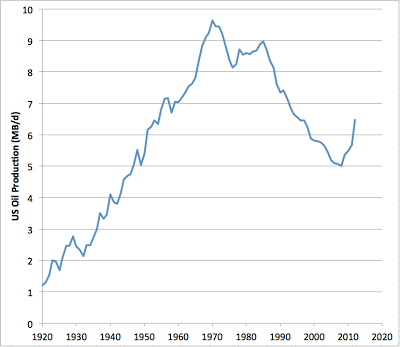
The particular trigger for this language is something called the ‘Bakken Shale’ in North Dakota, which has been developed heavily over the last few years (since the explosion in the oil price in 2008 basically). This oil resource has indeed made a difference to the oil produciton of the United States:

us oil 2012 staniford

The ‘puffers’ appear to believe that this increase in US production is a) going to be sustained over time, and b) will make a significant difference to the US economy. I believe that such a view is… misguided. This is the forecast:

us oil 2012 eia

In other words, the Bakken Shale represents a great short-term boost to a situation, but not a long term answer.

As I ponder this, I can’t help but be struck by the parallels with the Church of England. Membership of the church has been declining for a very long time, a trend partly disguised by the rise in population in England through the twentieth century. Measured as a proportion of the population, the number of CofE Easter communicants has declined steadily from 8.8% of adults in 1922 down to 2.3% of adults in 2010. (source)

Now, in the context of such a significant and long-standing decline, it is understandable that people seize upon the equivalents of ‘Bakken Shales’ – anything which offers the prospect of changing the pattern. The latest wheeze is ‘Fresh Expressions’. Yet the real solution to the oil crisis is not a more and more diligent search for new oil-fields; rather, it is to change our patterns of life in such a way that the demand for oil declines faster than the supply.

What is the equivalent for the church? Well, I’m not completely sure of the answer to that, but I’m pretty sure that it won’t involve holding on to the ‘sunk costs’ of the existing ‘drilling equipment’ and ‘oil-based infrastructure’. Our inherited architecture and establishment patterns of ministry may have served us well in a time of abundance; now they are simply costs that will sink us. We don’t need to keep the oil supply flowing; we don’t need to keep our extremely impressive ecclesiastical SUVs; rather, we need to learn to enjoy the riding of bicycles….

TBLA: Covenants and Parenting Bonds

I believe that there are two forms of relationship (not mutually exclusive) that can each be vehicles for the holy, and worthy of being blessed by the church.

The first is a Covenant, entered into for the mutual affection, aid and support of the parties concerned. This can be male and female, gay and straight, short and tall, of all different sorts. The important point is the nature of the relationship to be affirmed, which is for the relevant parties to decide, and that they wish the relationship to be affirmed and given support and substance by God.

The second is a Parenting Bond – that is, when two people come together and wish to form a family. This is (in origin) something which is only available to a male/female couple even where, for all sorts of other reasons, there are now other forms of parenting. I believe that the wider society has a strong and legitimate claim to be involved in this form of relationship, given the consequences of poor parenting upon that wider society, and that this form of relationship is therefore distinctly different to the first.

I believe that the wider conversations on this topic are bedevilled by a failure to distinguish between these two forms of relationship. It doesn’t matter to me which one gets called by the ‘m’ word, although I suspect a lot of hassle could be saved by keeping it for the second. That’s not a theological point though.

TBLA(9): the idolatry of romantic love (i)

This is slightly out of my intended sequence, but it is prompted by something I found here which I think is extremely well-expressed: “What nearly all modern Christians have done is place romantic love above marriage. Instead of seeing marriage as the moral context to pursue romantic love and sex, romantic love is now seen as the moral place to experience sex and marriage. This inversion is subtle enough that no one seems to have noticed, but if you look for it you will see it everywhere. Lifetime marriage, with separate defined roles for husband and wife and true commitment is what makes sex and romantic love moral in the biblical view. In our new view, romantic love makes sex moral, and the purpose of marriage is to publicly declare that you are experiencing the highest form of romantic love.”

This is why we have become so snagged on the arguments around gay marriage. If we take it that pair-bonding romantically is the esse of a marriage, then there is no substantial reason to deny marriage to gay couples. It is simply a matter for individual choice. If, in contrast, marriage in its esse involves the raising of children, then the structuring of the marriage bond has to reflect that. That is the traditional Christian and biblical view (of which Dalrock is an exponent).

What the idolatry of romantic love has done is to distort all our values on this subject. Romantic infatuation is well known to be fleeting, and the neuroscience involved is becoming increasingly well understood. The effects of this value shift – structuring our understandings of marriage around romance – are all around us, in the form of divorce and shattered families and all the havoc that has followed.

This is not to say that romance doesn’t have its place, it is to say that we cannot structure a society on the basis of something so shallow. Life, and most especially the raising and forming of new life, is too important to be left to that.

The joy of good, live theatre

Courier article
Well, after an enjoyable cameo role in the panto I’ve managed to get myself a substantial part in the next Mersea Island Players production at the MICA. I’m acting as the director of a small amateur dramatic society, who at one point is rehearsing a part acting as a vicar, so I’m definitely cast against type.

In amidst all the enjoyable strains of learning lines and rehearsing I’ve been thinking about the nature of the theatre, and why ‘good, live theatre’ is an irreplaceable experience. I say that despite being something of a movie addict myself, who hardly ever goes to watch live performances any more. So why do I think theatre is irreplaceable? Well, it’s similar to the difference between work which is done by craft and that which is manufactured.

With live theatre, the emphasis is upon the particular moment. There is something happening in this place and at this time – there are real human beings watching and being watched – and, of course, there is the ever-present risk of something going wrong, whether that be forgetting lines or having an accident or lighting failure and so on. In other words, there is something unique about live theatre as an event. Contrast this with a movie, especially a modern blockbuster. The very essence of what is happening is that it is both manufactured and repeatable. Rather than a direct human interaction between performer and audience, the actors are often recorded in front of a ‘green screen’ on which all the special effects will later be portrayed. This is a fascinating process, and the results range from the awful (Star Wars prequels) to the groundbreaking (the Matrix) yet even when the results are good, it is a very different experience to watch a movie rather than a play.

There is something undeniably primitive about watching another human being act out a story. Small children know and enjoy this intuitively, and will happily play dress-up and act out stories for hours on end. Adults often have that sense of excited wonder drained out of them by all the vicissitudes of life – and the wonderful thing about ‘good, live theatre’ is that is provides a context in which that sense of wonder and engagement can be resurrected. It’s not an accident that I’m using religious language there, for there is an ancient link between theatre and religious ritual – indeed, there is an ongoing academic debate about which emerged from the other. Was it that religious ritual was a particular form of theatre, or that theatre was a particular form of ritual? Whichever is the case, the nature of being able to share in a common experience, journeying through a common story and being changed by that process – this is right at the heart of what makes theatre so special.

This was well known to the ancient Greeks, from whom much of our understanding of theatre descends. They talked about something called ‘theōria’ – a word that has come down to us as ‘theory’ but, as is so often the case, that ‘coming down to us’ is a descent in more ways than one. For the Greeks, theōria was something immensely practical. Aristotle argued that theōria, the philosophical consideration of the nature of things, is the highest and most enjoyable activity there can be, it is the central purpose of the best possible human life. To our ears, this sounds like something very abstract and almost passive. In translations of Aristotle, theōria is normally rendered as ‘contemplation’ which suggests a single, steady gaze held on a single impressive object, like a telescope focused on the peak of a high mountain. This is very much not what Aristotle had in mind. On the contrary, what Aristotle had in mind was something called “sacralized spectating” – the sort of very vigorous and engaged communal experience that comes from a community watching something like the Olympic Games together (either then or now) – or, of course, watching a tragedy in the theatre at Athens. In other words, to participate by watching is at the heart of what the greatest thinkers in antiquity felt was the best sort of life. Our modern media gives us many ways in which to do this – and a dark movie theatre is a very good way in which to do this – yet there is something irreplaceable about ‘good, live theatre’. It is unique, it is profoundly engaging, and it is chthonically human.

Which is why we on Mersea are so extremely fortunate to have the MICA centre available for such productions, and if my view of how the coming years are likely to unfold has any merit, I believe that we will be making much more use of such community resources in the future. To have a neutral community space that can be adapted for such a purpose is a great blessing – long may it last. So please do come along! There are two one-act plays being performed each night on Friday 3rd and Saturday 4th May at 7.30pm. They contain adult content (theme and language) and even though I’m partisan, I do think that the scripts are hilarious – the plays have been performed to great acclaim at the Edinburgh festival for example. I just hope that we actors can do justice to the lines…