

Category Archives: Uncategorized
About Galileo
This is a partial response to Davidov’s recent comment, relating to the question of Galileo (for a relevant post about miracles go here). Galileo is often brought out as an example of the wickedness of church institutions, and certainly, to execute someone for their beliefs is an abominable act. However, the wickedness of that act – and the use of this example in the various debates between ‘science and religion’ (in truth, internal arguments within the Modernist mindset) has distorted one particular truth – that the debate was not the church suppressing ‘truth’, but the church suppressing an arrogant scientist who was claiming more than he could prove at the time. Thing is, a proper discussion requires us to be in full possession of the facts. Not least because the increasing salience of religious questions in our world in the coming years will force us to examine our deepest assumptions, both religious, atheist, agnostic and absconding – all of us.
I would want to point out two things.
1. Although Galileo’s perspective was correct (ie the earth does travel round the sun) it could not be shown to be correct at the time of the debate, principally because Galileo was assuming perfectly circular orbits, rather than elliptical orbits. The Ptolemaic model was a more accurate model for predicting the movements of the heavenly bodies. Galileo’s perspective had greater beauty, and promised great things, but it could not be shown to be correct at the time of his trial. (See Kuhn on this, amongst others).
2. The church authorities did not rule out the possibility of change. I quote from Cardinal Bellarmino (Galileo’s antagonist): “If there were any real proof that the Sun is in the centre of the universe and that the earth is in the third heaven, and that the Sun does not go round the Earth but the Earth around the Sun, then we would have to proceed with great circumspection in explaining passages of Scripture which appear to teach the contrary, and rather admit that we did not understand them than declare an opinion to be false which is proved to be true”.
In other words, if Galileo could have proved his point, then the Church would have backed down. I think this is very important to bear in mind. It doesn’t exonerate the church for what they did, but it does clarify what it was they were objecting to. And that makes all the difference.
(Source: Feyerabend)
The Oil Drum on "Peak Oil Myth" (CERA report)
If you’re interested, go read for a) a great overview of what Peak Oil claims, and b) a thorough deconstruction of the CERA report currently doing the rounds in the business media.
Non-violence from a different angle
In a comment, the question was asked why violence was always sinful. Pondering that further leads to questions of coercion, of violating I-Thou in favour of I-It relations, of defacing the image of God. And so on. (I do wonder whether violence – as in physical aggression – has not become totalised/idolised as a radical evil. Words can do much greater violence to a soul. In many ways, an act of righteous anger – the No! of Camus’ rebel – this seems less immoral than the slow poisoning of human relationships that never leads to direct violence. Jesus, after all, says rather more about language in human relationships than he does about violence.)
A while back, I wrote about capitalism, particularly with respect to Hernando de Soto’s work (see here). One of the key insights of de Soto’s research is the huge obstacles placed in the way of entrepreneurial activity in poor countries; hundreds of forms to be filled in; ages of time before work was rendered legal and visible to the authorities.
It is not an exaggeration to say that the existence of this type of bad-governance is directly responsible for the impoverishment of millions around the world, and that it is also therefore directly responsible for the deaths of millions around the world.
Let us imagine a) that a democratic system achieves a change of government which works to change these things (and therefore save people’s lives), but that b) those with a vested interest in the status quo ante (and there are always such people) resist the new government, not violently, but politically. Their property might be taken away; or, more likely, their economic opportunities and relative economic strengths are diminished. Hence they oppose, they struggle against this new dispensation.
In what way does the treatment of those opposed to this benign economic reform NOT qualify as ‘violent’ – in the deeper sense of coercion, I-Thou to I-It relationships, as opposed to a simple ‘well we haven’t beaten them up, have we?’ These individuals are not being treated as ends in themselves. Their interests and desires are placed in a minor relationship to the interests of the community as a whole.
Imagine that in the interests of non-violent interactions, these people were allowed to keep their perks and privileges – and therefore millions elsewhere remain mired in poverty. This respects the humanity of some, to the exclusion of others.
I think there is something here about masculinity. That the male capacity for making extreme choices – what is consistently explored to great effect in 24 for example – this has been culturally repudiated.
Thing is, Jesus makes extreme choices. You might say: Jesus ain’t no cissy.
I’m trying to put my finger on something darkly and deeply rooted here – a violent passion for life is the best way I can describe it.
That not only is a penis a gift from God, but the phallus too.
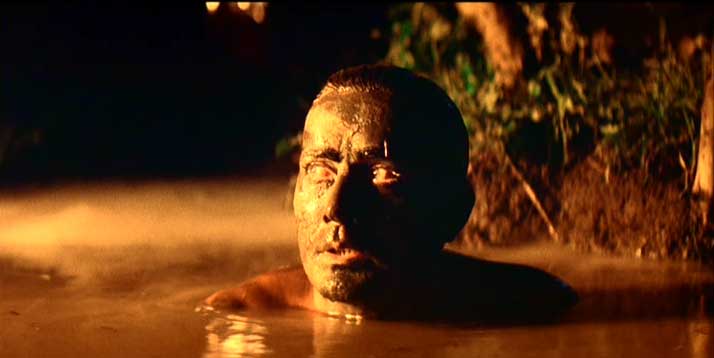
This haunting passage from Apocalypse Now:
I’ve seen horrors… horrors that you’ve seen. But you have no right to call me a murderer. You have a right to kill me. You have a right to do that… but you have no right to judge me. It is impossible for words to describe what is necessary to those who do not know what horror means. Horror. Horror has a face… and you must make a friend of horror. Horror and moral terror are your friends. If they are not then they are enemies to be feared. They are truly enemies. I remember when I was with Special Forces. Seems a thousand centuries ago. We went into a camp to inoculate the children. We left the camp after we had inoculated the children for Polio, and this old man came running after us and he was crying. He couldn’t see. We went back there and they had come and… hacked off every inoculated arm. There they were in a pile. A pile of little arms. And I remember… I… I… I cried. I wept like some grandmother. I wanted to tear my teeth out. I didn’t know what I wanted to do. And I want to remember it. I never want to forget it. I never want to forget.
And then I realized… like I was shot… like I was shot with a diamond… a diamond bullet right through my forehead. And I thought: My God… the genius of that. The genius. The will to do that. Perfect, genuine, complete, crystalline, pure. And then I realized they were stronger than we. Because they could stand that… these were not monsters. These were men… trained cadres. These men who fought with their hearts, who had families, who had children, who were filled with love… but they had the strength… the strength… to do that. If I had ten divisions of those men our troubles here would be over very quickly. You have to have men who are moral… and at the same time who are able to utilize their primordial instincts to kill without feeling… without passion… without judgment… without judgment. Because it is judgment that defeats us.
There is something truly frightening about the tragic vision – about the capacity to choose sin boldly (as described in my Iraq post here).
Whilst I feel viscerally the appeal of non-violence, whilst there is still no question in my mind that the way of peace is the way that we are called to live together, I still can’t bring myself to let go of something here. That there is something in the tragic vision, the embrace of the painful choice, which is profoundly life-affirming and of God. There can be no generation without the blood shed from the hymen being broken.
The question of imagination is closely tied in with this – if we imagine only good things, will the bad things go away? I don’t know.
I’m still inching forward through the murk.
Fulminations
Fulminata posted a review of the Robinson critique of Dawkins in the comments. I thought it would be worth pulling out parts of, because it is such an egregious example of the sort of thing which Robinson critiques in her article (too subtly for the reviewer, Lawrence Crowell, unfortunately).
Actually this review is not that great. She uses that old canard that Hitler used science for his race genocide and so forth, which is pure nonsense. Of course Hitler’s ideas had as much to do with biological evolution as perpetual motion designs have to do with physics.
Which merely demonstrates that the reviewer hasn’t bothered to read the article with even a modest amount of attention. Robinson writes: “Dawkins deals with all this in one sentence. Hitler did his evil “in the name of. . . an insane and unscientific eugenics theory.” But eugenics is science as surely as totemism is religion. That either is in error is beside the point. Science quite appropriately acknowledges that error should be assumed, and at best it proceeds by a continuous process of criticism meant to isolate and identify error. So bad science is still science in more or less the same sense that bad religion is still religion…To Dawkins’s objection that Nazi science was not authentic science I would reply, first, that neither Nazis nor Germans had any monopoly on these theories, which were influential throughout the Western world, and second, that the research on human subjects carried out by those holding such assumptions was good enough science to appear in medical texts for fully half a century. This is not to single out science as exceptionally inclined to do harm, though its capacity for doing harm is by now unequaled. It is only to note that science, too, is implicated in this bleak human proclivity, and is one major instrument of it.” (For more on the widespread uptake of eugenics, especially in the US, go here.)
One of the most important points that Robinson makes is this one: “To set the declared hopes of one against the real-world record of the other is clearly not useful, no matter which of them is flattered by the comparison. What is religion? It is described by Dawkins as a virtually universal feature of human culture. But there is, commingled with it, indisputably and perhaps universally, doubt, hypocrisy, and charlatanism. Dawkins, for his part, considers religion wholly delusional, and he condemns the best of it for enabling all the worst of it. Yet if religion is to be blamed for the fraud done in its name, then what of science? Is it to be blamed for the Piltdown hoax, for the long-credited deceptions having to do with cloning in South Korea? If by “science” is meant authentic science, then “religion” must mean authentic religion, granting the difficulties in arriving at these definitions.”
In other words, a level playing field.
One of the goals of science is to reduce some set of complex processes or systems into some small set of rules. It is a bit like a data compression algorithm we use — it can compress large amounts of data into a few postulates. Whether one likes it or not Dawkin’s theory of the selfish gene largely does this. It might sound cold that all of life can be reduced to a set of self-replicating molecules which obey subMarkovian information principles — but this is about what biology is. Some people a couple of centuries ago did not like that Newton found the laws of motion reduced to a few principles, but that’s tough. Such people don’t like these things because it removes magic from the world.
What is often unacknowledged in an argument like this is that – probably due to either philosophical or historical ignorance – the governing metaphor or paradigm is a historically conditioned one. In other words, the mechanical model being assumed is one derived from Newton (derived in turn from some very bad theology), whereby a mechanical explanation is sufficient for the phenomena under consideration. Popular understandings of genetics seems now to be the only place where such a crude understanding is still embraced, as it has been rejected everywhere else.
And the point about magic is asinine; assertion masquerading as argument. Girard’s insight is truer: “The invention of science is not the reason that there are no longer witch-hunts, but the fact that there are no longer witch-hunts is the reason that science has been invented. The scientific spirit…is a by-product of the profound action of the Gospel text.”
Dawkin’s stance on religion is that it seeks to displace scientific principles, where in some cases they are well understood, with supernaturalistic stories. In other words such people would prefer that Noah’s flood be real, where by some magic 20 times the amount of water than what exists came and left the Earth in a great flood, than to have to grapple with the idea we Humans are just a tiny branch in the tree of life. Dawkins objects to the forcefulness with which such people want mythic stories of angels, demons, second comings, universal floods, along with all their magic which counters what is known or knowable by reasoned principles. As he sees it this amounts to the removal of realistic understandings and their supporting facts with fantasies and delusions supported purely by faith concerning their divine truth. Faith is the substance of things hoped for, the evidence of things not seen. Hebrews 11:1
Aaagh. Straw men again. This just assumes that ‘religion’ = late Modern Protestantism. It begs the question about what is being “displaced” and about what the “supernatural” is.
I am not so sure about his “war” against religion, when I think there are better ways to go about this. Yet I can understand the sentiment. Here my nation has a President who has set up a defacto Department of Faith (Faith based initiative) and other programs to extend the social power of churches in the nation. I do think it is time to push back against this rot, for if we don’t we will have a theocracy here. Supporters of religion and faith should not be so cowed by Dawkin’s charge, for they have their ducks lined up in the WhiteHouse and Congress — that is unless they really are terrified by the prospect that what they believe is a load of crap.
So tell me, in what way is this not the equivalent of the ‘Hitler was a scientist’ argument? Bush is a Christian, therefore all religion is awful.
Puhlease.
The real issue is that Dawkins and his ilk realise that they have lost the argument. They have quite clearly lost it politically (any analysis of the modern world that doesn’t take religion seriously is manifestly doomed to irrelevancy) but they have also lost the philosophical argument. Like all scientific revolutions, it will take time for this one to complete – but as the blowhards die off those coming to the field with fresh eyes will take up the better explanations. Atheism has had its day, and Dawkins – as Denys Turner so wonderfully puts it – is simply not up to scratch as a thinker in this sphere:
“…since today my purpose is to encourage the atheists to engage in some more cogent and comprehensive levels of denying, I shall limit my comment to saying that thus far they lag well behind even the theologically necessary levels of negation , which is why their atheisms are generally lacking in theological interest. So, I repeat: such atheists are, as it were, but theologians in an arrested condition of denial: in the sense in which atheists of this sort say God ‘does not exist’, the atheist has merely arrived at the theological starting point. Theologians of the classical traditions, an Augustine, a Thomas Aquinas or a Meister Eckhart, simply agree about the disposing of idolatries, and then proceed with the proper business of doing theology.”
(Denys Turner, ‘How to be an atheist’)
More on climate change scepticism
Curiouser and curiouser.
Monckton, whose original article sparked these musings, responds to Monbiot’s rebuttal here.
Real Climate gets down to the nitty gritty here.
I still think that Fred Pearce has the best discussion of it.
“What makes a subject hard to understand – if it’s something significant and important – is not that before you can understand it you need to be specially trained in abstruse matters, but the contrast between understanding the subject and what most people want to see. Because of this the very things which are most obvious may become the hardest of all to understand. What has to be overcome is a difficulty having to do with the will, rather than with the intellect.” (Wittgenstein, 1931)
Oh this is so good
Go on. Just read it. It’s a bit more disembowelling of Richard Dawkins, a man who has, perhaps, now crossed over beyond parody. All he needs now is a cackle and the effect will be complete.
(HT Bryan Appleyard)
Pledges
Stimulated by some recent books – and, of course, by my Learning Church programme – I’m pondering the question of pledges. As in – what can we commit ourselves to, what can we bind ourselves into, what disciplines can we employ to structure our lives around – in such a way that leads to life for all? I want to end up with ten or a dozen that I can use at the end of the Learning Church sequence, by which time I hope I will have made the case that signing up to these pledges is a) the Will of God, and that b) if you knowingly turn your back on them, you are walking into the darkness. (This is the ‘path for the faithful’ bit of ‘Let us Be Human’).
So this is a first draft, not in any order other than what I think of first.
1. Repudiate the aeroplane.
This means not simply not using the aeroplane directly, for foreign holidays etc, but not using the products of aeroplane transport, principally fruit and veg that is flown into our supermarkets. It’s remarkable just how damaging the aeroplane is.
2. Never step foot inside a (major?) supermarket.
I was very struck by the point made by Monbiot in ‘Heat’ that, in carbon terms, one of the worst things about supermarkets is the stores themselves, which are terribly profligate sinks of energy. If we switch to home deliveries, most of this is overcome. There are still lots of problems with supermarkets (see, eg, pledge 1) but turning the superstores into warehouses would, in Monbiot’s view, almost on its own contribute to the 90% reduction in carbon needed in this sector.
3. Learn to grow your own vegetables.
Not just to get zero-carbon vegetables but to change the manner of our lives. This I see as much as a spiritual as a practical point. It will change our relationship to the earth.
4. Transport priorities: Walk, Public Transport, Carpool.
Obviously – try and not use a car at all, for all sorts of reasons. But where walking or public transport is not possible, share journeys. Accept a small loss of autonomy for the sake of other people’s lives. There are all sorts of ways this could be done – something that a church might reasonably get involved in I think.
5. Entertainment: share, and pursue low-carbon options
I keep thinking about the number of DVDs I see in people’s houses (and in mine!), which are very energy intensive to produce, and which mostly spend their time gathering dust. In the early church they had all things in common – what’s to stop us pooling all our DVD collections into one place and sharing them? Like a library… Beyond that, why should people have as the default setting for entertainment lots of separate sitting in front of the glowbox? Get people together to watch a film! Or sing songs! Or just sit around sharing a bottle of wine! LET US BE HUMAN!!!(This is what I’ve started to push towards here, but it hasn’t borne much fruit yet. A deeply rooted individualism. Protestantism has so much to answer for.)
(Have to admit – partly my thinking on this is driven by my possession of big plasma TV etc – which Monbiot says uses five times as much energy as a normal TV. I think the only way to square my conscience is to share it(!) But it’s also a source of great pleasure, and I’m not a Puritan.)
6. Switch to a non-carbon electricity supplier.
Simple really. Might cost a few more pennies, but it will save a few more lives. Can any Christian argue against this??
7. Eat less meat.
I don’t agree with going veggie 100% – though I think 90% or so is unarguable – but the meat should only come from land which would otherwise not be used (eg Welsh lamb). The figures for how much water is needed to produce a steak are frightening. Eat less meat so that others can simply eat.
8. Vote Green.
Not because that party has all the answers, but because the more votes they get, the more the other parties will gravitate towards a position which gains these votes.
9. Conserve energy in the home.
Especially insulation; turning off at the wall; compact flourescents – you know the drill. Get used to wearing a thicker jumper.
10. Pray.
This’ll be number one in the eventual list. We need to pray in order to stay God’s hand. Prayer is what tunes us in to the will of God, which shows us the way forward, and it is the essential discipline underlying all the others. It’s also the only means of sustaining hope in the darkness which is coming down upon us.
11. Church
By which I don’t just mean worship (the other Learning Churches will spell out why this is essential) but the simple gathering together with other human beings. Socialisation. Community. Becoming a sign of the Kingdom which is coming.
That’ll do for now. Any and all comments welcome.
Whose wrath?
A foretaste of one theme from the next Learning Church – which should have been the last Learning Church – but there you go.
Consider Andromeda.
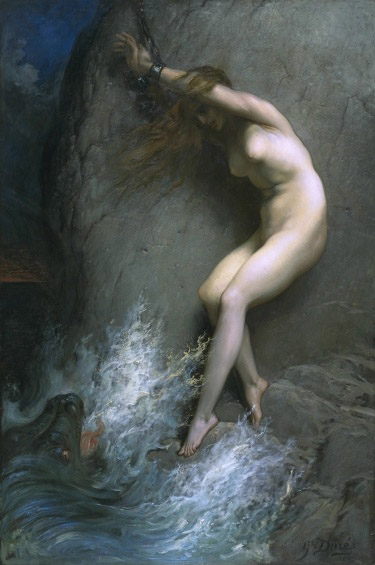
Isn’t she lovely?
Any of you who have seen ‘Clash of the Titans’ should remember this. The parents of Andromeda have offended the gods. The oracle says that in order to provide recompense, the daughter – whose beauty, being praised as higher than the gods, is the scandal – the daughter must be sacrificed. So she is chained to a rock, there to await her fate of being consumed by the Kraken.
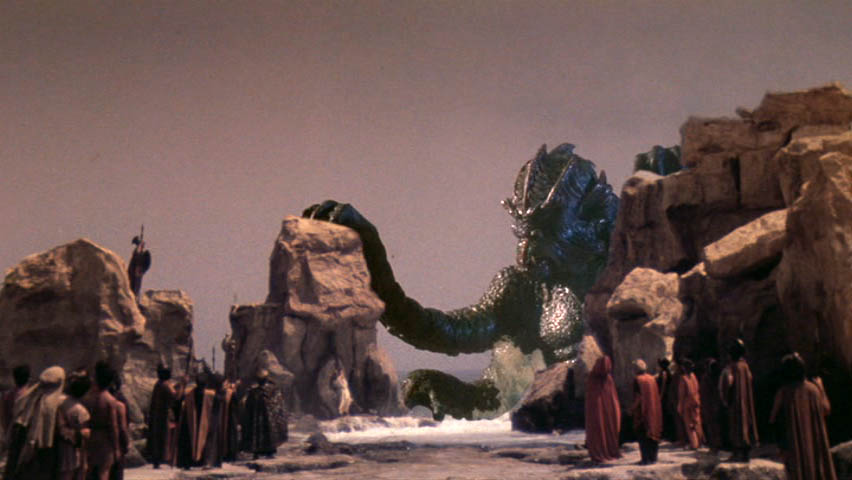
This is the pagan understanding of sacrifice. The gods have their own agenda. Their honour is paramount, and any insult to their honour must be met by sacrifice and the shedding of blood. So we have an angry deity, who needs to be appeased in order for the community to flourish and live in peace.
The Jewish understanding of sacrifice is quite different. According to the Jewish account, God is benign and loving – not vengeful and concerned with his honour (as if anything we do could either raise or diminish the living God’s honour!!) So in the ritual of the first temple (see this; James Alison is my source) the priest goes into the Holy of Holies, and comes out – as YHWH – to sprinkle blood upon the people as a sign of their forgiveness.
In other words God acts before we act, to reach out with love to forgive us and enable our lives. The God of the Bible is not a pagan deity. “There is no wrath in God”. In God is light, and in him there is no darkness at all.
Yet there is a wrathful deity here. There is a sacrifice. So watch this, and ask whose wrath is being satisfied.
Genes for nothing
“…by the time you get to courtship, or emotions, or creativity, or mental illness, or any complex aspect of our lives, the intertwining of biological and environmental components utterly defeats any attempt to place them into separate categories, let alone to then decide that one of them has got to go.”
Great article dismantling genetic determinism here.