
On Divorce

(Basically my sermon notes for Mark 10.1-12)

Jesus’ teaching on divorce is robust: “at the beginning of creation God ‘made them male and female.’ ‘For this reason a man will leave his father and mother and be united to his wife, and the two will become one flesh.’ So they are no longer two, but one. Therefore what God has joined together, let man not separate.”

I am persuaded that an easy acceptance of divorce, particularly where children have come into being through the relationship, has caused all sorts of social breakdown, and evidence for that is not hard to find. Yet I don’t believe Jesus’ teaching is quite as simple as it is made out to be. I am coming to accept that a slavish obedience to a rule can be destructive of the human flourishing which is God’s consistent will for us. We could begin with the hidden elements of the text today, in that Jesus was advancing a radically pro-women argument, in that he structures the question in terms of mutuality and loneliness, rather than property.

Consider the context of first century Judaism – every woman was defined by their relationship with a man, first the father, then the husband. A woman typically had no independent status – hence the repeated injunction in Scripture to look after the widows and orphans, in other words all who have no male economic protector. In terms of social status, the key thing for woman was fertility (with Genesis 1 referred to, “be fruitful and multiply” understood as the divine command) and women who were infertile were cast on the scrapheap. This was often the excuse for divorce, and was the context behind Jesus’ words.

In answering the question, Jesus doesn’t refer to Genesis 1 but to Genesis 2 – man and woman cleave to each other and become one flesh – which is to emphasise the point about mutuality, where the key phrase is “not good to be alone”. This brings out the importance of relationship – God as trinity, where relationship is essential to God’s own makeup – and we are made in God’s image, in other words we find our fullest expression through relationships and service to one another.

The cornerstone of this is commitment – to maintain a relationship through the bad patches – yet even this, because of our hardness of heart, can become something offensive to God. For the point about sticking to a relationship through thick and thin, which we do have to take with great seriousness, has, I believe, been abused and rendered idolatrous at certain times and in certain contexts. It comes down to a question about the place of rules and the grace of God – the rules are there to give us life; Jesus shows us the life which comes from following the rules; but what this means is that if the rules lead to a life where the love of Christ is absent then it is more important to follow Christ rather than the rule.

It is never of Christ to collude with injustice – Christ aggressively and angrily challenges injustice and stands up for those who are weak and defenceless – yet so often in human history the rule about sticking with a marriage through thick and thin has been abused in order to abuse, normally the woman but sometimes the man, and to put it bluntly, Jesus does not teach us to be doormats!

The thing is that breaking off a relationship – ie separation – can itself be a way of continuing a conversation. To collude with injustice, to not speak the truth about a situation, this is not of God. If all else fails, separation can be the last resort of the one whose will for the marriage is that it continues. Surely they will listen to this! But if even this cannot work…?

Let us remember Jesus’ teaching elsewhere about marriage, when he links it to the resurrection – a marriage is not eternal, it is not something that partakes of heaven – it is an earthly relationship, an earthly form, which can be wonderful and heavenly, but can also partake of the other place. The real issue is about our brokenness, the fracturing of our world through sin, and the presence of God’s grace which can redeem the most fallen situation.

I find Jesus’ teaching on divorce difficult – primarily because at heart I agree with it, and we can see the consequences of an abandonment of the teaching around us in our society today – yet I also believe in a God of grace, not of rules – as Jesus repeatedly quotes Hosea, the living God is a God who desires mercy and not sacrifice. So often we see sacrifice as the demand made upon us, that we need to mutilate ourselves in body or spirit in order to be acceptable – yet this is not the living god, this is the baal or the moloch who destroys life, not the one who dies on our behalf in order to give life.

Yet there is a suspicion in my mind here. Jesus’ begins his teaching on divorce by relativising Moses’ words – placing them in context, as a concession to human sin. Are we not called to do something similar? To relativise the words of our Lord, as a concession to our sin, in order not to have our hearts and souls broken on the rigidities of the law? All we have are fragments, within which we make our lives, trusting not in our own righteousness, but the grace and mercy of God.

NB for a slightly different take on divorce and the blogging of sermons, see this.
We need to work on having fun

Paul Mobbs is the author of what I think is the best introduction to Peak Oil, especially for UK readers (see here).

This is an optimistic interview with him. “The whole point about modern society in Britain is that the only way we know to have fun these days is to expend energy. We need to relearn all those skills our grandparents had for having fun with very little. That’s what its really going to be about. If you look at human history, we can bear anything, so long as we have a bit of fun at the same time. The fun bit is what we really have to work on.”

NB I’m booked to talk to our council about Peak Oil in the next few weeks. The Totnes model seems to be the way that Mersea needs to go forward.

Sam Sam pick up thi musket

The end of the world cometh (see here, from the man who first notified me of Peak Oil).

I still muse much about non-violence. I was recently told a story (non-parish related) about a man who was abusing his four year old daughter, and who was therefore barred from further contact.

This is violence. For what would the non-violent response to such abuse be? There is sometimes a folly that sees sanctions as morally different to war, rather than as points upon a continuum (indeed sometimes sanctions are worse than war, as with Iraq prior to 2003). The moral issue is coercion, to no longer have a relationship of I-Thou but of I-It – and the It must be conformed to my will.

There are situations where I am simply not satisfied that non-violence is right. Undoubtedly these are situations that are mired in sin, and where a violent response is sinful – but nonetheless the violent response seems less sinful than the alternative.

As with protecting a child.

This is on my mind because I am more and more convinced of the coming trauma (have a read of this essay for an example of something that influences my perspective).

The logic seems inexorable. Wars are most often triggered when there is a decline in resources – and we face a decline in spades. And then lots of war, of new and deadly forms.

So what does a community do when there is a band of brigands coming to take away the means of life of that community?

“Do not resist the one who is evil”.

I’m just not sure a) that I could or would follow non-resistance, or b) I could persuade anyone else of the rightness of it. I don’t deny that a violent response is sinful. I just insist that the non-violent response is also sinful.

There is the choice. Resist – and therefore choose the lives of A over B. Or do not resist, and choose the lives of B over A.

In a situation where billions will die and be slaughtered, do you just give up? Or do you seek to preserve something of your community, your civilisation – your gospel?

I do not know. I just do not know.

“Blessed be the LORD my strength which teacheth my hands to war, and my fingers to fight” (Psalm 144.1)

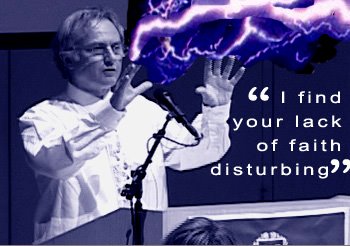
The Demonic Richard Dawkins


A few years ago I read this very interesting book called ‘Demonic Males’, by Richard Wrangham and Dale Peterson. The basic argument is that much of our (male) aggression is ‘hard-wired’ and shared between ourselves and the chimpanzee. Thus, observing chimpanzee aggression gives insight into the aggression that human beings are capable of. It’s a good book.

One of the central planks of Richard Dawkins’ objections to religion is the argument that religious belief causes violent conflict. Hence: “…faith seems to me to qualify as a kind of mental illness… Faith is powerful enough to immunize people against all appeals to pity, to forgiveness, to decent human feelings… What a weapon! Religious faith deserves a chapter to itself in the annals of war technology, on an even footing with the longbow, the warhorse, the tank, and the hydrogen bomb.”

One would imagine that even Richard Dawkins would accept that chimpanzee violence is not driven by religious ‘delusions’.

However, I wonder about the disconnect manifest in Dawkins’ outlook; that is, the way in which this prominent zoological understanding – of which he is surely aware – is bracketed out of his perception of religion. If most of our genetic inheritance is held in common with the chimpanzees; and if chimpanzees, without religion, manifest violence – why should religion be held to be the ‘source of wars and violence’? Why the appeal to ‘decent human feelings’? And where do they come from?

I just begin to wonder about the level of personal integrity that Richard Dawkins enjoys. What is wrong with him? Why is he so caught up with this issue – what is it that is gnawing away at him, driving him mad like this?

My suspicion is that he is fighting something in himself.

He is struggling with demons.

Hauerwas on right worship

“One reason why we Christians argue so much about which hymn to sing, which liturgy to follow, which way to worship is that the commandments teach us to believe that bad liturgy eventually leads to bad ethics. You begin by singing some sappy, sentimental hymn, then you pray some pointless prayer, and the next thing you know you have murdered your best friend.” — Stanley Hauerwas, The Truth About God: The Ten Commandments in Christian Life, p.89

Sam laughs manically in the background ‘ yes yes yes….’

HT: Alastair
(This is, by the way, the topic of one of my Learning Church sessions. It’s gratifying to find a Hauerwas quotation that makes the point so well.)

TBTE20061026

I took loads of piccies this afternoon. Many contenders, but this one just edged it. The ones I like the most at the moment have the most ‘painterly’ skies – ie they look as if they have been painted on, they have texture.