Polish

You scored as Poland. Your army is Poland\’s army. Your tenacity will form a concept in the history of your nation and you\’re also ready to continue fighting even if your country is occupied by the enemy. Other nations that are included in this category are Greece, Norway, Belgium and the Netherlands.

Poland

88%

Finland

81%

British and the Commonwealth

69%

Italy

63%

France, Free French and the Resistance

44%

Soviet Union

38%

Germany

38%

Japan

38%

United States

31%

In which World War 2 army you should have fought?
created with QuizFarm.com

HT Normblog. I am perversely gratified that the US came at the bottom.

Learning Church 2006 – 2007

Learning Church 2006 – 2007
Let us be human: Prophecy, Peak Oil and the Path For the Faithful

Saturday
7th October Overture: Jeremiah
14th Peak Oil Revisited
21st The accelerating crises of our time
28th Red or Blue Pill? Idolatry and science
4th November Deuteronomy and the Wrath of God
11th The Apocalyptic Imagination
18th No session
25th Biblical stewardship
2nd December No session (WM PCC)
9th Amos and poverty
16th Ezekiel, Sayyid Qutb and foreign policy
23rd No session (Christmas)
[30th Christmas]
[6th January Epiphany]
13th No session (Sam on paternity leave)
20th Isaiah and right worship
27th The tradition of the virtues
3rd February Faith, praxis and schism
10th Living in the Kingdom
17th No session (WM PCC)
24th Let us be human (summary)

Dates and topics are subject to change.
There will likely be a further sequence after Easter.

TBTE20060831

And I came to believe in a power much higher than I
I came to believe that I needed help to get by
In childlike faith I gave in and gave him a try
And I came to believe in a power much higher than I

(Johnny Cash)

Obedience

Evensong sermon 27 August 2006

I wonder how many of you reflect on experiences in your early childhood that have shaped your life ever since. When I was ten I was made ‘head boy’ in my primary school – it was the sort of school that had ‘head boys’ – and full of my few found importance I began to give orders to my class mates. As you can imagine they resisted this, in one case violently and forcibly, and ever since I have felt extremely inhibited about exercising authority. Yet some six months ago I was very struck by this verse from this evening’s text: “Obey your leaders and submit to their authority. They keep watch over you as men who must give an account. Obey them so that their work will be a joy, not a burden, for that will be of no advantage to you.” (Hebrews 13.17)

A remarkable text. I have been mulling over this text rather a lot in the last six months or so – some of you may even remember that I quoted it in my letter to the congregation after Easter. It represents something that rubs against the grain, both of my own nature and what I have absorbed from our culture, for it offends against the modern idols of freedom and choice – but the more time goes on, the more authority I recognise in it.

This question of obedience has become problematised in our society, partly because it has rightly been seen as something which can be corrupted – one of the conclusions of the Nuremberg trials. Yet the rejection of blind obedience does seem to me to have gone way too far, and conscientious obedience, obedience from a principled acceptance and informed understanding – this too seems to have been ruled out of court, and that now seems to be a mistake. Rightly understood, the traditional understanding of obedience has never undermined the priority of individual conscience – for conscience is paramount in both protestant and catholic traditions – but this has become cheapened and reduced in modern life, where there is now a manifest idolatry of personal preference. The conscience of the christian is informed by prayer and study and the development of the virtues of patience and prudence – it is not part of the idolatrous elevation of individual willpower that so scars our modern society. To cut to the quick: Jesus is not a choice for us to make between others – it’s not as if we are in the supermarket and we make our selection from the different brands – a bit of new age here, a bit of buddhism there – that perspective still places the power of choice within us, and it doesn’t belong there. For we don’t choose christ, he chooses us – and that means we submit to christ – that’s a phrase from the baptism liturgy – submission and obedience are our proper responses, they are a necessary component of our Christian path – and that is how we bear fruit – not through a concentration upon our choice for Christ, for he chooses us – he says ‘you did not choose me, I chose you, and appointed you to bear fruit’.

There is a fine example of this in the liberty of the monastic life, where all power of choice is given up – a great freedom comes – the weight of the world and decision is lifted, which is what I believe Jesus talks about when he says that his burden is easy and his yoke is light – if we genuinely allow Jesus to be lord in our lives, if we let his spirit make our decisions, then life becomes much simpler and more peaceful. After all Jesus speaks often about the necessity of obedience.

In the Rule of St Benedict, the Abbot is given strong authority, over the monks, but with the clear proviso that he will be answerable to God for the state of the souls in his care, which is also picked up in our text this evening: “They keep watch over you as men who must give an account.” This is one of those passages of Scripture that are sharper than a two edged sword, cutting both ways, for it flags up the essential role of the pastor, what is meant by the traditional title of curate – the cure of souls, the GP for the soul – that’s what it means that those in authority will have to give an account of their ministry. That we will be held to account for the health of the souls in our care.

The Hebrews passage goes on: Obey them so that their work will be a joy not a burden for that would be of no advantage to you. I have recently joined up with a clergy support group, and I have been very struck by how depressed and despondent so many of my colleagues have become – and I think this question of obedience is relevant, for so many of the battles which clergy have to fight are with the products of the idolatrous worship of individual choice that, even within the church, are rampant and destructive. One of the things that was quoted to me recently is worth sharing: there is a sequence of steps that a pastor goes through as they lose their way: 1. stop their wider reading; 2. their prayer life; 3. their sense of humour; 4. their humanity…

This is such a tragedy, for the work of the pastor, the care of souls, is intensely joyful. To watch a soul heal, and a life then to flourish – that is the most intense privilege, and it is intrinsically a joyful task – when we are enabled to do it. That is what this passage is about – allowing the one who has the responsibility for the care of souls to get on with doing just that.

At the heart of this question, of obedience and freedom, lies the paradox that it is in God’s service that we find our freedom. That is because it is through obedience to God’s calling that we find our true selves, we begin to understand who we most profoundly are – and then we are enabled to become ourselves, where our choices are aligned with God’s will for us. It is about allowing God to be in charge, in particular, to let go of the teaching which our world is saturated with, that our destinies lie in our own hands, that if only we can make the right choices then all will be well – this is the way in which works-righteousness has taken shape today. We live by grace, not by choice. God is in charge.

This is what obedience is ultimately about – it centres on trust, principally trust in God, a trust that even when we make mistakes, even when church leadership makes spectacular mistakes – that God’s will is not thwarted, and that he will succeed in all his good purposes. It is about putting our own perceptions of what is right – even when they are clearly correct – to one side, in order that God’s plans come to fruition. It is when we can accept that that our hearts are set free, and we can attain that peace which the world cannot give, which is God’s intention for us.

Pluto


I remember much of the astrology that I was obsessed with as a teenager – some of it still hovers in the background of my thinking, even though I think, on the whole, it is spiritually harmful – so I’ve been watching the debates about Pluto’s status as a planet with great interest. Of course, it exposes the pseudo-science pretensions of astrology quite wonderfully, but the psychological and mythological truths which astrology explores (I’m thinking here of Liz Greene and this book in particular) seem to be standing up quite well. For in astrology, Pluto is the lord of the underworld, the dark realm from whence great riches flow. And as well as the links with fascism in the 1930’s, and the expanse of state control, there is also a very vivid link with oil culture, which really took off at the same time. And which is now coming to an end – just as Pluto itself recedes back into the nether regions.

So this could be a coincidence. It could be synchronicity. Or it could be a really absurd bit of evidence that there remains some resolutely non-scientific truth in astrology after all.

BTW I like the cartoons at Cox and Forkum – see this one about Pluto!

BTW2 for anyone who has a serious interest in astrology, my vocation experience, which was an utterly terrifying and dreadful confrontation with both God and my id, but which bore great gifts as well, coincided to the day with a final Pluto transit of my natal 10th house Neptune (square natal Sun/Ascendant, opp natal Saturn). Another coincidence, of course.

American Theocracy & Persecution


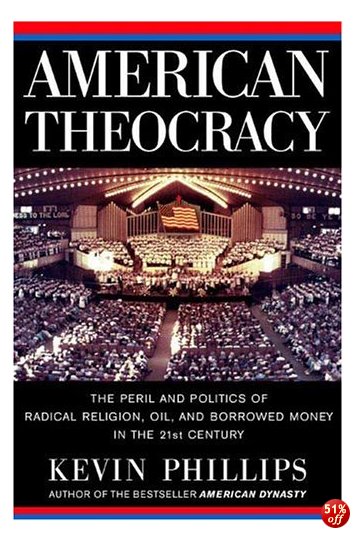
I read two wholly opposed books on holiday: American Theocracy, by Kevin Phillips, which argues that the United States is a) poised for a serious collapse in its relative power, and therefore b) drifting towards a religious-right fundamentalist government, with shades of fascism; and Persecution, by David Limbaugh, which argues that Christians are being driven out of American life and being forbidden to practice their faith.

Both books were decidedly mixed; I’m not sure I’d recommend either, but I found the experience of reading them sequentially quite valuable.

The Phillips book is a ragbag of condensed journalism, with occasional insights from his area of true expertise (psephology) – and he’s persuaded of Peak Oil as well, which marks him up 🙂 He buys into some of the standard anti-Christian arguments with respect to science, though, and his equation of Bush’s opposition to stem-cell research with the Spanish Inquisition is just nonsense. It is in fact the idolatry of science that takes its shape as fundamentalism (fundamentalism and aggressive secularism are siamese twins). His overall thesis has some merit however, principally in showing how previous dominant powers have believed themselves to be ‘special’ and then land on their backsides – eg the Dutch, British and Spanish (wonderful quotes reflecting the sequential delusions on p299 of my edition).

One of the things which counts against Phillips (on b) above) is that it seems perfectly plausible that the US will react against the present Bush administration so strongly (when its incompetence is fully revealed) that it will swing the other way. Which brings me to Limbaugh. I am thoroughly persuaded of the overall argument that Limbaugh makes, ie that contemporary Western society (Anglo-American in the main) is becoming more aggressively anti-Christian. It’s a more salient issue in the US than in the UK, because the process has been much more thoroughly established in the UK, and the persistence of the Church of England has covered over the decay, but in the US the Christian community is still both vital and engaged. “What can the theistic Sunday-schools, meeting for an hour once a week, and teaching only a fraction of the children, do to stem the tide of a five-day program of humanistic teaching?” (he’s quoting Charles Potter).

However, Limbaugh’s understanding of Christianity itself is impoverished – he shares the general amnesia of the American church with regard to Christian tradition, and consequently he plays strongly into the hands of critics like Phillips. For example, he writes “Thus it is no mystery that Christianity is unacceptable to the post-modern paragons of tolerance. For the Christian worldview holds that the one and only God objectively intervened (and intervenes) in history and that its truth claims are absolutely valid and open to rational, empirical investigation. Aquinas, for one, would have no truck with that. (Interesting how even now the echoes of what Marsden described resound in the American debate.) And it is particularly difficult to take a writer seriously who begins one chapter (11) with the words “America is the greatest, freest nation in the history of the world.” That said, his chapter 11 I found to be the best of the book, talking about the theological underpinnings of the American democratic tradition, which I had suspected but never seen chapter and verse on. (Strangely enough, it was confirmed by a Guardian article that I read the next day – see here. The Guardian supports the views of the US religious right! Who disbelieves in miracles now?)

So, any conclusions? Principally confirmation of Strauss and Howe’s Fourth Turning thesis which predicted an increase in extremism through the next twenty years, reminiscent of Yeats: “The best lack all conviction, while the worst/ Are full of passionate intensity.” Beyond that, I remain concerned that the trials that the US are about to experience will provoke an extreme reaction, of a possibly fascist nature, which is Phillips’ thesis. Christians have flourished in times of persecution before, so I am much less afraid of what Limbaugh describes – the truth will out in the end. But a corruptly Christian fascism – that prospect is not negligible, and is profoundly alarming. As always, have a read of Chris Locke for more background on that.

Collapse


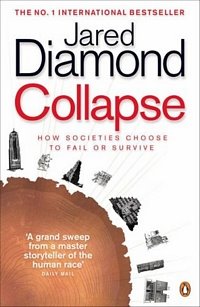
Before going on holiday I read Jared Diamond’s ‘Collapse’, which I thought was very good (I’ve also read his ‘3rd Chimpanzee‘ and ‘Guns, Germs and Steel’ – he’s an author whom I rate highly). It was a much more optimistic book than I had expected, in overall tone, but I was disappointed with the end – I felt he could have written more about the options and decisions that we face. Overall, well worth reading, especially for the material about Montana and the Greenland Norse, which were wholly new to me.

NB for a different view to the received wisdom on the Easter Island collapse (which Diamond makes great play of) go here (HT Arts and Letters Daily)

The Question of Character (a MoQ post)

Something written for the MoQ discussion group a few years ago.
~~~~~~~~~~

In ‘Zen and the Art of Motorcycle Maintenance’ (ZMM) the Narrator writes:

“I think it’s about time to return to the rebuilding of *this* American resource – individual worth. There are political reactionaries who’ve been saying something close to this for years. I’m not one of them, but to the extent they’re talking about real individual worth and not just an excuse for giving more money to the rich, they’re right. We *do* need a return to individual integrity, self-reliance and old-fashioned gumption. We really do.”

The Narrator is here giving the notion of individual worth a clear degree of Quality, ie it is a good thing, it is something which should be nurtured and affirmed. The question I’d like to explore is: where does this fit in with the MoQ? Or is it something to be left behind?

Consider the literary structure of Lila. We have a correspondence between the four static levels of the MoQ with four characters (so the boat is inorganic, Lila is biological, Rigel is social and Phaedrus is intellectual) and a correspondence between DQ and the river on which the static levels float. Moreover, the way in which the character Phaedrus fails to engage constructively with the character Lila seems to be an acting out of Pirsig’s point that the intellectual level cannot engage directly with the biological level, but must rely upon the social level (Rigel – equals ritual?) in order to cope.

Now this structure is hierarchical. The higher levels are more moral than the lower levels, so that, where there is a conflict between levels, the higher level must be supported (eg intellectuals must support the police). At which level does individual worth fit? Or is it a product of a combination of levels (the forest of static patterns)?

A tension arises for me because if the characters in the novel represent the levels, and the levels are hierarchical, then to accept the MoQ would seem to imply that we should make ourselves more like Phaedrus in terms of our static patterns (which certainly seems to be the aim amongst some members of the moq.org community). Yet Pirsig, in Lila’s Child, talks about his displeasure at being identified with the character Phaedrus: “Yes, Phædrus is overwhelmingly intellectual. He is not a mask, really, just a literary character who is easy for me to write about because I share many of his static values a lot of the time. I don’t think big self and small self are involved here. My editor wanted me to make him a warmer person in order to increase reader appeal. But making him warmer would have made him more social and weakened the contrasts between himself and Rigel and Lila that were intended to give strength to the story. The fact that everyone seemed to think that Phædrus was me came as an unpleasant surprise after the book was published. I had assumed that everyone would of course know that an author and a character in his book cannot possibly be the same person.” Clearly we must distinguish Pirsig the author from Phaedrus the character, and where Phaedrus is an isolated, asocial, possibly amoral metaphysician, Pirsig the author, in his presentation of Phaedrus, is distancing himself from those very things. Elsewhere in Lila’s Child Pirsig quotes a response to an interview: “One interviewer asked me, “Are you really Phaedrus?” The answer was, “Yes I really am Phaedrus. I also really am Richard Rigel. I also really am Lila. I also really am the boat”.” In other words, the ‘I’ of Robert Pirsig is composed of all the different levels in greater or lesser patterns of harmony.

This all suggests to me that individual worth in the sense that the Narrator praises in ZMM is not to be identified with one level, but is the product of a combination. However, another strand in Pirsig’s writing tends against that, and might suggest that character is a wholly third level pattern. In the foreword to the 25th anniversary edition of ZMM Pirsig comments that the Narrator is dominated by social values – and, of course, the passage from ZMM that I quoted at the beginning of this post are the words of the Narrator.

First a question: is it legitimate to take the views of the Narrator as being the views of Pirsig? Or is the Narrator another character, in the way that the characters of Lila are, and not to be identified with the author? I don’t know what the answer to that question is.

Second, there is clearly a sense in which the Narrator IS dominated by social values. The Narrator’s personality is one that was constructed whilst in hospital in order to satisfy the doctors that he was not insane, and was therefore at liberty to leave the hospital. And in that sense the eclipse of the Narrator is a positive development within the story.

But this leaves me with a question. If the Narrator is dominated by social patterns, does this mean that all the things he says within ZMM – such as the comments about individual worth – are compromised? This would seem truly bizarre, in that the Narrator is clearly operating intellectually throughout the book (he is manipulating symbols). And just as clearly the Narrator is analysing society (think of overlooking the freeway and describing the expressions on the faces of drivers). So….?

I would tie this in with two elements, one relating to the story in ZMM, and one relating to metaphysics. In ZMM the Narrator chooses not to go up the mountain; that is, he chooses not to track to the source of a particular philosophical problem, presumably from fear that Phaedrus would then return. Whereas in Lila, Phaedrus has returned, and is content to ‘climb the mountain’, ie explore metaphysics. So you could say that the relative status of metaphysics has changed between the character of the Narrator in ZMM and the character of Phaedrus in Lila. The Narrator is very pragmatic – if it helps in daily life, it’s fine, otherwise forget it (reminds me of Wittgenstein: “What is the use of studying philosophy if it does not improve your thinking about the important questions of everyday life?”). Whereas Phaedrus is quite clearly not pragmatic, is quite unworldly in fact, and pursues the metaphysical questions with abandon. I can’t imagine the Narrator being quite so socially incompetent with respect to Lila, for example.

The second element relates to the differing status of Socrates, the founding father of metaphysics. In ZMM the Narrator describes his rediscovery of Phaedrus’ intellectual explorations. The climax of this movement comes when Phaedrus realises that Socrates is, in fact, one of the bad guys: “Socrates had been one of Phaedrus’ childhood heroes and it shocked and angered him to see this dialogue taking place.. Socrates is not using dialectic to understand rhetoric, he is using it to destroy it. Phaedrus’ mind races on and on and then on further, seeing now at last a kind of evil thing, an evil deeply entrenched in himself, which pretends to try to understand love and beauty and truth and wisdom but whose real purpose is never to understand them, whose real purpose is always to usurp them and enthrone itself. Dialectic – the usurper. That is what he sees. The parvenu, muscling in on all that is Good and seeking to contain and control it. Evil.”

The Narrator then goes on to describe what Plato does with regard to arete (excellence, aka individual worth): “Why destroy arete? And no sooner had he asked the question than the answer came to him. Plato hadn’t tried to destroy arete. He had encapsulated it; made a permanent, fixed Idea out of it; had converted it to a rigid, immobile Immortal Truth. He made arete the Good, the highest form, the highest Idea of all. It was subordinate only to Truth itself, in a synthesis of all that has gone before.”

This is a rejection of traditional metaphysics, the history of western thought. The Narrator is objecting to the raising of dialectic over rhetoric – and it is THIS which underlies the maxim at the beginning of the book, ‘and what is good…’, because the point is that you don’t need a definition of the good in order to know what the good is. (Another echo from Wittgenstein: “It has puzzled me why Socrates is regarded as a great philosopher. Because when Socrates asks for the meaning of a word and people give him examples of how that word is used, he isn’t satisfied but wants a unique definition. Now if someone shows me how a word is used and its different meanings, that is just the sort of answer I want.”)

But in Lila, the status of Socrates has been changed. Now he is once more the martyr to the independence of intellectual patterns from the social level, that ‘truth stands independently of social opinion’. Instead of being an instrument of evil, he has become an instrument of a higher evolutionary level, and therefore more moral than those who oppose him.

This is why I think there is a problem with the structure of the MoQ. In ZMM the Narrator quotes Kitto saying: “Arete implies a respect for the wholeness or oneness of life, and a consequent dislike of specialisation. It implies a contempt for efficiency – or rather a much higher idea of efficiency, an efficiency which exists not in one department of life but in life itself”.

Yet Phaedrus – emblem of the intellectual level, fan of Socrates – is clearly a specialist, moreover an intellectual specialist, a master of the art of dialectic.

So what is the problem? The problem is the question that I began with: where does individual worth, arete, fit in with the MoQ? Or is it something to be left behind?

If Phaedrus is the emblem of the higher level, and that higher level is the realm of abstract thought, manipulation of symbols etc, and Socrates is the martyr to the independence of the intellectual level from the social level – is arete the social level? (That would seem to relapse into equating arete with virtue, which the Narrator unpicks as a mistake in ZMM). Yet if arete does not belong to the social level, how does it relate to the intellect? The argument of ZMM is that the intellect (dialectic) is the parvenu, overthrowing rhetoric which is the proper means for teaching Quality, the best, arete. Or is arete the equivalent of DQ, that which can’t be defined? Possibly – but clearly it can be taught, and there were settled ways of teaching it, through rhetoric, which are static patterns. So the question comes – what is the proper classification of those static patterns?

What lies behind all these questions is the notion of philosophical ascent, our pursuit of Quality. It has always seemed to me that the Narrator is a voice of wisdom, and he resembles Wittgenstein in many ways, whom I also revere as a deeply human guide. In terms of what I wish to pursue in my life, it is precisely that pursuit of Quality, the ‘wholeness of life’, which corresponds to arete, or individual worth, or (as I put it in my essay on moq.org) the eudaimonia which I find to be of high Quality, both static and dynamic. Whereas the intellectualism of Phaedrus, and the construal of the fourth level as represented by that character, I find to be sterile, of little interest.

I suspect that Pirsig himself pursues a broad and rich understanding of arete. This is why he didn’t wish to be identified with Phaedrus, the character in Lila. Yet somehow, the structure of the MoQ has elevated dialectic above arete, and there is this consistent tendency, especially in MD, to glamorise Socrates, and to dismiss the social level as contemptible, which has always seemed profoundly unwise to me.

Is the arete that we are to pursue an intellectual one? No. Is it to be identified with DQ – partly, surely, but does that mean that there are no accumulated static latches that can be absorbed to gain insight and develop our individual worth? If so – what about ZMM itself?

Surely we are to pursue individual worth, precisely the ‘individual integrity, self-reliance and old-fashioned gumption’ that the Narrator praises, the ‘duty towards self’ which is the good translation of dharma, the ‘wholeness of life’ which Kitto refers to. That, it seems to me, is what the highest level of the MoQ should be about. Individual worth is not to be left behind, it is, in fact, right at the heart of all that has Quality. It just seems that the way the MoQ is dominantly interpreted pushes it to one side, in favour of dialectic and that parvenu called Socrates. We must return to the rhetoric of the Sophists.

Anyone who has reached this far and remains interested is referred to my essay called ‘The Eudaimonic MoQ’.