On pastoring

Does Ministry Fuel Addictive Behavior? – LeadershipJournal.net: “But here is reality. Well-meaning pastors can work 80-hour weeks and still not be able to please their flocks.” (HT Eternal Echoes)

I was told something very interesting yesterday. When pastors are under stress, they lose things in the following order:
1st Their wider reading;
2nd Their prayer life;
3rd Their sense of humour;
4th Their humanity.

I’m coming more and more to the conclusion that the cultural expectations on ministers need to be put through the blender. I think often of One Salient Oversight’s comment about teaching being the essential part of ministry (for the truth is pastoral), and also of some of my hassles.

The old is dying and the new cannot yet be born. In the interregnum a great variety of morbid symptoms appear. (Gramsci)

Quite what this means for where I am I do not yet know. I’m pretty sure I am where God wants me though.

X-Men 3

A tale told by an idiot, full of sound and fury, signifying nothing.

As such, profoundly disappointing. I wonder if there will be a “Director’s Cut”, folding in at least a further half hour of plot development and characterisation. That would be worth watching.

Four Tough Questions

Get Religion has offered a very interesting Four Tough Questions, with a view to discerning whether someone is a liberal or conservative.

(1) Are biblical accounts of the resurrection of Jesus accurate? Was this a real — even if mysterious — event in real time? Did it really happen?

SN: Yes. Tho’ there is room for a much longer answer clearing up ambiguities.

(2) Is salvation found through Jesus Christ, alone? Is Jesus the Way or a way?

SN: Yes – but I don’t think they have to call Jesus BY that name (see here)

(3) Is sex outside of the Sacrament of Marriage a sin? The key word is sin.

SN: Yes, but I don’t see it as necessarily grievous, especially compared to the sin that we are all saturated in.

(4) Should Anglican leaders ban the worship, by name, of other gods at their altars?

SN: Absolutely! It boggles the mind that this is even a question.

[You can tell that I am catching up on my blogroll today – nice way to spend the morning of my day off :o) ]

Deciding to hope

This is by way of a more personal follow-through to that last post. Ranter describes a situation where he has genuine need of an SUV; Looney, in comments, wonders “have you done anything” in this respect.

Truth be told, my lifestyle has changed very little. My research hasn’t yet got to the stage of forcing major changes in behaviour (tho’ I think it will – I just do things very s – l – o – w – l – y). I’ve done some easy things (eg shifting to renewable electricity, beginning the process of planting vegetables) but the major stuff – if anything, I’m moving in the wrong direction. Two major ways in particular: we are sending our children to a private school, which will result in a major increase in our driving and petrol consumption; and child number three is now on the way. Why this decision, in a context where it is the population explosion driving all the problems? Various reasons.

I might be wrong about Peak Oil.

The crunch (for the West) probably won’t really hit for another ten years or so – and we have to do the best for our children today.

I don’t believe the crash is in our power to prevent (tho’ God’s grace may); the crash will cause a huge reduction in population; the problems faced in that situation will be very different to those faced now. In particular I think the environment for my children will be much more hazardous, violent and fraught, and Psalm 127 is never far from my mind.

In the end, though, there is a more or less explicit thread of nihilism in the die-off mind-set, and I cannot accept that. Whilst I can accept that Jerusalem will be destroyed, yet will the exiles return.

And so I decide to hope.

Memory and Virtue

This is what Wikipedia might call a ‘stub’.

The Alasdair MacIntyre quotation (the conclusion of ‘After Virtue’) that has haunted me since I first read it in 1990:

“What matters at this stage is the construction of local forms of community within which civility and the intellectual and moral life can be sustained through the new dark ages which are already upon us. And if the tradition of the virtues was able to survive the horrors of the last dark ages, we are not entirely without grounds for hope. This time, however, the barbarians are not waiting beyond the frontiers; they have already been governing us for quite some time. And it is our lack of consciousness of this that constitutes part of our predicament. We are waiting not for a Godot, but for another – doubtless very different – St Benedict.”

Peak Oil is what has crystallised a number of strands in my thinking about these issues. I am moving more and more to the view that the core Christian task in these times may not be to prevent the catastrophe from coming – I do think we should do what we can, I just don’t believe we have the capacity to control the process, or prevent a significant reduction in worldwide human population – but to ensure that the events are witnessed and chronicled, in order that whatever remains of our civilisation in the coming centuries can move to a more human future – doubtless never a perfect future, but one more step beyond where we are now.

What we will need to cultivate are our memories and our virtues. Perhaps a new monasticism, one which both embraces scientific processes (to preserve technology) and places that scientific capacity within the larger moral and human framework which enables our flourishing.

More on this as time permits.

Time to get embarrassed

Those of you with pretensions to genuine musical taste should look away now.

Don’t say you weren’t warned….

Ranter tagged me with the musical meme: List seven songs you are into right now. No matter what the genre, whether they have words, or even if they’re not any good, but they must be songs you’re really enjoying now. Post these instructions in your blog along with your 7 songs. Then tag 6 other people to see what they’re listening to..

Ahem.

1. I like it, Narcotic Thrust
2. Crazy, Gnarls Barkley
3. Personal Jesus, Johnny Cash (sometimes the Depeche Mode original, dependent on mood)
4. Clocks, Coldplay
5. Porcelain, Moby
6. Sometimes You Can’t Make it On Your Own, U2 (could have been one of half a dozen U2; this one just coz I’m thinking about my father a fair bit at the moment)
7. The Man Comes Around, Johnny Cash

I’m not sure I have the nerve to tag someone on this….

Terrified

Every so often I let my attention wander away from the nitty-gritty details of Peak Oil, and I focus on the long term future (about which I remain relatively optimistic, ie there will be continuing civilisation (continuity of cultural memory), albeit with a smaller population).

Then I have another look at what is actually going on, and I get terrified thinking about the great dislocation that we will be journeying through over the next ten to fifteen years.

‘By 2020 the current 85million barrels a day production could be reduced to 25 mbd. THIS IS A BIG DEAL’

No shit, Sherlock. We’re fucked.

(Please forgive the obscenity; flatter language is also obscene when it obscures the truth)

Why I blog

In the interstices I’ve been thinking much about why I blog, partly inspired by the CT article referenced here, but also by something Tim wrote about stepping back from blogging to a certain extent. I’m enough of a Catholic to feel guilty about anything in which I take pleasure, and I take great pleasure in the writing of this blog, but knowing that is normally enough to keep the guilt chained down. Yet I want to express something more constructive than ‘it’s fun’.

Blogging, it seems to me, isn’t anything else; it is sui generis. It has links and overlaps with existing art and media, but it has it’s own rationale. Rather in the way that film cannot be understood through the lenses of other art forms (it is not art, it is not literature, it is not theatre, it is not opera – see this book), so too blogging is not journalism (although it can be journalistic); nor is it a diary (although it shares many elements in common). It is a new form of communication: democratic, chaotic, narcissistic, fertile.

What begins by reflecting the existing cultural forms slowly takes its own shape, as it manifests what Aristotle calls its telos, the point to which its development tends. Rather in the way that children will develop first by copying the behaviour of their forebears, then rebelling against it, and then finding their own maturity, so too the most prominent blogs have taken on the form of the mainstream media, as transmitters of news and stories (I’m thinking of Instapundit). Yet it seems to me that the inherent construction of a blog tends against that shape. There may well be blogs which end up as news vendors – large trees within the blogging ecology – but they strike me as being a little bit like Olympic athletes – they have gone so far in pursuit of one aspect of their existence that they have become distorted and mis-shapen. I think the proper telos of the blog is more akin to flowers or weeds, or perhaps mustard plants.

The heart of a blog is an individual voice. It is the record of what passes through the mind and experience of one particular person, and to that extent, it is akin to a private diary. Where it is radically irreducible to that existing form, however, is that it is not only public but interactive. It would be as if someone writing their private diary had a team of friends kibitzing them whilst they wrote.

This has major effects. It inhibits full disclosure, whilst at the same time raising the value of such personal disclosure as may be made. More importantly it also provides much richer soil for personal growth: self-pity, for example, is more likely to be challenged in a public forum. Again, this is not something which is new – it is a classical sign of friendship – yet it does take a different form in the blogosphere.

Which brings me to the final point that I wish to make. Certainly with me, and I believe with others, the existence of blogging has allowed a side of my character which had been submerged to emerge into a more conscious awareness. Those things about which I once merely read and pondered – with very occasional conversation – are now routinely matters of public record and comment. That can only be healthy. In trying to visualise this, I cannot escape an image from James Cameron’s The Abyss, when the alien intelligence comes into the submarine rig:
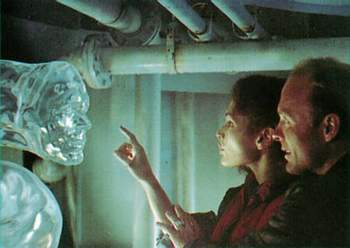

That’s a little like how it feels. I cannot believe God is absent from the process.

I blog because it is a sharing of thoughts and impressions, a working out of daily life, which, if not examined, loses worth and value. It is the sharing, the reciprocity, which enhances its Quality; in truth, it is the opposite of solipsism – it is solitarily social, not socially solitary.

Thank you for reading.