Read this.
I’m sure Frank Field will sign up for it – it’s not just for right wing nut jobs like me :o)

Read this.
I’m sure Frank Field will sign up for it – it’s not just for right wing nut jobs like me :o)
If you go here you’ll be able to read an issue of Transmetropolitan, the journal of the future-journalist Spider Jerusalem, created by Warren Ellis. BE WARNED – MATURE CONTENT!!!
But it is mature content with a social conscience, and an important point. That’s why Mr Jerusalem is my hero.
“Because you wouldn’t have it any other way”

Finished the series yesterday. Enjoyed it greatly, although the formula is wearing a little thin – too many implausibilities, even allowing for suspension of disbelief, eg Almeida functioning anywhere near full effectiveness after being shot and undergoing throat surgery…
Lots of things remain in my mind from it. It seemed to be struggling too hard not to have a happy ending – hence the many sadnesses and sacrifices (Almeida must be pardoned!) – but most of all I am left reflecting on the portrait of ‘hardness’. I say that rather than ‘masculinity’ because I’m not sure that what is being portrayed is male – but there seems to be a celebration of ruthlessness, undercut rather expertly by the negative consequences (this time) of such ruthlessness – in every case, I think.
Well worth watching – should you find yourself ill for a weekend with nothing else that you can cope with 😉

“Well, considering the rapidly growing demand for fuel from nations like China and India, not to mention the world’s oil production is expected to peak in the next five years and then sharply plummet, I think it’s pretty clear we’re looking at an exponential rise in global conflicts along with an energy crisis of unfathomable proportions – so yes, I’d say, a hybrid’s an excellent idea.”
Jack Bristow, Alias, Series Four, Episode 10: “The Index”
I have been thinking about the Eisenhower comment on the military-industrial complex rather a lot recently, for obvious reasons.
I’m annoyed because I have become persuaded, very reluctantly, and slowly and against my habitual will… I have become persuaded that the attacks on 9/11 were not perpetrated by Osama Bin Laden, but were instead perpetrated by actors on the inside of the US government.
And it’s annoying because just writing that sentence makes me feel like an absolute lunatic. I feel I’ve just stepped outside of the acceptable bounds of social discourse; I’m no longer a reasonable person. Everything I now say and think will be tainted by a sense of ‘oh yeah, he’s that guy who thinks Dick Cheney blew up the twin towers…’ – and thus my ‘voice’ is eclipsed.
And it’s annoying because I supported the attack on Iraq, and now I wonder ‘have I been had?’
Yet you have to pursue the truth, whatever the temper.
This line of thought was prompted by viewing this video, kindly linked for me by Sven, although it had been building for a while. Too many unanswered questions, which need answering….
UPDATE: for what it’s worth, I no longer believe this 🙂
Should a Christian be offended by blasphemy, in the way that various Islamic groups have been offended by those cartoons? I believe not – and I’d like to explain why.
There is no shortage of material that could be cited as offensive to Christians – the ‘piss Christ’ is possibly the most egregious – but I’d like to focus on the graphic novel ‘Preacher’, written by Garth Ennis, partly because it is a cartoon/ comic, and partly because it is a work that I am familiar with.

To understand ‘Preacher’ you must imagine a tale composed of a blend of three other stories, but then put through the blender of a particular film. The three stories that ‘feed’ it are: Unforgiven, the Clint Eastwood western; the Da Vinci Code (although it predates the Da Vinci Code – it’s actually drawing on the Holy Blood and the Holy Grail); and Anne Rice’s ‘Interview with a Vampire’; and all of this is then fed through the blender of Quentin Tarantino’s “Pulp Fiction”. It is certainly blasphemous, also obscene, disturbing and very funny. I believe it also makes some interesting theological points – not as profound or interesting as I had once hoped, when I was first reading it, but interesting nonetheless.
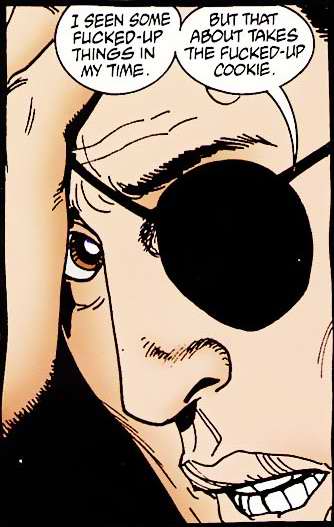
The basic plot is this: an angel and a demon come together and conceive a child; when the child is born it is immediately expelled from Heaven, and God vanishes from His throne. Genesis (the child) plummets to earth and is ‘united’ with Jesse Custer, a preacher (probably Episcopalian 😉 who was raised by some rabid and violent fundamentalists in the Deep South of the United States. You could say he has some problems with his faith… However, once Genesis is united with him, he gains the Word – the power to command people to do whatever he tells them. Through various adventures involving the Priory of Sion and his best friend, an Irish vampire, he ends up producing a confrontation between God and the Angel of Death. God, of course, isn’t the God that a ‘normal’ Christian would recognise – God is schizophrenic, in the popular sense, in that there is sometimes a raging Old Testament father figure full of righteous anger, and sometimes there is a radiant New Testament figure seemingly all sweetness and light. The end of the tale is the death of God – and the continuance of the world without Him, seemingly all the better for it.

Ennis grew up in Northern Ireland, not a place where balanced Christian thinking has been much in evidence, and there is clearly a kinship between the God in ‘Preacher’ and the attitudes of someone like Ian Paisley. I had hoped that there would be something theologically creative at the end – that was what kept me reading – along the lines of Genesis becoming a renewed God, essentially a retelling of the Christian story but in a modern idiom. Instead, Preacher is profoundly atheistic, and is in fact much more of a story about the importance of friendship than anything about theology. It remains deeply memorable, and the set-up I think is wonderful, but in the end there is little engagement with ‘mainstream’ Christianity – Christians within it are portrayed as either fundamentalist fascists or as idiots, and the ethics that are vindicated are those of the western, ie righteous violence.
Now, in the face of such a sustained and offensive criticism – how should a Christian react? Should a Christian shun any contact with such writing, with a view to avoiding ‘contamination’ from its blasphemy? My reading of Christianity, influenced from what I know of the work of René Girard, (partially mediated via James Alison) is rather the opposite, and that the degree of our ‘offense taking’ is the degree to which we remain to be converted to the gospel.

A key word in Girard’s analysis is skandalon (see the analysis here). It means the taking of offence, seeing something as shocking or blasphemous. As part of his anthropology, Girard argues that scandal is contagious and reproduces itself across a society, forming a major way in which a society polices its own customs. (In MoQ terms it is the most important social level pattern of value). The practices of societies are founded in sacred violence and scapegoating – in other words, societies reinforce their identity by choosing a person or group as the ‘cause’ of all their problems (think Jews in 1930’s Germany) and the society achieves a sense of unity by combining against that person or group, expelling them violently from their midst, and then telling a religious mythology justifying their actions. This practice persists over time, for the society is never able to completely eradicate tensions within itself, due to the maintenance of rivalrous desire, when one person wants what another person has.
Girard describes this contagion of scandal as the way of the world, and sees the Satan, the ‘lord of this world’ as that force which seeks to reproduce scandal, the taking of offence – for it is in the shared nature of the offence taking that the social solidarity is affirmed and reinforced. A society has a vested interest in ensuring the maintenance of scandal, for that is how the society itself is maintained. What such a society cannot accept is the continued existence of the source of scandal.
I believe this can be seen rather clearly in the case of the cartoons published by Jyllands-Posten. When they were first published, nobody in particular took offence – they were even reproduced by an Egyptian newspaper! Yet certain authorities have a vested interest in shoring up the unity of Islamic societies over against the West – the West being scapegoated as the source of the problems (internal tensions) experienced in Muslim countries. Thus it is Islamic sources which seek to generate a sense of scandal about the cartoons – to great success.
Christianity, however, begins with the scandal of the cross. That is, in the story of Jesus we have the unmasking of this process – a scapegoat who isn’t simply a victim, but one who is cognisant of this process and who forgives those who take part in it. In other words, a victim who does not take offence. This “non-taking of offence” is central to Jesus’ entire ministry – indeed, he is regularly criticised for eating with sinners and tax collectors, and memorably criticises the religious authorities saying that the prostitutes will get to heaven before them! Through not taking offence, through not seeing religious pieties as things to be defended, Jesus changes the social dynamics and enables a non-violent reconciliation with the excluded to take place. That is the essence of the Kingdom – an unmasking of this process of scandal, scapegoating and violence, in order that a new common life, not built upon these elements, can come into being.
Thus, for a Christian, it is wrong to take offence. To take offence is to play the devil’s games, to enter into antagonism between the ‘righteous’ and the ‘unrighteous’, the ‘sinner’ and the ‘saved’. In letting go of any sense of offence, one is released from the mythological pressures embedded in all stories of ‘them and us’, and is set free to become the sort of person that God originally intended – living in peace and loving the neighbour. This is what lies behind the striking language in Matthew’s gospel (5:29, where Jesus commands us to pluck out our eyes if it “causes us to sin” – language taken up by a great many moralists seeking violent self-harm, as it is, of course, to scapegoat a part of oneself). The original language used in Greek, however, is related to this word skandalon and the passage means ‘if your eye is scandalized, pluck it out’ – in other words, do not see offence.
This I find profoundly helpful, in terms of guiding my engagement and interest in the world. We are not to seek to preserve some sort of moral purity – that runs counter to Jesus’ own well documented practice. Nor are we to protest at being offended. If God does not take offence at the murder of his Son, how can we take offence at anything milder?
The lesson I take from Girard and ‘Preacher’ is that the Christian community must understand why it is seen in such negative terms, in order to move more completely into the Kingdom itself. Paradoxically, it is precisely because of this bias against ‘offence’ embedded in Christianity from the beginning that Western society has grown up with this remarkable notion of free speech and free enquiry, which is what is now at stake in the confrontation with the Islamists. It is the unmasking of the sociological processes of scapegoating and sacred violence by Jesus on the cross that fundamentally enables the fruits of Western society that we presently enjoy – including, not least of all, modern science. Girard puts it well: “The invention of science is not the reason that there are no longer witch-hunts, but the fact that there are no longer witch-hunts is the reason that science has been invented. The scientific spirit … is a by-product of the profound action of the Gospel text.”
Western civilisation is under threat and it is worth defending, but not by being offended by those who hate it, whether the Islamists, or delinquents like Andres Serrano:

A condensed thought or two about those cartoons.
One way of looking at the issue is to say it is about not causing offence – that whilst something may be permissible (legal) it is immoral, or rude. So Jack Straw: “I believe that the republication of these cartoons has been insulting, it has been insensitive, it has been disrespectful and it has been wrong.”
There is something in this. I can’t imagine a cartoon which is gratuitously rude towards Jesus being published in an Islamic newspaper (please point out the error if anyone has proof!) and I can see this as one aspect of a general (religious, ie both Muslim and Christian) view of Western society as decadent, barbaric and uncivilised – a large part of the critique developed by Sayyid Qutb with which I have some sympathy.
However, I don’t believe that that is the principal issue. For the cartoons are not being rude about Mohammed on the grounds of his followers being religious, or not quite. They are – so far as I understand – about the way in which his followers are prepared to murder in the cause of advancing their faith.
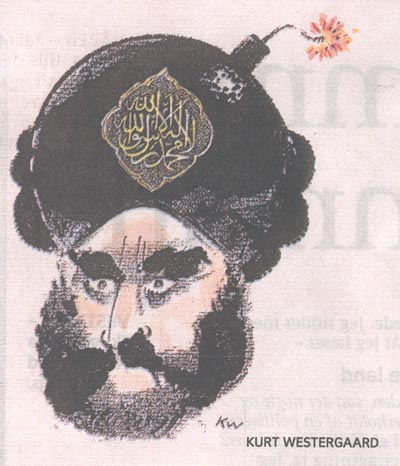
In this situation, where it is perceived that one party is intent on causing grievous harm to another, it seems rather beside the point to talk about rudeness – imagine a black man making fun of the Klu Klux Klan – why should we care if the Klansman gets upset???
The issue seems to me to be about two competing arguments. The one which the mainstream media buy into, because it accords with their secular presuppositions and political correctness is that of free speech vs religious respect. The other argument is about the possibility of co-existence between a militant Islamism and any other perspective, whether religious or not. It’s the latter which is more important. I’m doing a Learning Church session on Islam soon – that will be the suitable opportunity to clarify my wider thoughts.

This was fun, full of interesting information, but strangely unsatisfying as a book. Levitt is the economist who has become notorious for pointing out the statistical link between the legalisation of abortion in the United States, and the drop in crime twenty years later; a good example of the law of unintended consequences which is discussed in detail in the book. Having read Rudolph Giuliani’s autobiography, it was sobering to see the discussion of the drop in crime in New York, in the light of the drop across different cities in the US. The bigger drop in NYC was – according to Levitt – much more a consequence of the rise in police recruitment undertaken by Giuliani’s predecessor David Dinkins than anything which Giuliani himself developed.
The elements on crime were most interesting, especially the research undertaken by one academic ‘on the ground’ in a Chicago drug gang, the principal conclusion being that the organisation of the gang resembled less the Mafia and more McDonalds!
Unfortunately, given the various interesting snippets of information scattered throughout the book, the last chapter was underwhelming, being a discussion of the socio-economics of naming of children. This did have some interest, but compared to the foregoing discussions, not a great deal.