Two thoughts on Farage, racism and culture

So on the day that the Church Times quotes me as saying that ‘there are stupid people in every party’ it is somewhat disappointing, if not completely surprising, that Farage demonstrates the truth of my comments with regard to UKIP.

What concerns me is that there is a substantive issue being obscured by the sturm-and-drang of arguments about racism, and that substantive issue is about cultural difference and whether it matters. So here are two thoughts to throw in to the conversation.

1. Racism is intellectually and morally bankrupt. There is only one race, the human race. Even if there are, when averaged out, some statistically significant differences across the allegedly different ‘races’ (as is currently being alleged by this book) it is unarguable that the different races can make babies together. There are therefore no hard divisions between the races, and those ‘statistically significant differences’ become meaningless when looked at in the context of the human race as a whole. What matters are the particular gifts, virtues and vices that a single human being may possess, not what they may or may not share by virtue of being a member of a hypothetical class called ‘race’. NB some of the most racist thinking in contemporary life is actually displayed by those who claim to be most opposed, through things like ‘affirmative action’, but that’s another story. In other words I tend to the view that any language that refers to ‘race’ in anything other than the sense of ‘human race’ is confusion and obfuscation, a mask for power politics on each side of the divide.

2. We need to have a full, open and honest conversation about culture. This is where, in my view, the dominant left-wing narrative in our society is failing us badly, and where UKIP, despite their very obvious flaws, are gaining traction because they are the only people willing to address this very important question. To bring this home, and to bring out the contradiction in the dominant politically-correct understanding, I would simply ask – do we wish to live in a society that has a progressive understanding of gender? In other words, one where girls are educated and expected to be able to pursue their own choices with regard to their working and romantic lives? And by ‘girls’ I mean ‘girls born in the United Kingdom’? If we believe that this is indeed a desirable outcome, if we believe that this is indeed the culture within which we wish to live, then that will inescapably lead to a conflict with those alternative cultures and practices which are currently becoming embedded within this nation.

Of course, the question about girls is only one aspect of the larger conversation about who we are as a society, and whether what we are as a society is worth defending or not. I believe that the traditional British virtues of fairness, tolerance and equality before the law are indeed worth defending – and, moreover, that they are under threat from a confused approach to both immigration and contemporary law-enforcement. My concern is that if we don’t have the conversation in a healthy fashion, the legitimate fears of those who see an indigenous and progressive culture under threat will end up taking a much more toxic form. We need to regain a proper measure of national pride, and not be ashamed to seek to defend those things which need to be defended.

FrankenBibles and the Sandman’s Ruby

It is becoming clear that Protestantism is an historical phase which is coming to an end. What I mean by this is not a matter of ecclesiology but of culture, of relationships to texts and the written word, which was dominant in North-Western Europe for around five hundred years from the invention of the printing press to the invention of the cathode ray tube. Take, for example, the impact of ‘FrankenBibles‘ which is the term given to a translation of Scripture that is at least partly generated by a computer. With the development of sufficiently capable translation technology it is now possible to generate our own translations of particular texts, including Bibles as a whole. This development is likely to have huge effects upon the way that students in general, and Christians in particular, relate to their Holy Scriptures. Put simply, the resources that are now available on-line to any interested Bible student hugely outweigh the resources available to almost any student in the past, including many of the greatest theologians in history, the Luthers and Calvins and Aquinases. In just the same way that the translations of the Bible into local languages enabled more people to assess whether the local religious authorities were accurately teaching from Scripture, now the impact of technology means that anyone with an interest can very swiftly gain access to any and all translations and arguments about any particular verse from Scripture.

Given the way in which Protestant culture has geared itself around the importance of particular printed texts, most typically the King James version of the Bible, I do not think that it is possible to underestimate the cultural disruption that such a development will have. Rather than authority being placed in a particular text as such, authority will become placed in other bodies, whether a network of trusted friends, a pastor, a particular denomination and so on. In many ways this is part and parcel of the wider ‘post-modern’ shift in society, which has broken apart every text. I don’t believe that a Christian living in the contemporary world can ever have the same attitude to Scripture – indeed, to any text – as would have felt so natural as to be unobservable in the Modern era. Does this mean that Christianity has come to the end of its natural life? I don’t believe so.

Let me share a story from a graphic novel – that’s a ‘comic’ to most of us, but a comic that can bear an immense weight of literary analysis. The story is about a character known as the Sandman, and what happens to his ruby. The Sandman, also known as Morpheus or Dream, is one of the Endless – seven ‘beings’ or ‘anthropomorphic representations’ of aspects of creation. The story sequence begins with Dream being mistakenly captured by an Aleister Crowley type character, and the initial seven issues of the comic describe the immediate consequences of the capture – Dream’s escape and pursuit of the valuable objects taken from him – his helm, his ruby, and his pouch of sand. The ruby eventually ends up in the hands of a madman named Doctor Destiny, who uses it to perform diabolical acts, and then to fight Dream himself. Dr Destiny drains Dream of all his power, and then destroys the Ruby, thinking that in doing so he will destroy Dream. In fact the reverse happens – all of Dream’s power and identity that had been vested in the Ruby is returned to him, and he is ‘recalled to himself’, thence easily able to overcome Dr Destiny, and return him to Arkham Asylum.

What struck me on originally reading this story is that it is a parable for the church and the Bible. The Church is formed by the Holy Spirit descending at Pentecost; the community gathers for prayer and fellowship, the apostle’s teaching and the breaking of bread; it grows and strengthens around the world. Eventually it creates an object, a tool, which allows it to pursue its ministry – what we call the New Testament. That New Testament is then taken away from the living church community (which is the only place wherein it is able to be used properly) and diabolical consequences result. In particular, the Bible is taken into the academic community, and is used to make dark materials which are destructive of the church. The academic community has now, in effect, destroyed the Bible that it originally took from the church.

Yet it seems that what is now opening up is a possibility of the church being able to return to its divine origins, to allow the Bible to be what it always was – the principal tool of the church, not something of divine origin in and of itself – the Bible can return to what it is, and the church can return to what it was always intended to be: the Body of Christ in the world, a group of people trying to work out and accomplish all that Christ might accomplish, yes ‘and even greater things than these’.

Until Jesus returns and establishes his Kingdom, the final resting place for the interpretation of Scripture is, for me, the consensus fidelium – the considered and settled opinion of the faithful – and that settled opinion can itself develop over time, and change. It is expressed, most of all, through worship – lex orandi, lex credendi – this is why it must be rooted within the communion, when we sing our love songs to Jesus and renew our marriage vows. It is when we break the bread and renew the new covenant that we are authentically the church, that we are authentically the Body, and that we can authentically listen to His voice. It is when we are enabled to truly hear the word that we are enabled to interpret the word; and then to speak that word within the world. Scripture belongs to the church – it was formed by the church for the church, and it is for the church to interpret it, for good or ill.

Politics and the transcendent dimension

I want to make the argument that, not only do religious people have a right to engage in the political process but that, without religious people involved in politics, without the religious dimension being accepted as legitimate, the political process itself breaks down and inevitably corrupts. I want to make that argument by talking about ‘the transcendent’.

So what is ‘the transcendent’? Well, for my purposes here, I want to describe it simply as ‘that to which we are accountable’. In Christian terms, obviously, it is God, but the core understanding is in common across the different religious traditions. In all of them there is a sense that there is a higher authority than any person’s own particular judgement, and that the path of spiritual growth, of personal maturity, lies in learning to conform the individual will to that transcendence.

Where there is no such accountability – where there is no such sense of the transcendent – then there are no external brakes or restraints on the exercise of individual will. The political conversation devolves into a simple struggle for power, and whoever swings the biggest gun wins. This, it seems to me, accurately describes our existing political arrangements. We suffer from being governed by a class that, collectively, does not acknowledge any wider accountability. That is clearly not the case on an individual level – there are many religious people who exercise political authority – rather, it is a point about the cultural assumptions that dominate the political discourse as a whole. To bring this out dramatically, we only need to consider Alastair Campbell’s infamous ‘we don’t do God’ comment. We don’t do God; we don’t do the transcendent.

Why does there need to be such accountability? Surely I am not not arguing that those who accept the transcendent are somehow ‘better’ or ‘more virtuous’ than those who don’t? At an individual level, no. This is a red herring. Any one individual person may be more or less ethical and righteous, capable of acting honourably and without fear or favour. It is perfectly possible for the language of the transcendent to become empty, a way of disguising all sorts of internal horrors. Jesus said of the Pharisees that they were whitewashed tombs – the language of the transcendent was there, but the internal character that such language was supposed to reflect was markedly absent.

What I am wanting to focus on is the nature of the broader culture within which individuals operate. I believe that one sort of culture – one which acknowledges a role for the transcendent – allows for a different sort of political discourse, and a better sort, than one that does not. Take the decision to invade Iraq in 2003. People of good will can disagree on the merits of that particular decision, but was our dialogue helped or hindered by the absence of ‘doing God’? After all, the salient feature of our foreign policy environment since 9/11 is surely that we need to find a way to engage with and overcome those who ‘do God’ in a particularly virulent fashion. Is it possible to work out a way of engaging with Islamist terror without having a conversation about how and why such religious based terrorism is wrong? And can it be done without coming up with some alternative sense of the transcendent to set against that of the terrorists? I don’t believe so. After all, a specific part of the Islamist critique of our society, which they see as corrupt, soft and decadent, is precisely this loss of any sense of the transcendent, any sense that there is a higher authority than our own choices. They see this as a weakness, and they are emboldened by it.

What a sense of the transcendent allows for is the cultivation of a proper humility within our political culture, a sense that ‘we might be very wrong about this’. This is what seems to me to be most lacking. Our political culture seems to run on a tacit acceptance that the political contest is simply about different varieties of bureaucratic managerialism – a ‘we will run the business better than that lot’ sort of argument. So the political debates become ones about marginal efficiency, and the capacity to raise our long term growth rate by half a percentage point. The environment in which we now live – where there are existential questions for our nation to address, including the challenge of Islamist terrorism, the financial bankruptcy of our institutions, the exhaustion of natural resources – these are not challenges that can be met by managerialism!

Why is humility important? Humility is not self-abasement, it is not about being “ever so ‘umble”. It is about having a true recognition of our place in the world, of our own position and capacity – no more and no less. The language links with that of ‘humus’, that is, the earth. Those who are humble are earthed, they are well grounded in reality. In other words, those who are humble have, by definition, a more accurate understanding of the way that the world works. Blessed are the pure in heart, for they shall see God. They are, therefore, as a direct consequence, better able to make good decisions, decisions that are more likely to have the intended effect. Those who lack humility are those who are misled about their place in the world; they therefore have a distorted understanding of reality; and they therefore make decisions accordingly.

A political culture which lacks a sense of the transcendent, therefore, lacks this capacity for humility. It will inevitably over-reach itself. It will believe that it has a greater capacity for influencing events than is the truth, and this will lead to increasingly dire consequences. For examples of this, simply read our devilish press. The political actors within such a system do what is right in their own eyes, and the nihilist zombies lead the lemmings over the cliff. Yes, lots of mixed metaphors there, but I’m sure you get the gist.

TBLA (11): the nature of heterosexual attraction (ii)

I wasn’t planning to come back to this so quickly after the last post, but I obviously didn’t make myself clear….

My language of ‘fundamental building block’ and ‘fundamental basis’ was meant to convey that this is where heterosexual attraction *begins*. It was not intended to reduce heterosexual attraction to this.

When St Paul talks about ‘the flesh’ I take him to mean precisely this biological inheritance. It is what we share with the animal kingdom, or, possibly more precisely, it is the nature of our ‘lizard brain’. It is the most primitive part of our personality. It is also what is most stimulated (in the male) by visual cues, which provoke the dopamine hit leading to addictions.

I believe that human desire – that is, the desire of one human being as a human being, not simply as an animal – is irreducibly complex. It begins with the biological for that is the stuff of which we are made, but it grows and develops until – ideally – the whole of a person is involved. This is what I believe the Christian notion of ‘chastity’ properly consists in. Not a simple repression of the biological but an integration of the biological with all the other elements of the personality. It includes all sorts of labyrinthine details of memory association, context and habits, friendliness and charm – all the things that poets have written about for a long time. Here, also, is where I think we don’t need to talk about ‘heterosexual’ either (I only brought in that restriction to try and simplify that first post).

So: sexy babies. That’s where desire begins for a human being. It isn’t where it ends, it isn’t even it’s most glorious flourishing – but I’m getting ahead of myself in my argument there.

TBLA (10): the nature of heterosexual attraction (i)

motorcyclemen
Image taken from – and this post prompted by – this post at one of my favourite film sites.

I want to sketch out a simple understanding of the nature of heterosexual attraction, in order to explain why I disagree with the line of argument expressed in the picture. It is an understanding which has only developed in me recently, and is still a ‘work in progress’, but the main lines of it seem to me to be very plausible.

The starting idea is this: the fundamental building block for what counts as sexy in a member of the opposite sex is “whatever makes for healthy babies” (and I owe that formulation to Athol Kay, whose writings I recommend). However, what counts as ‘making healthy babies’ is different in men and women.

For men, any particular act of sexual intercourse is ‘cheap’. It requires very little investment of biological “currency”, ie time and resources. For men, therefore, the question of what will make for a healthy baby is first and foremost a question of fertility, and therefore whatever indicates fertility is seen as sexy.

For women, however, the situation is directly opposite. However brief an act of sexual intercourse might be, the consequence, at least potentially, is immensely costly in terms of time and resources. Whilst there is undoubtedly an element of purely physical attraction (ie a purely ‘biological’ assessment of health and fertility) there is also a significant social element. That is, one of the key markers that trigger attraction for a man is ‘social status’, which is a proxy for the ability to command resources – and therefore ensure that any child born has a better chance of being raised to a healthy age.

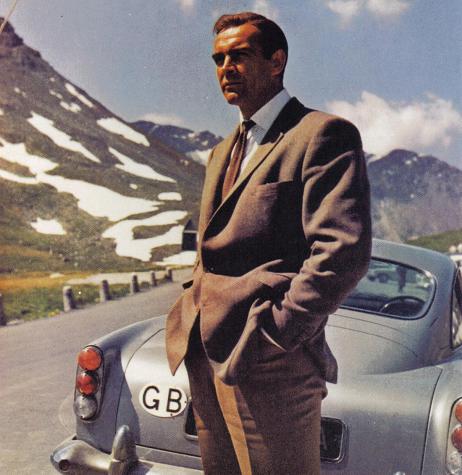
So having said all that, what is my disagreement with people like MaryAnn? Well, that motorbike image is not comparing like with like. It is comparing an image developed to appeal to the biological instincts of heterosexual men – in other words, an image of a woman emphasising all the cues of healthy fertility – with a pastiche. The picture of the man by the motorcycle is not an image designed to appeal to the biological instincts of heterosexual women. What would such an image look like? Well, how about this:

gb-sean-connery-as-james-bond

In other words, not just that here is a handsome man, but that here is a man with significant social status and dominance.

What the objections to such images seem to me to be based on is a repudiation of the fundamental basis of male heterosexual attraction. Perhaps this is a good thing. Perhaps male heterosexual attraction is so inherently destructive to the social order that it really does need to be corralled and controlled. In many ways, traditional Christian sexual ethics is about just that.

Yet if we are not to be irredeemably sexist about this, we need to also acknowledge the fundamental basis of female heterosexual attraction, and the possibility that an unrestrained female desire can be just as destructive as the equivalent in the male. In other words, if we are not to be completely prejudiced, we need to ensure that those things which might turn women on are kept as far from them as possible, in just the same way that those things which might turn men on must be kept away from them.

We would end up with, among other things, a ban on images and a rigid segregation of the sexes. Something, perhaps, that looked a lot like Saudi Arabia.

Alternatively, we could just become a lot more relaxed about both sides of the equation, accept that men respond sexually in the way that they do, women respond sexually in the way that they do, and delight in our differences.

Night of the nihilist zombies

One of the contemporary successes in popular culture is the TV series “The Walking Dead”, based upon the excellent graphic novel by Robert Kirkman. What is it that makes zombies so popular, across the age range? Generally considered to have taken their modern form under the influence of the film director George Romero, zombies can be found in all sorts of surprising places, from children’s games where they fight plants to serious works of academic theology (eg “The Gospel of the Living Dead” by Dr Kim Paffenroth).

I believe that popular culture functions as a mirror to contemporary behaviour. So, for example, the Frankenstein stories take off at the same time that scientific research starts to reveal immense power; the vampire stories, especially Dracula, are driven by the Victorian taboos about sexuality. So what are the zombies saying about us?

Well what are zombies? They are creatures who are superficially human – two arms, two legs, hands, eyes and so on. They also, classically, exhibit some similar behaviours, most famously shopping in Romero’s ‘Dawn of the Dead’. Yet this similarity is undercut by a monstrous hunger for eating normal human beings. In other words, zombies are consumers par excellence – and this, I believe, is the clue to what they mean.

For we live in a profoundly materialist culture. The one who dies with the most toys wins. We are encouraged by a vast advertising and marketing industry to think that the meaning of our lives can be displayed through our purchases, because we’re worth it. This materialist culture rests, of course, upon a materialist philosophy, the idea that we are ultimately nothing more than physical atoms bouncing off each other in random fashion. In other words, beneath our disordered culture of materialism lies a profound nihilism – a loss of meaning, a gaping hole in the fabric of our culture where the sacred used to be.

To my mind, therefore, the zombies represent nothing more than the foot-soldiers of nihilism, those for whom nothing matters, nothing has meaning. Of course, rather like zombies themselves, I’m not sure that a genuine nihilist has ever existed. We might hear rumours of fabulous creatures in far off islands, but in the mundane reality of our day to day existence, a genuine nihilist is as rare a creature as the fairies that dwell at the bottom of our gardens. After all, what would it take to be a real nihilist – to rigorously adhere to the notion that nothing has meaning? It would mean not simply that the big pictures that had previously provided meaning have to be discarded – so no Christianity or Buddhism or Stoicism or anything like that. No, all notions of better and worse need to be discarded, for those are quintessentially value judgements, and without meaning there is no value, and without value there is no meaning. A proper nihilist must be dedicated to the notion that there can be no discrimination between good and evil, and as a consequence, cannot be relied upon to serve anything which is good or resist anything which is evil.

What I find most sinister about the nihilist zombies is their unconscious innocence, the way that they function as useful idiots for the corporate machine. After all, the way in which the modern economy functions is by seeking to turn us into excellent consumers. Those patterns of resistance to consumerism all assert, even if only by a negative rebellion against the bad, a positive sense of what it means to be human, that there are elements of human life that cannot simply be reduced to a materialist analysis. Nihilist philosophies, however, are deployed as a type of universal solvent attacking the basis of resistance. There is a reason why capitalist culture does not like the local and particular – a reason why, for example, the EU wishes to standardise all the weights and measures across diverse peoples. It is because these local quirks and customs stand in the way of the great idol of material efficiency, and that is the only acceptable ground for behaviour within the corporate state.

Which is why the Walking Dead are such a powerful metaphor. Human beings live within a meaningful world in the same way that fish live within water, it is an essential element of our natures. Those who reject meaning are like fish proclaiming their independence of water (and doubtless the Darwinians will proclaim – but that is how evolution took place! See what wonderful things have come from fish who walked on land! Maybe so, but that is a meaningful claim not a nihilist one). I can’t help but see nihilism as an arrested stage of development; it is the teenage protest against the parent and their culture, a necessary first step in the establishment of a new personal identity, but one that rapidly becomes sterile unless further steps of genuine commitment are taken. So you are no longer simply the child of your parents? Excellent – what are you then?

Part of becoming an adult is the process of developing a code of behaviour to which we are committed, a code of behaviour which represents something larger than our own particular and temporary desires, something more creative than our base biological appetites. All the wisdom traditions of the world offer ways in which a person can pursue such a code and thereby become more truly themselves – that, after all, is what a wisdom tradition is. In our dealings with one another, what we most wish to find out about another person is what their guiding code might be, for that will tell us where and how we might be able to work together, where we might find a common purpose and meaning, where it is possible to establish trust. With a nihilist there is always a sense that at any point they might turn and seek to start turning you into their next meal – for what is there to stop them other than your own capacity to resist? There is no consciousness, and there is no conscience.

Nihilism is the code of the zombie, and we are living through the night of the living dead. How can we resist? How can we support the human against the undead plague? It’s all a metaphor of course – but metaphors are the way in which human beings share meaning. The nihilist will cry ‘It’s all meaningless’ and when we hear such cries we need to translate it to uncover the fundamental truth: ‘I am an undead servant of corporate capitalism! You will be assimilated!’

Aim for the head.

TBLA: reading list on sexuality and related issues

I’m planning to get back to my TBLA sequence as time permits – hopefully once a week on Fridays, as that is now my day off again! This post will be regularly updated – and where I identify gaps, I’d be grateful for pointers from the better-informed in the comments. Some of these are in my ‘to be read’ pile. Please note that I am trying to be comprehensive in my reading and studying on this, and do not assume that I agree with all that is described or linked to. In the nature of things, some of these are distinctly non-Christian. You have been warned.

Questions relating to homosexuality specifically
A question of Truth, Gareth Moore
Strangers and Friends, Michael Vasey
All of James Alison’s writings

Feminist writings
The Female Eunuch, Germaine Greer
Sexual Politics, Kate Millett

Alternative sexuality
Spiritual Polyamory, Mystic Life

‘Manosphere’ writings
Married Man Sex Life, Athol Kay

An evangelical perspective
Evangelical Feminism and Biblical Truth, Wayne Grudem

Secular philosophical aspects
The Sex Code, Francis Bennion
The Puzzle of Sex, Peter Vardy

Traditional philosophical/theological
The Bible
Aquinas

Anthropological
Sex at Dawn, Christopher Ryan and Cecilda Jetha
Sex at Dusk, Lynn Saxon
The Myth of Monogamy, David Barash and Judith Lipton
Strange Bedfellows, Barash and Lipton
The Sex Myth, Brooke Magnanti

Historical
Marriage: a history, Stephanie Coontz
Uncommon Arrangements, Katie Roiphe

Church of England
Some Issues in Human Sexuality
The Way Forward, ed: Bradshaw
An Acceptable Sacrifice?, ed: Dormor and Morris

Other theology
Touching the Face of God, Donna Mahoney
Sex God, Rob Bell
The Education of Desire, Tim Gorringe

Selected novels, films and other culture
Stranger in a Strange Land, Robert Heinlein
Fifty Shades of Grey, EL James
Diary of a London Call Girl, Belle de Jour
Shame, Steve McQueen

Interesting blogs
Dalrock
Sunshine Mary
The Free Northerner
Donal Graeme
Chateau Heartiste
Married Man Sex Life
The Rational Male
Women for Men

Privacy, Protestantism and Print Culture

The revelations about government snooping and spying on our lives raise the question of how far we are entitled to have a private life, which the state is forced to respect and which it cannot breach with impunity. I believe that privacy is a foundational freedom. What do I mean by that?

Let me quote from the European Declaration of Human Rights, Article 8, which comes in two parts. Part one states “Everyone has the right to respect for his private and family life, his home and his correspondence.” So, where this respect is denied – as, for example, when the government monitors all of our e-mail traffic – then our legitimate human rights have been undermined. Of course, the real meat of arguments about privacy come when different rights start to conflict with each other, and this is why there is a more substantial second part to Article 8, which states “There shall be no interference by a public authority with the exercise of this right except such as is in accordance with the law and is necessary in a democratic society in the interests of national security, public safety or the economic well-being of the country, for the prevention of disorder or crime, for the protection of health or morals, or for the protection of the rights and freedoms of others.” So, in terms of the Declaration, the right to privacy is balanced against the various needs which a state might have for preventing crime, terrorism and so on.

However, notice that the second part includes a clause about ‘morals’. In terms of the case law, it has been established that homosexuality, for example, is a protected freedom because the actions of two consenting adults in private do not have a sufficient impact upon the wider society as to justify a curtailment of their right to privacy. The question is how far the state’s legitimate concern in preventing terrorist acts justifies the establishment of a surveillance state.

Another relevant example relates to home schooling, that is, when a particular family decides to pursue the education of their children through means other than that provided by the state. This is, of course, the predominant mode of education throughout history, up until the last one hundred years or so, but in our present society it is customary for education to be provided centrally. In the United Kingdom it is legal for parents to choose to educate their children in their own homes, and this seems consistent with the fundamental right to a private family life that Article 8 enshrines. Yet in Germany such a choice is illegal, and the state actively breaks up the families which seek to pursue such an independent path. The grounds given for such action in Germany are that certain teachings are illegal – a legacy of Germany’s own twentieth century experience – yet that seems remarkably flimsy justification for the destruction of home and family life.

If we consider the nature of what it is that the state is wishing to monitor through the establishment of the various surveillance networks on the internet the key element for me is simply that it is about the monitoring of words. That is, all the activity that takes place on the internet is more or less intellectual – it is a forum for the sharing of ideas, of free speech, of open communication. That sharing may well include things which are inherently dangerous, such as the recipes for making certain sorts of bombs, but there are no actual bombs blown up in an e-mail.

For the state to justify the invasion of privacy that has taken place, therefore, it has to argue that the existence of certain sorts of words are sufficiently important, that they matter ‘extremely’. As a religious observer, I can’t help but think that this is a tremendously Protestant attitude. After all, it is in countries that have a predominantly Protestant culture that the written word is given such importance. It was through the understanding of words that salvation was found; Holy Writ was the vehicle for eternal life. In countries with a less Protestant emphasis there is a far greater concern with actual actions, not simply the discussion of actions. Words do not matter so much. It is not an accident, of course, that this new emphasis coincided with the introduction of new technology, a technology that gave the written word much greater prominence.

This, I believe, is the direction that our culture is travelling in, as it traverses our own post-Christian environment. I believe that in our own lives we are placing less emphasis upon particular words and far more upon how people’s choices and attitudes show in actual behaviour. It is less important what people believe, it is more important what they do. In our present case, too, new technology is having an impact, and the internet is allowing for a much greater exchange of ideas and – when it works – a fuller mutual understanding and acceptance of difference.

In this conflict between the state and the various whistleblowers, therefore, it seems to me that the state is trying to preserve a particular understanding of what matters, and it is sacrificing our privacy on a Protestant altar. In just the same way as Luther was able to use new technology to dismantle the power held by an oppressive and corrupt institution, so too are the Assanges and Snowdens using our contemporary new technology to expose the corruption at the heart of our own arrangements. The overmighty state is reaching in to our private lives – our family lives and correspondence – and not only does it have no no right to do so, it cannot hope to achieve the aims that it intends. Nobody expects the English Inquisition. It is acting from an obsolete script, and it cannot but fail. Let us hope that it doesn’t cause too much suffering in its death throes.

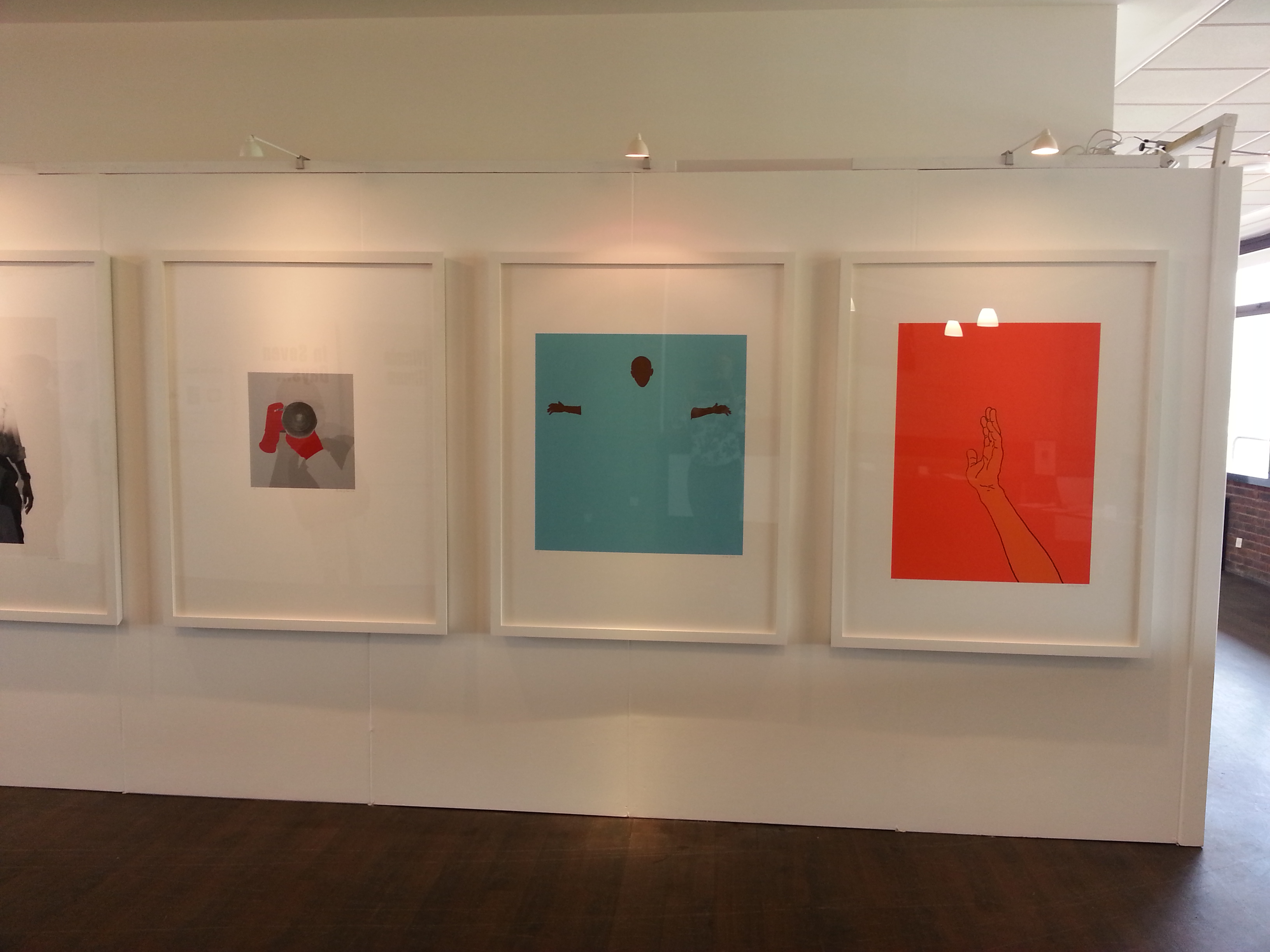
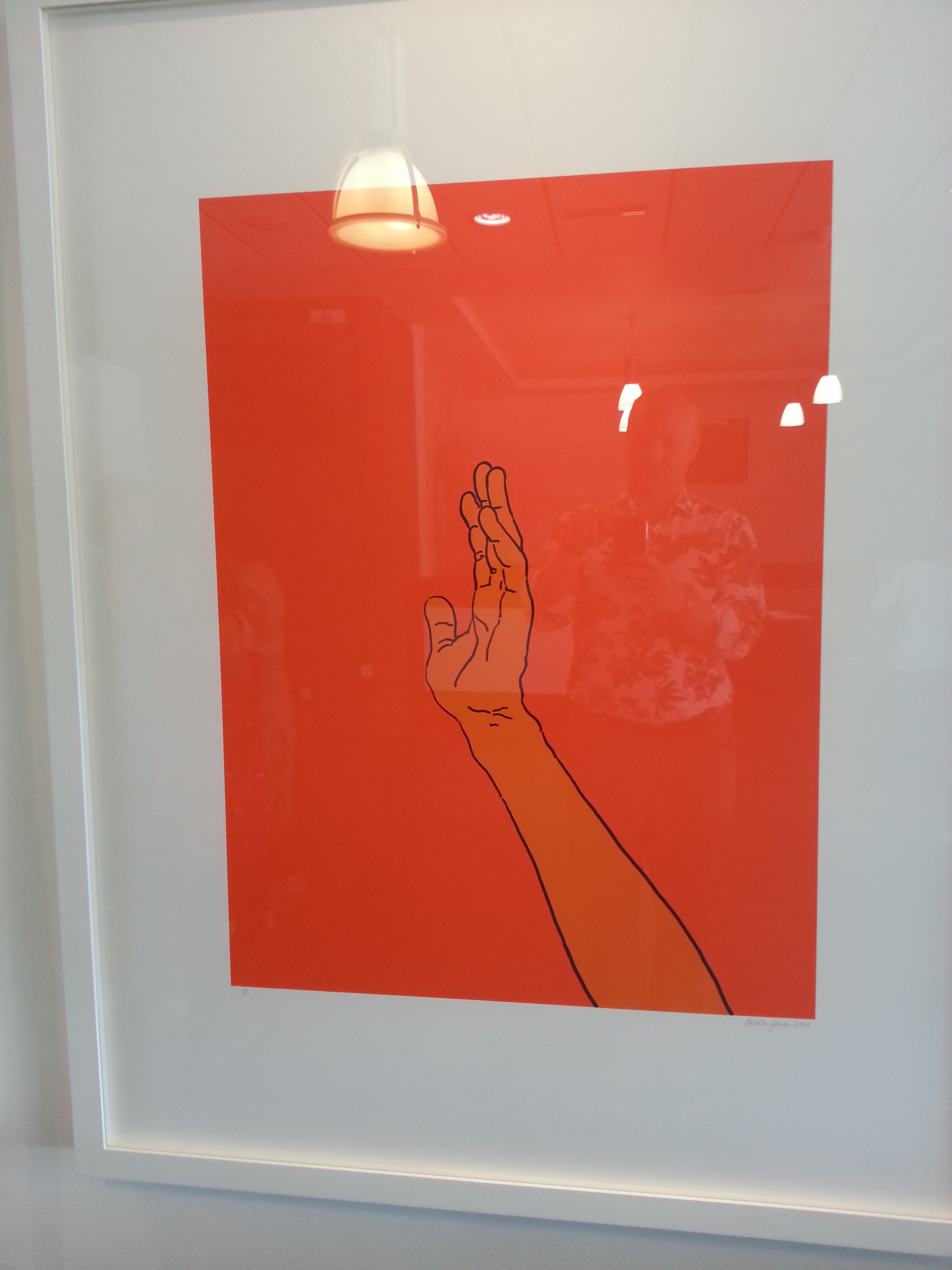
Nicola Green’s Obama sequence

Saw this at Greenbelt (on which there will be a longer post when I get a moment) but wanted to put up some pictures as a reminder. Could have contemplated these for hours…

2013-08-26 12.03.42

2013-08-26 12.05.43

Her site talking about the sequence is here. For the benefit of new readers, I should probably explain that I really don’t like Obama – and I feel thoroughly vindicated by the course of his administration, especially at the moment with regard to Syria. This remains a good summary of my views.

Who do we think we are?

Courier article.

Once upon a time, there was a gifted writer who told a story entitled ‘The Dream of a Thousand Cats’. In this story, we learn that in the deep history of time life on earth was remarkably different. Cats were the dominant species; humans were merely their playthings. The conceit of the story is that slowly, the humans began to talk and dream of a different world – a world where they would be free of the tyrannical oppression of the cats, where they would be in charge. One day, enough human beings dreamed the same dream – and when they woke, from the dream, they discovered that the world had been changed. It had become what we would recognise today – where humans are dominant and cats are merely pets. The story itself is told from the perspective of a cat who has learned the truth, and who has dedicated his life to telling all other cats the same tale. If only a thousand cats would dream the same dream, they could once more rule the planet! But of course, as soon as that criterion is mentioned, any cat-owner will see why humans are safe from feline revolution…

Our imaginations are vastly more powerful than the official narrative of our society leads us to accept. The imagination is good for children – all those fairy tales! And it’s good for entertainment – all those wonderful movies! But when it comes to the serious business of life, imagination just gets in the way. Those with imagination are seen as lacking in common sense, as being woolly-thinkers lacking a concrete connection to reality. Yet – ponder for a moment; look around you, wherever you are, and ask yourself what things that you see were not first conceived in the imagination of another human being? One obvious exception would be living creatures; another exception would be the sky – but what else? Every building, every street, every object in a house – all were first dreamed up by the imagination of one person or another.

The imagination is yet more powerful, for the simple reason that all of our understandings of the world resolve down to a level of story. Even the “hardest” of scientific facts take their place within a particular narrative – whether that be a narrative of the Big Bang or the narrative of evolution or something else. We are a story-making species, and it is the imagination that gives birth to the stories that structure our lives. The imagination determines the colour of the glasses that we wear, and through which we see the world. So it is not simply the objects in our world that are born in our imaginations, but the meaning that all those objects have, and the meaning of all our experiences besides. Put simply, the story that we tell about something or someone determines how that something or someone is understood – and therefore, what sort of activities and changes and lives might be possible.

This is why, in the Bible, the first and foremost task of the prophets – those people driven by the Spirit of God to engage directly with the political authorities of their time and place, from Moses to Jesus – was to engage people’s imaginations. This would often be done through something called ‘prophetic drama’, which was an acting out of a scene or a parable which engaged people’s imaginations. Jesus casting out the money-changers in the Temple is the most famous example, but there are many others. What the prophet first had to do was enable the people to dream; principally to dream that ‘it doesn’t have to be that way’. Always and in every case, it was the response of the political authorities to scorn such imagination, to repress and ridicule it, and, often, simply to terrorise and silence the dreamers. Yet, in just the same way that a ‘war on terror’ can never be won – for how is it possible to make war upon an abstract noun? So too is it impossible to eradicate a dream, once it has got into the bloodstream of a society.

This is what I believe we as a nation and a society have to talk about in the context of a referendum about our EU membership. What sort of a people are we? What is our dream of who we are? A previously dominant dream was one of Empire, but what is to take its place? Who are we? I can’t help but feel it was a reaction to loss of Empire – to the breaking of a dream – that led to a loss of national self-confidence, and which in turn led to our engagement in the structures of European Union. It was if the guiding story was – we are a fading nation, we are not strong enough to make our own way in the world any more, let us join in with our neighbours and seek safety and prosperity through their strength. That particular story – a story perhaps most closely associated with the anarchic 1970s – is not one that holds true for us any more. My own sense is that our ‘national story’ is much more effectively told through something like the wonderful 2012 olympic ceremony – we are not the Imperial people that we used to be but, actually, it’s good to be British.

I believe that this sort of story-examination applies on an individual basis too – we literally become who we imagine ourselves to be (obviously, there is such a thing as delusion; that’s not what I’m referring to). In other words, if we imagine ourselves as not worthy, we actually become less worthy – we defeat ourselves before we have ever stepped into the arena. This is the realm of faith – this is the realm of what Christians call ‘spiritual warfare’, which is the struggle between the voice that says we are weak and worthless and wicked, and the voice which much more quietly and more persistently says ‘you are loved’. It is when we allow that latter voice to dominate the story that we tell ourselves about who we are that we are enabled to work creatively and imaginatively to heal and restore our broken world.