
 Picture stolen shamelessly from Sven.
Category Archives: politics
Continuing to wrestle with violence
Exhuming that Iraq post was revealing, in terms of how far my political perspective (on the Bush administration in particular) has shifted, and how much closer I am to embracing non-violence completely. Yet there is something that prevents me from going the whole hog – and in fact there is a part of me which has started to become suspicious that ‘non-violence’ is an idol. Here are some more or less connected thoughts, which represent a snapshot. The last paragraph is probably the most important.
A sincere embrace of the just war perspective would practically differ from a pacifist perspective in only a very small minority of cases. Most wars are unjust and unjustifiable.
Tim sent me an interesting link – here – which contains an interesting argument: “A second confusion in this argument is the notion that taking part in war shall be regarded as a lesser evil, rendered necessary by extreme circumstances. Such a claim has no part in traditional just-war theory—or, indeed, in any coherent moral theory.” This is exactly my perspective. It may well be true (though I doubt it) that it has no part in traditional just-war theory, but to engage in the discussion on those grounds would rapidly become academic and abstract. The intriguing question, for me, is whether it is true that this perspective has no place ‘in any coherent moral theory’ – because this I think is quite true, and it underlies why I chose the Bonhoeffer quotation this morning: “The knowledge of good and evil seems to be the aim of all ethical reflection. The first task of Christian ethics is to invalidate this knowledge.” This, I think, puts the finger precisely on the difference between a Christian perspective and a more conventional philosophical/ moral position. We live by grace.
Hauerwas’s argument (in The Peaceable Kingdom) about interrogating our imaginative examples is a strong one, but he doesn’t actually deal with the examples themselves – and the examples themselves are not abstract, but are real. So for the time being, I remain of the view that there are situations where I would resort to violence. This is an admission of sin, but I can’t see any way around it. Where things get awkward is when this perspective is shifted to a wider context, ie national or cultural. I remain of the view that Islamo-fascism is a radical evil, and one which if left unchecked will cause a tremendous pestilence to descend upon the world.
Yet is this just a question of lack of faith? That’s the issue that repeatedly nags at me. If I really believed in the overcoming of the world, I would not presume to judge the outcomes of decisions that might be made – I would simply obey the divine commands. For example, in pragmatic terms, I think that the Islamo-fascists have enough truth in their arguments to be heard sympathetically by most Muslims; I think that the Western world is sufficiently weak in material and spiritual terms that the eventual ‘victory’ of the West is not assured [[I’m a long term optimist there – I think the West will bounce back – but I think we have a darkness to work through first – and I don’t think we will be able to bounce back without addressing our cultural blind spot with regard to our Christian inheritance, in other words, without something like a revival]]; so it is not by any means implausible to me that the gospel could be eclipsed in the world; that the Bible could become a demonised text, that, over time, within a world-wide caliphate, the New Testament becomes something forgotten. Now I don’t believe that God will ever leave himself without witnesses, and I think Shia theology in particular has resonances that cross over into Christianity, so whether the Word becomes silent, that I don’t believe. But how far is the Incarnation repeatable? And does it threaten the church’s understanding of itself if it allows itself to die?
And what is the cost? Even if I was convinced of the long term triumph of the gospel against all odds (and I do believe in the long term triumph of the gospel in the hearts of all people) – does it really make sense to acquiesce to the fascists? And if we embrace a non-violent resistance against them, what does this mean when the fascists also embrace non-violent processes (eg democracy) to introduce something abhorrent (eg Sharia law)? Rowan Williams is fond of asking the question – and I think it is an extremely good one – “Who pays the price?” Is it legitimate, by my actions, to expect others (eg children) to pay the price? Or is there something here worth defending with dirty hands?
I am also starting to harbour a suspicion about non-violence, about whether it can itself take an idolatrous position within a theology. The Scriptures are violent texts; Jesus himself is angry and acts in ways that can be considered violent (Temple cleansing, obviously, but also violent speech acts); most of all, the violence of the world exhibited in the crucifixion is incapable of preventing God’s plans being accomplished. I do not doubt that violence is inherenty and inevitably sinful. My dispute is about whether it is always the MOST sinful option available.
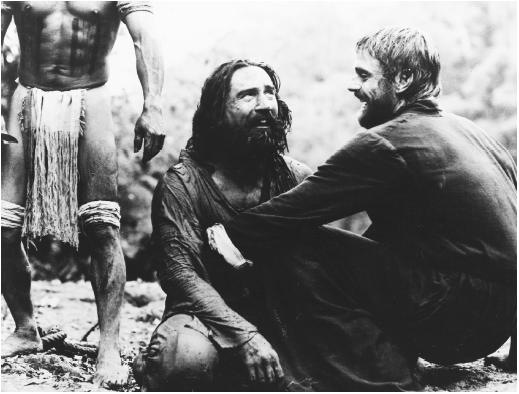
I am thinking an awful lot about two films. One is the Passion of the Christ, which haunts me, and was responsible for a significant shift in my attitudes. Watching Jesus exhibit non-violence was intimidating and inspirational. The second is the Mission, full of wonderful filmic imagery, and which throws up the fundamental choice at the end. Do you walk with Jeremy Irons behind the monstrance, or do you pick up your musket with Robert De Niro? I’ve always thought I’d be with De Niro (partly because my character is much more like the one he portrays in that film) but I am perennially disturbed by a sense that Irons is the one who shows faith. Yet the outcome of his faith is that the villagers are slaughtered.
There is a different way, I am sure. Not bound by pre-existing categories, into which we must fit our moral instincts. We can only ask ‘Lord, what is your will for me here and now?’ – and then seek to follow it, leaving any judgement as to merit in His hands alone.
Head-in-the-Sand Liberals
This was rather lucid, I thought. Yet it raises the whole question of what the appropriate Christian response would be (as opposed to conservative or liberal, and both sides have their head in the sand in different ways). Tim has been thinking about this recently, and I realise that I have never put up on my blog my analysis before the Iraq invasion, which is still – with a wealth of caveats – my basic understanding. Perhaps I’ll put that up next.
The Mein Kampf of Islamism
Guardian Unlimited | Special reports | The age of horrorism (part one)
Good article by Martin Amis, looking at many things, but Sayyid Qutb in particular.
The World in 2031
Hmm. Go read this (go quick, it’ll be behind a paywall in the next 24 hours).
The sort of idle prognostications that I enjoy. Only one analyst talked about the energy crisis, and there clearly without a full appreciation of the implications. None of them talked about global warming.
I think by 2031 we will be in a radically different world. We’ll either have sorted out the energy issues, powered down, and be on a sustainable path – or we won’t, in which case we can expect increasing disorder, and probably an Islamic worldwide caliphate.
More likely, I think there will be several interlinked crises; nuclear war in the middle east (probably the end of Israel); a return to a multipolar world; hugely increased localism and regionalism; a drop of population (10% maybe); a lot of nervousness; a lot of human migration. Yet for the survivors, something positive to hope for.
And who will have won?
She dreams of nineteen sixty-nine
Before the soldiers came
The life was cheap on bread and wine
And sharing meant no shame
She is awakened by the screams
Of rockets flying from nearby
And scared she clings onto her dreams
To beat the fear that she might die
And who will have won
When the soldiers have gone
From the lebanon
The lebanon
Before he leaves the camp he stops
He scans the world outside
And where there used to be some shops
Is where the snipers sometimes hide
He left his home the week before
He thought hed be like the police
But now he finds he is at war
Werent we supposed to keep the peace
And who will have won
When the soldiers have gone
From the lebanon
The lebanon
The lebanon
From the lebanon
I must be dreaming
It cant be true
I must be dreaming
It cant be true
And who will have won
When the soldiers have gone?
From the lebanon
The lebanon
The lebanon
From the lebanon
(The Human League)
One of my favourite songs from my teenage years – I even still possess the 12″ version. Sadly still appropriate. I’m listening to it a lot.
Hezbollah and Apartheid
Steve left a comment on my earlier ‘judgement’ post, which is worth reading. I’d like to pick up on one aspect of it though, which is the comparison of Hezbollah to the Apartheid regime in South Africa:
“Was Hizbollah really “irrevocably” committed to the destruction of Israel? Such a commitment will no doubt be strengthened as a result of the events of the last three weeks. But it was not necessarily “irrevocable”. The Nationalist Party in South Africa had an irrevocable commitment to apartheid, but in the end they abandoned it.”
I’m happy to accept – in principle – that a view which is held to be ‘irrevocable’ can in fact be changed. I’m particularly happy to accept that it can be changed in the context of a religious faith (either Christianity or Islam) as I see one of the tenets of both faiths as being a ban on idolatry – and any perspective which we render ‘irrevocable’ is prone to turn into an idol. However, that being said, I think the differences are more important than the resemblances.
The apartheid regime gave up on its ‘irrevocable’ commitment to a racist polity for certain very specific reasons (this is not an exhaustive list, it’s just what comes to mind – and I’m not particularly well informed about South Africa):
– a rejection of slavery (and the associated theology) by the broader mass of Christian thinkers;
– an explicit repudiation of the racist polity by the ‘peers’ of the white establishment, as expressed through both trade sanctions and sports sanctions;
– a slow realisation that maintenance of the status quo was untenable in the long run;
– the existence of both extreme and more moderate opposition to the racist polity, and, in the person of Nelson Mandela there was ‘someone to do business with’.
In other words, there were a lot of preconditions in place allowing the regime to change.
The situation with Hezbollah seems to me very different:
– Hezbollah is drawing upon a form of language and mode of behaviour with deep roots in Islamic theology, history and practice;
– rather than being rejected, that language and behaviour is endorsed by the wider Islamic community (more or less explicitly);
– it is particularly endorsed – and materially supported – by a major regional power (Iran), which is itself aggressively pursuing the same agenda;
– there is a significant amount of truth in the critique which Hezbollah etc offers against the Western way of life (of which Israel is seen as an instance), which reinforces their sense of the rightness of their cause; and
– Hezbollah sees itself – not unreasonably – as being on the long-run winning side, not the losing side.
So when Hezbollah states, for example, that “It is an open war until the elimination of Israel and until the death of the last Jew on earth” it seems reasonable (to me) that Israel should take it as a reflection of their operating perspective for the foreseeable future. If there is a reform movement in Islam, which explicitly repudiates this ideology (and therefore accepts the long-term right of Israel to exist, not seeing it as Dar al’Harb eternally) – then I think Israel would have grounds for changing its perspective.
This does not make their actions (eg in Qana) ‘right’ – it is wrong to kill civilians – but I still maintain that there is a vital difference between wickedness carried out from fear (or error) and wickedness which is in the service of hate.
I will pronounce my judgements upon my people
I remember reading a particular Fantastic Four story when I was younger. The Fabulous Foursome have been trapped by the enemy (can’t remember who – probably Doc Doom) inside a force field, a bubble. The Thing hurls himself against it, and just bounces back – the field reflects the force used against it. Reed and Sue Storm are helpless – Johnny is in an even worse situation because if he flames on then all the oxygen within the bubble will get used up and they’ll all die. Then Reed figures that there must be a ‘threshold’ level at which the field is activated. So then Ben starts tapping the field ever so gently, and slowly he forms a ‘gap’ in the field, through which they escape.
This story is on my mind at the moment, because it is about the futility of force in certain circumstances – and Israel is in precisely such a circumstance at the moment, and cannot win by main force (see here). Worse, it is inevitably morally compromised, and the bombing of Qana is terrible in every respect. (I would want to maintain a difference between terrible things done from fear and terrible things done from hate – and exulting in the terror – but such words seem more than usually vacuous in this context).
The thing is, Israel sees itself as in significant danger; it takes Hezbollah at its word in believing it to pose an existential threat to Israel’s continued existence – rationally so, in my view; and it is resorting to the methods which have served it well in the past, ie main force. Yet they cannot win in this way. So either they are forced to accept a ceasefire, which doesn’t disarm Hezbollah – which will hand Hezbollah a huge moral and propaganda victory, merely postponing a continuing conflict – or else they will be forced escalate the conflict, to start addressing some of the logistical roots – possibly even the spiritual roots? In other words, Israel is now in a corner. If it backs down, it is handing power to enemies who are irrevocably committed to the destruction of Israel – I can’t see that happening. Yet if it continues fighting in the way it has been, it will destroy any remaining moral capital it possesses, without any significant benefit on the ground. Israel cannot win this fight with Hezbollah. This would eventually mean an Israeli defeat, ie withdrawal and cessation of attacks, but for one thing – the support of Israel from the United States (and UK etc). This gives Israel strength and a longer time frame within which to work.
Thus we should expect an escalation – presumably an attack by Israel upon Syria, which would be justified by Israel on the basis of logistical support for Hezbollah being channelled through that country. At which point, the implicit war between Israel and Iran becomes explicit. First steps in World War Three? See here, here and here for my previous thoughts on the subject. August 22nd seems to be looming as the key date – see here.
IF – and it remains IF – TSHTF then we can expect a quite rapid collapse of our usual patterns of life. This is precisely why such a consequence will be taken as evidence for divine favour on the Islamists (see this and follow the link) because God has never been content with our injustice, and he _will_ bring it down.
Given this, I wonder about Bush and Blair. I was recently mulling over with our confirmation class the phenomenon of God hardening the heart of Pharaoh, something which is consistent in the Old Testament (consider 1 Sam 2.25: “His sons did not listen to their father’s rebuke, for it was the Lord’s will to put them to death.”) I remain persuaded that the removal of Saddam Hussein from power was a right and necessary act (however many qualms and criticisms I could make of timing and tactics). Yet it seems to me that the West is walking nonchalantly towards a cliff edge, unaware of how things are about to change.
Inshallah.
Some good articles about Israel/Lebanon…
Now this is truly scary (the second half, of course)
David Peebles Williamson: “This system channels power of an almost unprecedented scale into a single human being. The Prime Minister can launch nuclear weapons and name the head of the worldwide Anglican Communion.”