SUV spirituality

Consider the appeal of an SUV (what we in England call ‘4X4’s or, more to the point, ‘Chelsea Tractors’).

You are strong. You are safe. You are independent and self-sufficient, accountable to no-one. If there is a collision, the other car will come off worst. You are elevated above the common herd, able to look further into the distance. You can trek across exotic locations, you can even cross the Strood when the tide is high.

The appeal of an SUV is to a particular mentality – a mentality which owes just about everything to Modern philosophy. It is the Cartesian ego transformed by the parameters of the internal combustion engine. Iris Murdoch describes it as presented by Kant:

“How recognisable, how familiar to us, is the man so beautifully portrayed in the Grundlegung, who confronted even with Christ turns away to consider the judgement of his own conscience and to hear the voice of his own reason. Stripped of the exiguous metaphysical background which Kant was prepared to allow him, this man is with us still, free, independent, lonely, powerful, rational, responsible, brave, the hero of so many novels and books of moral philosophy.” (From ‘The Sovereignty of the Good’)

This man drives an SUV, for the SUV expresses all those virtues in kinematic form. The culture which reveres these attributes calls forth in mechanical expression an embodiment of it’s own soul – and so we arrive at the crisis of our culture. We are, in James Howard Kunstler’s words, up a cul-de-sac in a cement SUV with an empty tank.

This is a spiritual problem: the roots of the crisis are spritual; the only possible solution is spiritual. Consider those virtues expressed in the SUV; consider most of all the virtue of autonomy – the independent man, accountable to none, moving off to decide by the light of his own conscience and his own reason what is good. The child of Martin Luther permanently protesting against external authority.

Now consider the voice of a Modern atheist: I do not need an external authority to tell me be to be good. I do not need to find a purpose for my life from a religious tradition. I choose my own tradition! I am the master of my destiny!
I SHALL DRIVE MY OWN SPIRITUAL UTILITY VEHICLE!

The point of a religious tradition – the definition of one perhaps – is that we are accountable to a higher authority. That authority need not be a God as understood by theistic tradition. It might simply be ‘the truth’, or – as with Plato and Aristotle – ‘the good’. The key thing is that it is not amenable to personal choice. A person is accountable, and shall give an account. The person is open to being engaged by other people who also consider themselves accountable, and that shared accountability and shared purpose provides the irreplaceable glue of human society. It is precisely that communal glue which the driver of the SUV repudiates. For the driver of the SUV must at all costs be a sovereign ego at the centre of his body – the homunculus this time, not watching a screen, but behind the wheel.

The SUV – sport and spiritual, car and soul – symbolises all that will be left behind on the other side of Peak Oil.

Bob puts it well:

You may be a construction worker working on a home,
You may be living in a mansion or you might live in a dome,
You might own guns and you might even own tanks,
You might be somebody’s landlord, you might even own banks

But you’re gonna have to serve somebody, yes indeed
You’re gonna have to serve somebody,
Well, it may be the devil or it may be the Lord
But you’re gonna have to serve somebody.

Misplacing the Apocalypse

Have a (brief) look at this site. It’s a very interesting perspective, and the main point can be simply stated: the earth can only support around 1.5 billion people sustainably; the rest are being sustained by easy access to fossil fuels (something like ten calories of fossil fuels for each calorie consumed). Thus, when the fossil fuels run out (soon) most people will die; more or less swiftly, more or less horribly.

Those who buy into this perspective are called ‘doomers’, and it seems to me that a theological perspective has something to say about the subject. For what I think we have is a use of apocalyptic language (“the world is going to end!”) abstracted away from a context in which it makes coherent sense. In other words, the foundation of the ‘doomer’ perspective is implicitly theological – and as such is open to theological critique.

Consider what Tom Wright says on apocalyptic language (from New Testament and the People of God) “Within the mainline Jewish writings of this period, covering a wide range of styles, genres, political persuasions and theological perspectives, there is virtually no evidence that Jews were expecting the end of the space-time universe. There is abundant evidence that they knew a good metaphor when they saw one, and used cosmic imagery to bring out the full theological significance of cataclysmic socio-political events. There is almost nothing to suggest that they followed the Stoics into the belief that the world itself would come to an end; and there is almost everything to suggest that they did not.”

In other words the primary use of apocalyptic language is as a critique of the political and economic status quo, and to express a longing, and expectation, that God’s judgement upon that status quo was coming. Apocalypse was the genre adopted by the downtrodden, those who were most victimised in the present arrangements – for obviously, if you benefited from the present arrangements you wouldn’t want to see them destroyed – and God’s judgement would ‘cast down the mighty from their thrones… and scatter the proud in the imagination of their hearts’. So apocalypse is driven by, at root, a righteous indignation and hatred of an existing political or social arrangement, and a longing and expectation that God will act to re-establish justice, ie the Kingdom of God.

It seems plausible to me that the ‘doomers’ share a hatred of the present system, yet it also seems plausible to me that their position cannot be reconciled with Christianity. “So what!” might be their response “who cares what theology has to say about this – theology is a useless waste of space!” – but hang on.

To accept the ‘doomer’ framework, is to assert that there is no way out from the present crisis – and that is to go beyond what the evidence as a whole supports. The evidence is clear that there is a major problem, but to assert that, eg, civilisation will come to an abrupt end is to move from the realm of demonstrable fact (imminent absence of resources on which we presently rely) to a contestable conjecture (there is nothing that we can do to mitigate the situation). At root, then, the ‘doomer’ perspective is a denial of hope, and a denial of the possibility of redemption. It is a theological perspective, not a scientific one.

Now it may well be the truth – it’s certainly possible that human civilisation is about to press the reset button and send us back to a Hobbesian state of nature. Yet it is equally possible that what we face is, eg, a cross between the black death and the 1930s, and that, just as in those situations (bad as they were) human society negotiates the passage more or less successfully, and we continue to move forward as a species and as a civilisation.

My point is simply that we cannot know what the future holds – despite all the suggestive parallels with Easter Island – because it hasn’t happened yet. So I repeat my point – those who have a convinced ‘doomer’ perspective are making a theological assertion, not a scientific one.

Now as a theological assertion, it is open to theological critique. The heart of the assertion is the denial of hope, and therefore of meaning, and it is therefore an embrace of nihilism, the notion that nothing matters (for if we are all going to die what is the point?). Hope is absolutely central to a Christian perspective – the insistence that God is acting within the world for our redemption, and that Christ came not to condemn the world but to save it. That there is no place to which we might fall which is beyond the reach of God’s creative Act – and therefore, no situation is as bleak as a nihilist might paint it. There is always point to what we do.

“If you knew that the world was going to end tomorrow, what would you do?”

“I would plant a tree.”

The Old Testament prophets cannot be bettered in their denunciation of a corrupt status quo. Listen to Hosea:

“Hear the Word of the Lord, O people of Israel;
for the Lord has a controversy with the inhabitants of the land.
There is no faithfulness or kindness,
and no knowledge of God in the land.
There is swearing, lying, killing, stealing, and committing adultery;
they break all bounds and murder follows murder.
Therefore the land mourns, and all who dwell in it languish,
and also the beasts of the field, and the birds of the air;
and even the fish of the sea are taken away.”

Or listen to Ezekiel:

“Therefore this is what the Sovereign LORD says: You have been more unruly than the nations around you and have not followed my decrees or kept my laws. You have not even conformed to the standards of the nations around you. Therefore this is what the Sovereign LORD says: I myself am against you, Jerusalem, and I will inflict punishment on you in the sight of the nations. Because of all your detestable idols, I will do to you what I have never done before and will never do again. Therefore in your midst fathers will eat their children, and children will eat their fathers. I will inflict punishment on you and will scatter all your survivors to the winds. Therefore as surely as I live, declares the Sovereign LORD, because you have defiled my sanctuary with all your vile images and detestable practices, I myself will withdraw my favor; I will not look on you with pity or spare you. A third of your people will die of the plague or perish by famine inside you; a third will fall by the sword outside your walls; and a third I will scatter to the winds and pursue with drawn sword.”

I trust that the resemblance between this language and the language and expectations of the ‘doomers’ is clear. Yet always with the OT prophets there is the promise of restoration, of a new heaven and a new earth. That is what the ‘doomers’ miss. As with Isaiah:

“A shoot will come up from the stump of Jesse;
from his roots a Branch will bear fruit.
The Spirit of the LORD will rest on him—
the Spirit of wisdom and of understanding,
the Spirit of counsel and of power,
the Spirit of knowledge and of the fear of the LORD –
and he will delight in the fear of the LORD.
He will not judge by what he sees with his eyes,
or decide by what he hears with his ears;
but with righteousness he will judge the needy,
with justice he will give decisions for the poor of the earth.
He will strike the earth with the rod of his mouth;
with the breath of his lips he will slay the wicked.
Righteousness will be his belt
and faithfulness the sash around his waist.
The wolf will live with the lamb,
the leopard will lie down with the goat,
the calf and the lion and the yearling together;
and a little child will lead them.
The cow will feed with the bear,
their young will lie down together,
and the lion will eat straw like the ox.
The infant will play near the hole of the cobra,
and the young child put his hand into the viper’s nest.
They will neither harm nor destroy
on all my holy mountain,
for the earth will be full of the knowledge of the LORD
as the waters cover the sea.”

It is a question of balance, and honesty. Balance in that the vision of apocalypse always offered a vision of hope for the faithful remnant, who would endure the tribulation and be brought back to a faithful and fulfilling life on the far side of the crisis. Honesty, more crucially, in that it requires an awareness of the limits to our knowledge, and therefore a consequent awareness of how far a more or less conscious perspective on the divine determines the interpretation of such evidence.

There is always hope; there are always things that we can do in the face of disaster; and at the heart of it all is the call to do justice, to love kindness, and to walk humbly before our God. It is the absence of those virtues that has led us to the brink of disaster; it is the restoration of those virtues that will guide our people through the coming forty years in the desert.

So I say with the prophets:

Come let us return to the Lord; for He has torn us, and He will heal us.
US/UK separation

…is something I worry about – and then wonder whether it is worth ‘worrying’ about at all. But I came across this article about the breakdown of defence co-operation between the two sides and I wonder where things are headed.

The last forty years or so have seen an undoubted strengthening of the ties between the UK and mainland Europe, and, at least at a popular level (eg dance music) a recognition of what is held in common amongst Europeans vis a vis the United States. Yet it could hardly be said that US influence on the UK has been light!

I just wonder how far the coming great dislocation is going to embed the UK firmly within Europe (not necessarily the EU), and start it on a separate path to the US, and maybe even the rest of the Anglosphere – a perspective with which I have much sympathy.

Ho hum. Pointless musing redux.

From Barfield Road to Bradwell (taking in Burgan oilfield en route)

Tesco want to build a ‘Tesco Express’ store at 1 Barfield Road. On the face of it this doesn’t seem too terrible. Let the competition commence! If Tesco can provide cheaper food to the residents of Mersea – and the residents of Mersea prefer that cheaper food to what the other local stores can provide, then so be it. It’s merely reflecting what the people want, isn’t it?

Well, there are certain assumptions embedded in that line of argument, and in this article I would like to tease out what I think is the most important, and why allowing Tesco to set up shop in Barfield Road would be a remarkably short-sighted and damaging decision. The story takes me via Burgan oilfield, in Kuwait.

Burgan is the second largest oilfield in the world. Two months ago the Kuwaiti authorities announced that it had passed ‘peak’ – in other words, the rate of extraction from the field had reached its limit, and would now go into decline.

This is what happens with an oilfield. When the field is discovered, the oil flows easily. Extraction builds up to a ‘peak’, and it then declines – the oil becoming harder and harder to extract – until the field is exhausted. This also applies to the amount of oil available on a world-wide scale – it will be extracted easily to begin with; it will build to a ‘peak’; and then it will decline.

But isn’t there lots of oil left? No. There isn’t as much oil as we have been told, and the issue isn’t about running out of oil so much as the consequences of a decline in production.

Official figures tell us that there is plenty of oil left in the ground, particularly the ground in the Middle East. This is based upon the published ‘reserves’ allocated to, in particular, Saudi Arabia. But those reserves are fraudulent. Imagine you had a bank account which had a £1000 in it in 1990. Since then you’ve been spending £100 a year from that account – and now, when you go to the cash machine to find out how much money you have left, you discover that there is still the very same £1000 in it that you started with. That is what the ministers of OPEC would like us to believe is the case with the ‘bank account’ of their oil reserves.

The powers that be, however, have started to realise that something is wrong. Matthew Simmons, a US investment banker, has published a detailed investigation of the Saudi Arabian oilfields and his conclusion is that – just like the Kuwaiti field – the major Saudi fields are at ‘peak’. Each year we will start getting a little less. Simmons, as well as being the leading investment banker to the US energy industry, also worked as an advisor to George W Bush from 2000-2004 – from which you may draw your own conclusions. This is also why Mr Blair wants to build a new generation of nuclear power stations – probably including one at Bradwell – because he knows that our present infrastructure, based on oil and gas, is going to be untenable in around ten years time.

So we’re hitting a ‘peak’ of oil production. Why is that a problem – surely that means there’s as much oil left as we’ve already used? It just means that as oil gets more expensive we’ll start switching to alternatives?

You can’t use nuclear power to fly a plane (it was explored in the 1950s). Nor can you use electricity. Oil hasn’t simply been an incredibly cheap source of energy for the last several decades – a virtually free source in fact – it also has some remarkably useful properties. It is dense – with the exception of uranium it is the most dense source of energy that we know – and it is easy to handle, being a liquid at normal temperatures. That’s why our transportation industry has been built up around it. ‘Peak Oil’ is only secondarily an ‘energy crisis’. It is primarily a ‘liquid fuels’ crisis – and our present economic system is based upon those liquid fuels.

In February this year the US Senate received a report on this problem (it will be much worse for the US), and the report said: “The world has never faced a problem like this. Without massive mitigation more than a decade before the fact, the problem will be pervasive and long-lasting. Previous energy transitions (wood to coal and coal to oil) were gradual and evolutionary; oil peaking will be abrupt and discontinuous.” (Text of the Hirsch report available at http://www.netl.doe.gov/otiic/World_Oil_Issues/Oil_Peaking_NETL.pdf)

Which brings us back to Tesco, and Barfield Road. You see, the assumption being made to allow Tesco to come into the community here in West Mersea is that the business model is sustainable. Tesco is able to offer cheaper prices as a consequence of economies of scale – it purchases worldwide, and its purchasing power enables it to provide food cheaply. Yet it is entirely dependent upon an oil-based transport system.

The ‘peak’ of oil production will mean that the cost of oil will rise massively, and it will force businesses that depend upon transport into bankruptcy. Our transport system – and therefore our food distribution system – is based upon the ready availability of cheap oil. When that cheap oil is taken away – which it will be, on best estimates, in around five years time – then the business will fail. But in those five or so years Tesco will have hollowed out the life of our town, forcing the local businesses to fail – and then we will be a ghost town. The only prudent course for our community to take is to build up a locally based food and energy system.

Some enlightened governments have started to actively pursue this – the government of Sweden, for example, has committed that nation to going ‘off oil’ by 2020. They have realised what is at stake. Other smaller communities have started to try and reduce the risk of oil-dependency, such as the town of Kinsale (population 2000) on the south coast of Ireland. That is what we in Mersea need to do – to strengthen all the institutions in our community to enable us to withstand the crisis that is coming in our direction. To allow Tesco onto the island would be like cutting off a leg in preparation for a marathon – insane.

If you are interested in this, and would like to know more about ‘Peak Oil’ in particular, come to the Parish Church Hall on Saturday January 7th at 9:30 am. I will set out in more detail what Peak Oil involves – what it means for Mersea (Tesco and Bradwell) – and what we need to do now to prepare for it. If we plan consciously to move away from oil, then the transition to the post-oil economy need not be too painful. However if we continue as we are, and proceed blindly into the future, then may God have mercy on us all.

Love’s the only engine of survival

“When they said ‘repent’… I wondered what they meant”

2nd Sunday of Advent: John the Baptizer comes preaching repentance. As Cohen sings – we don’t know what repentance means. So often we think of a stern moralistic preacher wagging his finger in judgement, predicting the doom of our civilisation.

Funny that, given all I’ve been reading up on in the last month or two.

From today’s Epistle: “Bear in mind that our Lord’s patience means salvation”. The thing I’ve been worrying about most is timing. How much time do we have to lay plans for alternative forms of life? What’s the shape of the slope on the other side of Hubbert’s Peak? How bad is it going to get?

“The heavens will disappear with a roar; the elements will be destroyed by fire, and the earth and everything in it will be laid bare”

Thing is, as Tom Wright often argues, this language is not about the prediction of heavenly events, but of the collapse of present day political structures. The ‘elements’ in 2 Peter are the powers that be.

There is a longing – and it is there in residual form in much secular doomsaying – for God’s judgement to come and for a spectacular end to our world. That is what the Book of Revelation is about after all. Yet it is also the case that Jesus defers the expectations, for ‘about that day and hour nobody knows’.

It’s a displacement of our own – often deeply buried – awareness of our own sin, that is, our own awareness of how far we have fallen away from what it is to be truly human. Our culture is so profoundly inhuman, not least in the monopoly of time, and deep down we know this. We want it to end, and so we long for it to collapse, and we long for the father figure to come in and sort it all out for us. Yet we also fear such a judgement for the very same awareness of our wrongness implicates us in the wrong doing itself. So in our terror we offer up sacrifices to appease the wrath of the vengeful deity “Lord spare us”.

The religious authorities recognise the power that this gives to them. They wag their finger and engender the terror. They exult in the coming judgement. They set up temples and demand sacrifice. They exist, parasitically, on the guilt and sorrow of the meek.

Into this situation comes the baptism of repentance for the forgiveness of sins. It is an invitation into life, it is not a death sentence, for “He is patient with you, not wanting anyone to perish, but everyone to come to repentance.”

Repentance – turn your life around – worship a living God – choose life – life for a community here and now, not the salvation of an individual soul at the end of time.

This offer of forgiveness comes first (like the resurrection) – no wonder they chopped off his head.

It’s all about time. The living God wants us to return to him, to break our hearts of stone and give us hearts of flesh, to become the community that we were called out of Egypt to be – and to be a blessing to the world, to show forth God’s blessing through that very same way of life which we show and which we share.

There is judgement – but it is not the judgement of a vengeful and wrathful deity. God’s wrath is simply when we experience the consequences of our own actions. God’s grace is when we are spared.

In the years to come we will experience the consequences of our actions (Kyrie Eleison) and many in positions of authority will seek to claim that this is the wrath of God – giving themselves authority at the same time.

Let us not believe them.

Instead, let us remember that Advent is the time for penitence (choose life!) and for hope – hope in the God of grace and love and vulnerability, revealed when he came to earth as a baby.

“With the Lord a day is like a thousand years, and a thousand years are like a day”

In the darkness of these days that are passing away, let us set all our hope on the mercy of Christ, and look “forward to a new heaven, and a new earth, the home of righteousness”.

BP to spend $8bn on green energy

Natural resources, oil news, mining news, Times Online: “BP to spend $8bn on green energy”

One of the key persuaders for me about PeakOil was the fact that oil companies are not investing in increased production (eg through more refineries etc). They know that there isn’t going to be enough oil to make it worth their while – even at these higher prices. So they are diversifying into other energy sources. Which is a very hopeful phenomenon, especially as it applies to developing energy storage systems. That seems to be the one thing that would make a big difference on the other side of the great dislocation.

Compare two maps

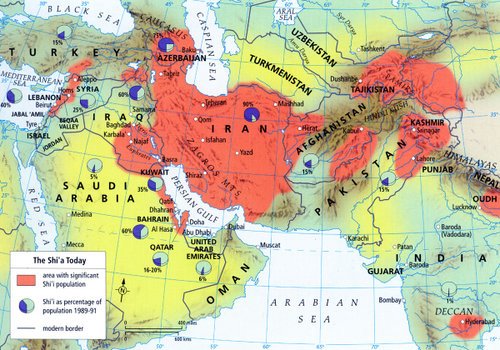
The red areas are where the Shia population is dominant.

And compare it to this one, which shows where the oil is in Saudi Arabia (I couldn’t get one at the right scale – this is a ‘close up’ – to get a proper sense of the size, focus on Bahrain).

The point of which is simply that most oil is concentrated in Shia-dominant areas, and Iran is a) in a very strong position, and b) is controlled by a more assertive leadership.