
Wendell Berry profiled by Christianity Today here.
Category Archives: book review
Heat (George Monbiot)

This was very good, and an excellent complement to The Last Generation. The basic argument is that it is possible to have civilisation more-or-less as we know it, coupled with a rapid (Let us be human!
I’m wondering about some ‘pledges’ that might be made. The first and clearest might be: I shall never board an aeroplane again. The second might be: I shall never enter a supermarket again (ie big out of town thing – not sure the local co-op counts). On this latter, I was most struck by the figures for electricity use in supermarkets, and the way in which shifting to a delivery system (whereby the superstores become warehouses) is part of the solution. So: walking into a Tesco store (even if you haven’t driven there!) is part of the problem, due to the phenomenal profligacy of the store itself. But having Tesco stuff delivered to your home – this might effect a 70% reduction in traffic, leaving aside anything else. (As long as you don’t then buy lots of stuff flown in from the other side of the world. Actually, you should just use it for bulk goods; veg etc should be locally grown.)
Hmm.
“Prevent Global Warming! Get Tesco to offer Free Home Delivery”
Do you think it’s a runner?
The Last Generation

This is an excellent book. I’d been a little troubled by the Telegraph article I had read recently, which was sceptical about global warming, and argued that it was based on scientific errors. This book goes into the arguments from that article in some depth (because the article wasn’t original – this book was published before the article was!) and the overall story is both well researched and very readable. Put simply, the ‘Last Generation’ is not a reference to the end of humanity, but to the stability of the climate system. We are moving to an environment which is more chaotic than any which humanity has yet been exposed to.
Very, very interesting. (I’m now reading Monbiot’s Heat, which is equally good, but with a distinctly different emphasis).
Dune: The Butlerian Jihad
This has been my bedtime reading for the last week or so, which I stayed up late to finish last night – always a good sign. Probably for fans of the original works only, although there are some nice touches – I particularly liked the parallel drawn between inhuman and monstrous machines, destroying humanity, and inhuman and monstrous humans, destroying humanity. It will be interesting to see where the authors take things in the next two books – which I shall now be getting, in a week or two.
I’ve been planning to re-read some of the classic SF series, Foundation in particular (let the reader understand) but possibly also the EE ‘Doc’ Smith novels, especially the Lensman books, which I read when I was about 12 and still hover in the back of my imagination. I suspect I might now find it racist claptrap, but you never know.
Some good quotes in this book though, especially for anyone sceptical of scientific claims: “Science, lost in its own mythos, redoubling its efforts when it has forgotten its aim.”
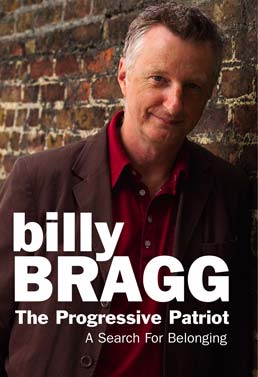
Billy Bragg: The Progressive Patriot
Friendship is a very strange thing; particularly childhood friendships. Looking back it seems quite odd how I fell in with some people rather than others. In particular, at school, one of my best friends (still one of my best friends, tho’ I don’t see him as often as I’d like as he now lives on the other side of the country) was in many ways the opposite of me: I was right-wing, he was left-wing; I was outgoing and optimistic, he was melancholy and introverted; I liked ‘Wham!’ – and he had musical taste (just like a certain MadPriest).
Fortunately for all concerned, we influenced each other. In particular I remember lots of occasions when he would insist that I listened to some ‘quality’ music – he introduced me to David Bowie; Simon and Garfunkel; The Jam, for example – but one of his key heroes was Billy Bragg. It took me a while to get beyond the flat tonalities, but – to try and be fair to myself – I think I recognised even then that Mr Bragg was a genius songwriter:
“If you’re lonely, I will call
If you’re poorly, I will send poetry
I love you…
I am the milkman of human kindness
I will leave an extra pint.”
Which means that when I was passed a copy of Billy Bragg’s new book by a mutual friend (of mine and BB’s) I was rather excited. I had kept tabs on Bragg’s more political side, as opposed to musical, and I remember being particularly taken with his ideas for reform of the House of Lords, which I thought were much the best proposal around.
So – a new book, triggered by Bragg’s reaction to the BNP’s success in his hometown of Barking, and his desire to articulate a progressive patriotism rather than the reactionary sort symbolised by the BNP. In this he succeeds rather admirably, although I don’t think it’s a particularly difficult task. Of much more interest, however, was his autobiographical description of music – especially how he enjoyed Simon and Garfunkel so much in his youth, which rang all sorts of bells with me. (I’m stunned that ‘The Boxer’ is based on an Eastender! That changes how I listen to that song, just a little). This reclamation of the English heritage is striking strong chimes with me, not least because I see it as one of the blessings in our post-oil future. And he’s an Essex boy – Free Essex!
Anyhow. A really good book, full of interesting facts and arguments, which has prompted me to recover an interest in the songs from the Bard of Barking. His new collected works are now on my Amazon Wish List. Many thanks to all friends concerned. 🙂
Holiness, Speech and Silence (Nicholas Lash)
Another very lucid book from Nicholas Lash. Didn’t teach me a whole lot that I wasn’t aware of, but it would be an excellent introduction to contemporary philosophical theology for someone trapped within the usual misconceptions which disfigure secular perspectives on the faith. I used my favourite quotation from the book here.
Soil and Soul (Alastair MacIntosh)
 Very good, extremely interesting, and just the thing to remotivate my own small motionings towards ecological activism on an island. Lots of strong positives to the book, including that it took theology seriously, the one real negative was that the theological angle just wasn’t very good (very liberal and new agey) – example (p219): “Traditional Christian theology saw its function as having been to appease once and for all God’s wrath at human wickedness…”
Aaaggghhhh!!!! He really needs to read James Alison (or Hauerwas, or Lash….)
And yet: “The deepest activism is always spiritual activism.” (p240)
Oh yes.
Living in the End Times (James Alison)

James Alison may just be my favourite theologian of the moment (other contenders are: Stanley Hauerwas, Nicholas Lash and Eugene Peterson [and hey Tim I’ve finally got started on Christ Plays…])
Anyhow, on holiday I read this book of his, which was wonderful – and a perfect antidote to the Christian fundamentalism that I’ve been reading much about recently. Lots of good things about it, much which will inform my sequence of Learning Church talks, and possibly my favourite quotation is this one, but this is also good: “Heaven is a dwelling in the Father which is possible only for those for whom death has come to be a non-definitive, non-toxic part of their story. Once again we are face to face with the central mystery of the Christian faith, which is that Jesus Christ the Risen Lord is risen AS crucified victim. Death is swallowed up by glory.”
His main argument is that, properly understood, the end of the world should transform the way that we think about this one, so that we enter into the way of life that Jesus first imagined to be possible (I think of U2’s ‘When you look at the world’). He draws on Wayne Meeks, arguing that the apocalyptic imagination is characterised by three dualities: cosmic (heaven/earth), temporal (this time/the time to come), and social (good/bad, or righteous/unrighteous). Alison argues that Jesus is using this apocalyptic language (the language of his time) in an eschatological way, ie in a way which first undermines and then overcomes and rejects those dualisms. I think the strongest argument for this is that Christ quite clearly rejects the social dualism, and we should take that rejection as governing his attitude to the other dualisms in the family.
One sequence of thought thrown up from reading Alison: it seems to me that the gay community within the church has something very important to say to the broader body, and one can see the strand of gay sensibility being profoundly rooted in Scriptural ideas, thinking of the church as bride, and therefore Jesus as groom. So if the wider body rejects the gay community then it is undoing itself. This is not to say that all the arguments from the gay perspective are correct – I don’t think they are, even if Alison’s are(!) – but it is undoubtedly the case that I would want to belong to a church in which the gay perspective has an essential part to play, and is not excluded – and that such a church would more adequately represent the Body. Rejecting the gay perspective is, in Alison’s terms, apocalyptic, not eschatological – in other words, it is not fully Christian. I’m persuaded of that.
Velveteen theology
(A wedding sermon from the weekend. The text of the Velveteen Rabbit can be found here.)
It is traditional for a preacher to base his remarks upon the reading from scripture – well that’s one tradition I’m going to ignore today – I would instead like to discuss with you the deep theological truths shared in the story of the velveteen rabbit, the velveteen rabbit who wants to be real, and in the end becomes a real rabbit, in a lovely image of the resurrection – that hope on which all other Christian hopes are grounded. Because this language of becoming real is very important in today’s culture, which is so profoundly unreal and has made an art of forgetting all that makes us into real people
To begin with the velveteen rabbit is a gift to a small child – and at the heart of the Christian understanding of the world is the idea that everything is a gift, for which we give thanks. Now there are some obvious ways in which that is true today, for today we give thanks that the world is such a place that two people have found someone to pledge their life to, to love – that the world allows this happiness. And it is important to give thanks for this, that two people have met someone else who is, in truth, God’s gift to them – a phrase that might be misunderstood. Normally if someone thinks that they are God’s gift to the world, it means that they’re arrogant and think they’re much more important than they really are. That’s not what I mean. I don’t mean that this other person is the answer to all your dreams – not in a shallow sense although in a profound sense I pray that that is true. I mean that this other person is from God to you, and so your marriage is a place where you meet God, the sacred, and in meeting God you in turn are made sacred, because it is the place where God’s grace can enter your life. This is why the church calls marriage holy matrimony for calling it holy means that God is present – officially it is a ‘sacrament’ – it is something sacred that makes you sacred – makes you sacred because of the love shared.
This is what the skin horse knows – the skin horse tells the rabbit that to become real he must be loved, and, because he has to tell the truth, because only the truth is real, he tells the rabbit that it can be painful – the sharp edges get removed – stitching might come undone… This is what happens in the married relationship – a softening needs to take place – sharp edges often rooted in our personal histories need to be worn down by love – it’s the truth underlying the phrase about ‘loving each other to bits’ – and as with the velveteen rabbit it is more true with each passing year, as I’m sure the long-married couples here can confirm – as the bits don’t work so well or lose their shape – and we should all ponder the truth that the skin horse speaks – that “it doesn’t happen often to people who break easily, or have sharp edges, or who have to be carefully kept”.
It is when you face those sharp edges that you are brought up against the reality of the other person. You have to pause, take stock, and face this wondrous, marvellous, beautiful human being whom today you are committing your life to. And that applies especially when it isn’t as obvious as today that this person is wondrous, marvellous and beautiful. When their sharp edges do stick in, or when their fragile nature becomes clear. This is where the real work of love begins, it is where the loving work of being real begins, and it is here that marriage becomes sacred, for in learning to truly love one another, you begin to know what it means to share in the love of God – that love which is the most real thing in the world.
This is god’s gift in a marriage – there is a theological phrase which the church uses to talk about these things: ‘loved into being’ – it describes God’s call on each of us – leading us to life – we are called by love, we are formed from love, we are formed for love – we are each loved into being – and that is something at the heart of a real marriage, where you love each other into being – this other person with whom you are now bound together, and who shall be the most real thing you are exposed to.
N____ and N_____ – love each other to bits – love each other into being – and above all be real – don’t get distracted by the world, teaching you that the stick out handles and whizzy bits matter – which is, of course, how the skin horse describes nice cars and big houses and well paid jobs – don’t believe the world that these things are important, that they are real. They’re not. The only real thing in life, the only true thing in life, is love. Remember this day; remember the promises you have made; and remember to give thanks for this gift of a real person to become real with, until your hair has been loved off, and your eyes drop out, and you get loose in your joints and very shabby. These things don’t matter at all, because once you are Real you can’t be ugly, except to people who don’t understand.
Embodying Forgiveness
An address given to a church healing group, 17 March 2001
What I would like to do today is say a little about the theology of our ministry of healing and reconciliation. The role of theology is to articulate the meaning of our existence, and that means not simply the big questions – what is our place in the world? what is God like? – but also the small-scale questions, like: what is our healing group for? how should we move forward in this ministry? So what I will try to cover in this address is the meaning of what we do, when we lay hands on one another in the name of our Lord, and pray for healing and reconciliation.
“Is any among you sick? Let him call for the elders of the church, and let them pray over him.”
The Epistle of James, 5.14
I have taken the quotation from James as my text, because, first of all, it is one of the clear scriptural foundations for our practice. We meet in the name of one who healed the sick, and as we have been instructed to love one another as he loved us, so too must we continue his ministry to the sick. The quotation also falls naturally into three parts, which are going to be the framework for my talk: Who are the sick? Who are the elders of the church? And how should we pray? At the end, I want to gather these elements together, and offer a theology of our ministry of healing and reconciliation. I should add at the beginning, that this address is meant to be a contribution to discussions, and not the final word. Theology is the product of a praying community, and it is the community that gives expression to the theology in their behaviour and actions. It is the practical application of words that gives relevance to theology.
Who are the sick?
In the New Testament, there is no division between physical and spiritual sickness. Consider a passage from early on in Jesus’ ministry. [Lk 5 17-26, Mk 2 1-1, Mt 9 1-8] This is where Jesus is teaching in a room, and the room is crowded out with all those who have come to hear his Word. And because there is such a press of space, a paralytic is lowered down into Jesus’ presence from above. Jesus says to the paralytic that his sins are forgiven – at this point no physical healing is offered. This saying of Jesus offends the Pharisees who are present, who consider it blasphemy for Jesus to be forgiving sins. Jesus then says, ‘that you may know that the Son of Man has authority on earth to forgive sins’ he tells the paralytic to get up and walk, at which point the paralytic is healed – and all were amazed and glorified God. There is much in this passage which could be drawn out – perhaps that is something that you would like to do individually during the quiet moments of today – but for my purposes the important point is the tying together of physical illness and spiritual sickness.
When we are talking about the healing ministry, then, we are talking about the most fundamental of sicknesses – our separation from God, our departure from Eden. The Christian claim is that this separation leads to a lessening of our physical well-being, that the life given to us from God, which dwells within us, which forms and shapes our lives, is frustrated and corrupted by our separation from God. In other words, by our sin. And this sin, which is our separation from God, has a large appetite that extends into our relationships with one another, causing us to become separate from one another, the broken fragments of the one Body.
Now, this could be taken to mean that if someone is ill, then they are sinful, and the illness is something that has been brought upon the person by their own actions. It can therefore be seen as the judgement of a wrathful God upon his errant children. This language has been heard in recent years in discussions over HIV and AIDS – it is a plague of Biblical proportions, sent by a vengeful deity angry at the transgressing of his moral law. That perspective is not a Christian perspective. When we address the suffering present in this world, we are running up against one of the harder mysteries of our existence. Why do bad things happen? In particular, why do bad things happen to good people? I do not have a straightforward answer to that sort of question. The answer that I stumble along with centres upon the nature of faith: that we have a choice between trusting that there is an answer, even if we cannot fully understand it in this world; or making the decision to say that there is no answer – which rejects God, and consequently rejects all value and meaning from our lives, falling into the abyss of nihilism. It seems to me that it is impossible to really live in that fashion – at most it is a decision to move passively through the corridors of this world, never looking up or engaging deeply with our existence. If we are to truly live – live in a way which reaches into the dark earth in which we are rooted, in a way which reaches up to the bright heavens for which we strive – then we have no option other than the way of faith.
When we are confronted with sickness, then, we are confronted with a mystery, something that we cannot fully understand or grasp, and something that, in consequence, draws us closer to God. It is not the case that all sickness is the result of human sin, which can be overcome by the resolute application of prescription confessions and absolutions. That is to take a model of technocratic efficiency as the way of faith, a modern idolatry. Some sickness, in God’s providence, will always remain out of our reach. We must allow that to teach us humility before God, so that we may say with Job, ‘Behold I am of small account; what shall I answer thee? I lay my hand on my mouth.’
Yet some sickness is the result of sin – both sin committed by the life of a person themselves, or by those with whom they are in relationship: their immediate family and loved ones, or those forebears whose legacy shapes and mis-shapes lives over generations. It seems to me that this is where our ministry lies – in healing and reconciliation for those whose lives are blighted in body mind and spirit, and who come to be made whole.
Who are the elders?
Which brings me to the second part of my address – for who is it to whom these people come? Who are the elders of the church? The church is in a sense the easy part of that question, for the church is the community formed by the resurrection of our Lord from the dead, the community constituted by that victory over death and sin, the community within which the message of the gospel resides. In other words, us. I don’t know about you, but I sometimes feel nervous when I consider our origin: that we have been formed and commissioned by this great breach in the world, when Jesus came again amongst his disciples, and was recognised in the breaking of the bread. I don’t feel up to carrying on that message. Yet Jesus himself chose the humble fishermen to transmit his message, not the high and mighty. So perhaps we might be bold, despite our shortcomings, and trust the Spirit to enable us to carry the message forward. For we don’t have to get it perfect – part of our message, after all, is that we are redeemed from our shortcomings.
So the church is the community of the resurrection, we who have been shaped by the events of two thousand years ago. The body of Christ, who meet in his name and partake of his life. Who are the elders? The literal translation, as I am sure many of you know, is presbyters – the priests. Those who have been acknowledged by the community and commissioned to exercise leadership. Yet, to make that simple equation, of elders to priests, is I feel to miss something important. For the essence of being an elder is this recognition and commissioning by the community, this acknowledgement of growth in the faith. For the exercise of leadership is a significant responsibility, which depends upon a mature faith to be sustainable.
This language of elders, then, does not refer to our chronological age – the number of years that we have grown through, but rather to the age of our soul, to our wisdom. To be an elder in this sense is to be mature in the faith, to have marinated in the faith for such a length of time that the flavour has sunk into the bones, and can therefore be brought out again into the community.
The church is the community of the resurrection, as I said before, and it carries a message – that God in Christ was reconciling the world to himself; that in Christ sin is overcome; that in Christ we see the way, the truth, and the life, and that life is available to us in all its fullness. A message of forgiveness for our sins. When Christ healed the paralytic, he first said to him that his sins were forgiven. When the prodigal son returns from feeding the pigs, his father comes out to greet him and welcome him before he has a chance to say any words. There is more rejoicing in heaven over one sinner who repents. We are a community whose central claim is that God moves towards us, before we get a chance to even realise our problems, let alone come to begin working on them.
This perspective, this grace of forgiveness offered without qualification or prior regard, is the essence of our faith. The elders of our faith are those in whom this message has been distilled and matured so that it has become the essence of their nature. The medicine of the gospel has reached down and healed a person so thoroughly that the healing seeks further work, overflowing outwards into the life and witness of the believer, and drawing ever more people closer to the source of our life and healing. This is a grace, the free gift of God to his children, the life in which we are called to participate. As we grow in faith, we become bearers of that grace out into the world, ready to offer it to all who are in need.
How should we pray?
So when someone comes to the church, seeking healing and reconciliation, how should we pray? This is the point where the gospel message meets the world – where we are put to the test. How is our faith made present in the world?
I mentioned earlier that Jesus does not recognise the division between physical sickness and spiritual sickness. That is a division which is overcome in him. It is related to the more fundamental division between God and humanity, which is also overcome in him – a division brought about by sin, which separates humanity from God, and an overcoming by the God-man, the one who is both fully divine and fully human: the incarnate Word. Our message centres upon the incarnation, when God was revealed in human form. When we bring the gospel to bear – when we pray with someone who is sick, in other words – we too must be an incarnation of God’s love.
For our message of communion and reconciliation needs to be embodied if it is to take effect, just as the Word of God needed to be embodied if we were to recognise Him and be transformed by Him. This is why we have the laying on of hands as a necessary part of our prayers. This physical, embodied action is – in a very direct sense – the incarnation of the gospel, the embodiment of forgiveness. And as such, this action fits naturally in a Eucharistic context, where we meet the body of Christ.
The gospel that we proclaim is a bright and living fire, which burns out the darkness within us. As the gospel takes root in our hearts – as we know ourselves to be healed of our sins, brought closer to God, and enabled to participate in the true life that lightens every heart – so we can be bearers of that light into the world. When we pray, we come closer to God, we develop our relationship with him, and we are known and transformed by him. And prayer does not have to be a falling onto our knees and closing our eyes – although that is essential. It is also, for example, a study of scripture, taking that word of God into our hearts, allowing us to be transformed by its message. With all our prayer – whether we hold the suffering of the world before God in our intercessions, whether we stand before God alongside the broken in body, mind or spirit, or whether we ourselves are the broken ones, seeking God’s grace in our own lives – in all these contexts, the life of prayer offers the opportunity to transform our situations. We cannot know how the situation will be transformed – we cannot prejudge God’s intentions for our lives, or those who come to us seeking healing – but we can trust in the grace that has been given us, that if we come before God in prayer, we will be heard, and we will be sanctified by grace.
The laying on of hands, therefore, is an expression of our life in prayer. Our life in prayer is what enables us to mature in the faith, to grow more steadfast in our love, to become able to take the gospel into the world, where it can work its mysterious favour upon all with whom we have to do. If what we do is rooted in prayer, if we (to get really theological) are able to participate in the self-giving love of the Holy Trinity, then in our healing ministry we will manifest God’s love to the world, we will embody forgiveness.
Conclusion
For as I said earlier, what we do with theology only makes sense if it is acted out in our daily lives. What we do in our service of healing and reconciliation is incarnate the gospel, but that incarnation needs to work on us, moving into us as well as moving out from us. I know that many people have found participation in the service to be healing in this way, and it is certainly something that is natural and a real part of our ministry – we share in the ministry of the wounded healer, who died to free us from our sins.
Our participation in healing prayer, in the laying on of hands, is something that must also deepen our own faith, and call us forward to acknowledge and be healed of our own sin. Forgiveness is something that we must practice ourselves, and that is hard work. The service is the capstone of the ministry, but the foundations are our own lives. The foundations lie in our reactions to pain in our own life – the letting go of offence, the refusal to nurture anger or hold a grudge. To do this requires developing new habits and new casts of mind – to put on the armour of Christ, as Paul has it. Yet this is the new life which we are called to create as a church, a new living community which holds reconciliation at the centre of its life and witness. Just as our faith is a journey, not a destination, so also is the ministry of healing. May the risen Lord guide us on our journey, and enable us to be ministers of his grace. Amen.
(Prompted by reading the excellent book with this title by L Gregory Jones)