Seymour M Hersh: Chain of Command

Outstanding and compelling argument. A book which simply must be read in order to be informed on the torture controversies and related matters.

Having spent so long researching the more loopy 9/11 theories, it was really refreshing to read this, which is stamped with both humanity and sanity. It also, in part, undermines the 9/11 conspiracy theories (why would Perle wait until 2 months after 9/11 to set up a company that would benefit if he was involved in planning it?). It has made me want to do another long post about 9/11 and US foreign policy, because I think I am now shifting quite strongly against the conspiracy theories (not completely, but for all practical purposes). So watch this space.

Also – last point – very interesting discussion at the end about Israel and the Kurds, which was an aspect to the current world situation I hadn’t appreciated. Gives more weight to this article (HT Global Guerrillas) which I read a couple of days ago, and would recommend.

Thom Hartmann: The Last Hours of Ancient Sunlight

I bought this because of the title – a beautiful description of what Peak Oil is about – but I was rather surprised, and stimulated, by the book itself. Instead of being the normal dry and technical discussion, it was a much more spiritual take, very New Agey in its elevation of ‘Older traditions’ despite being avowedly Christian (the quote on the front from Neale Donald Walsch should have given the game away) and asked some of the important questions. What I found stimulating was that it is addressing the Peak Oil issues in the way that I want to explore, ie as a spiritual crisis. Where I disagree with Hartmann is that his analysis is, frankly, theologically flabby. We need to get much more rigorous about the roots of our crisis – for I completely agree that it is precisely a spiritual crisis – and we can only do that by rolling up our theological sleeves.

Stimulating though.

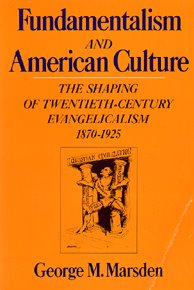
George M Marsden: Fundamentalism and American Culture


This was an outstandingly good book, not surprising given the amount of scholarly praise it has received. I read most of it for my Fundamentalism talks in the Learning Church, and managed to finish it in Germany.

Three points.

First, the ‘Babylonian captivity’ of Fundamentalism, by which I mean the way in which it accepts a Modern, scientific framework of understanding, is much more explicit in the history than I realised. I assumed that it was simply picked up by osmosis from the surrounding culture, but it was, instead, something explicitly argued for, most particularly by the Princeton school of theologians. The original Fundamentalists objected to (for example) Darwinism principally on the grounds that it was ‘bad science’, ie something based upon hypotheses rather than the assessment and classification of ‘facts’. The Fundamentalist movement gave primacy to a Baconian understanding of science (Newtonian), in which hypotheses and speculations were downplayed. The Bible was seen as a reliable source of facts, and the scientific approach was simply to aggregate these facts systematically. It seems to me that Fundamentalism can only persist through a more or less wilful self-deception, a desire not to investigate their own historical roots. Arguing with a Fundamentalist about specific points (eg evolution) won’t get anywhere, because the presuppositions are different – but NOT a presupposition to do with the place of Scripture; rather a presupposition about the nature of science. Fundamentalism has reified eighteenth century science, and given it an authority equivalent to that of Scripture. That is its principal idolatry. It may be the case that the one thing likely to free a Fundamentalist from their error is to study the history of science – for then the inheritance that Fundamentalism has received would be obvious, and its inherent lack of Scriptural authority clear.

Second, and related to my post about incarnation I was rather pleased to see many of my own perspectives articulated by the conservative evangelicals as they debated with the Fundamentalists. In particular – and a rather pointed skewering of Daniel’s ‘Barth-world’ comment – was this discussion about Augustus Strong, “the leading conservative Baptist theologian of the time… president of Rochester Theological Seminary”:

While holding a high view of Biblical authority, Strong’s starting point was that truth was not doctrinal or propositional, but rather ‘the truth is a personal Being, and that Christ himself is the Truth’. Strong attributed the intellectual difficulties in the church to a view of truth that was too abstract and literal. People mistakenly supposed that the perfection attributed to the deity could be attributed equally to statements about Christ made by the church, the ministry, the Bible, or a creed. ‘A large part of the unbelief of the present day,’ he said, ‘has been caused by the unwarranted identification of these symbols and manifestations with Christ himself. Neither the church nor ministry, Bible or creed, is perfect. To discover imperfection in them is to prove that they are not in themselves divine’. Strong rejected very explicitly the idea of Scripture as inerrant and in his influential Systematic Theology eventually dropped language that might even suggest such a conclusion. Statements similar to Strong’s could readily be found elsewhere among Baptist conservatives…

That is exactly my position – strange to think I might be aligned with Baptist conservatives (smile).

Finally, and most pertinent to our present day travails, was the way in which Marsden describes the politicisation of Fundamentalism, in terms of the desire to attain a ‘pure church‘, and the various manoeuvrings undertaken by the Fundamentalists to establish themselves in positions of power. Marsden is clear that the one thing which prevented a Fundamentalist takeover of mainstream denominations like the Presbyterians was the Scopes trial – the Fundamentalist mindset was brought up into the light, rather than being kept hidden away (as most religious debates – thankfully! – are); and once brought into the light, it withered under sustained ridicule. This seems to be the most salient difference between the Fundamentalist and conservative evangelical perspective (as I described): the Fundamentalist perspective is exclusive, and actively seeks to repudiate different forms of Christianity; the conservative evangelical perspective is inclusive, and is prepared to tolerate difference. You could say that the latter has a more fully developed understanding of adiaphora.

A scholarly book – very ‘dry’ – but not difficult to read, and absolutely fascinating. Highly recommended.

South

A story that has held me for quite some time, and it was good to read the man’s own account. A sense of self-justification hang over it though, not in such a way as to minimise his achievement, but more a sense of his trying to defend himself against certain criticisms which would now not have any purchase. There was also a sense of the stiff upper lip restricting some of the descriptions, especially of morale amongst his men. I have a second book on this (much longer) still to read, the biography by Roland Huntford. An outstanding leader of men – that’s what I feel the need to learn!

Intriguingly, the daughter of one of the men on the expedition is a member of my congregation.

Shopped

…or, why I am not wrong about Tesco (grin).

This was excellent, a very easy, thorough, lucid and dispassionate account of why supermarkets, principally the biggies, are destroying a real and sustainable food culture in the UK. There weren’t many new principles that I discovered, but there was a lot of flesh put on them, especially with regard to how the big chains abuse their dominant market position vis-a-vis the suppliers. Some really shocking stories recounted there.

Well worth a read. I’ll still write the Tesco mk 2 post at some point.

David Ray Griffin (New Pearl Harbour & 9/11 Report)

OK. A little while back I got interested in the various 9/11 conspiracy theories, wrote a few posts about it, then shut up because mentioning the specific ideas seemed to generate much more heat than light. In addition, it’s an area where the discussion rapidly becomes a matter of citing different authorities: I am not a scientist, it’s impossible to investigate these things to scientific standards of accuracy; and so it is impossible to establish certainty. I’ve continued to look into it though, and my mind is solidifying around certain conclusions.

The best book I have read on it, and the one I would recommend to anyone interested, is David Ray Griffin’s ‘The New Pearl Harbour’, not least because his chapter 9 contains a section called ‘problems for the complicity theory’ which was the single thing that I read that most made me want to accept, once more, the official explanation. The gravitational tug of social acceptance, along with a residual ‘surely this can’t be true, I must be barking mad‘, is there given solid and sane grounds for confidence. Yet that confidence is not enough. Having got quite au fait with the various technical elements of the conspiracy theories – many of which I think truly are barking – I am left with the conviction that a) the official story is a cover up; and b) elements of the US government were involved in the attacks on 9/11.

Crossing the Rubicon (Michael Ruppert)


“I will name Richard Cheney as the prime suspect in the mass murders of 9/11 and will establish that, not only was he a planner in the attacks, but also that on the day of the attacks he was running a completely separate Command, Control and Communications system…”

That pretty much sets out Ruppert’s argument in this weighty book. Ruppert is an ex-LAPD detective; he’s not academically trained, but he is determined, and the book reflects both those things. I would liken it to a blunderbuss – filled with garbage, debris goes everywhere, but the target will be hit, and almost certainly taken down. Which is a way of saying that I don’t agree with everything that Ruppert says (not sure anyone could; I particularly disagree with what he says about Israel) but that there is something nasty in the woodshed seems inescapable to me. I’ll say a bit more about that in my next post….

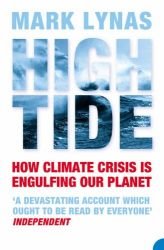
High Tide (Mark Lynas)


Writing about the zombies in the last post reminded me that I hadn’t written up this book, which I read a couple of months ago. I was a little disappointed with it, in that it had a lot of very interesting information and reportage, but the writing itself didn’t engage. That being said, I do think it is a book which we should all read, and the argument seems largely incontrovertible. The planet is warming; sea levels are going to rise.

The point about the zombies was this: consider the city of Lima in Peru. Virtally all of its fresh water comes from the glacier which is rapidly melting (and the inhabitants have been drinking the meltwater). When that process comes to an end in the next decade or so, there will be ten million people without water for six months a year. They will move because, to put it in the words of Darth Cheney, the human way of life is non-negotiable. They will then migrate to where water is available.

There will be many situations like this. They will cascade, like dominoes, each separate area will negatively reinforce the others. It has already started in Africa, in Zimbabwe and Darfur.

I believe that it is too late to prevent the global warming that is already in train. Peak Oil itself will “solve” the emissions problem; eventually the carbon emissions will come down to virtually zero, but by then the damage will have been done. I think we are facing a decade or two of continuous low-level warfare, with the possibility of larger ones breaking out every so often.

What do you do if you can’t get water to drink? Roll over and die? Some will, but those who are prone to aggression – young males – will make every effort to take water from those who have it. Guess where the most young males are located?

Oriana Fallaci

Is someone who needs to be read and considered. Her ‘The Rage and the Pride’ I found very interesting. Good interview with her here.

“In 1974 [Algerian President] Houari Boumedienne, the man who ousted Ben Bella three years after Algerian independence, spoke before the General Assembly of the United Nations. And without circumlocutions he said: ‘One day millions of men will leave the southern hemisphere of this planet to burst into the northern one. But not as friends. Because they will burst in to conquer, and they will conquer by populating it with their children. Victory will come to us from the wombs of our women.’”

A Canticle for Leibowitz

A Canticle for Liebowitz, by Walter Miller. There’s a good Wikipedia page here if you want to discover a bit more about it.

I loved this. Hadn’t read any sf for ages – must be at least six months – so it was great to plug back in. Lots of stimulating images, and, of course, it fitted so nicely with my ‘After Virtue’ interests. Lots of things will stay with me, but perhaps the final debate about euthanasia most of all. Very challenging, but I was grateful that the religious perspective wasn’t implicitly ridiculed, in the way that much sf would do.