
Mindless, but moderately enjoyable.

Mindless, but moderately enjoyable.

This was good, but not quite as good as I had expected. In fact the most notable thing about it was the sense that Woody Allen had modelled himself on Alec Guinness’ performance.
The genius opines here.
Like him, I’m looking forward to V for Vendetta being released. Especially given my last two posts…
After One Salient Oversight‘s request, I’ll say a little bit more about what made me change my mind.
Firstly, the attack on the Pentagon has always struck me as odd – where is the plane? Where were the engines? How could a 767 cause such a small amount of damage? Why is there no footage of the plane striking the Pentagon? Thing is, this would be a trivial ‘conspiracy theory’ to refute – the footage taken from security cameras in the vicinity would show what happened, and they have been confiscated by the US government.
What has really persuaded me, though, is the analysis of the collapse of the two towers. I had seen a TV documentary about the collapse, which essentially told the ‘pancake’ story, ie the impact weakened the floors, causing a sequential collapse from the top down. This persuaded me at the time. What changed my mind are really simple physical points:
1) the steel would not have melted (the fire would not have been hot enough);
2) even if the steel had melted (or been weakened sufficiently), the towers would have fallen in the path of least resistance (ie fallen over, sideways), rather than the path of most resistance (ie straight down); and
3) the speed and comprehensiveness of the collapse – at effectively the same speed as a rock falling in air – shows that there was no resistance from the lower floors.
I’m really not prone to conspiracy theories. I’m sad enough to have read through the 9/11 commission report, and I was quite willing to accept that as the truth. Even now, if someone could persuade me that a plane could have caused the collapse, I’d much rather believe the official story. I no longer believe that the planes caused the towers to collapse – and therefore lots of other dominoes start to fall.
(NB the wikipedia article, and various links that I’ve chased up in the last ten minutes or so, don’t go into detail about the ‘fire’ and how it could have caused what took place, especially point 3) above. That’s the real kicker for me. I’ll keep looking though.)
Update: this is the best article discussing the physics of the collapses that I have come across.
I’m annoyed because I have become persuaded, very reluctantly, and slowly and against my habitual will… I have become persuaded that the attacks on 9/11 were not perpetrated by Osama Bin Laden, but were instead perpetrated by actors on the inside of the US government.
And it’s annoying because just writing that sentence makes me feel like an absolute lunatic. I feel I’ve just stepped outside of the acceptable bounds of social discourse; I’m no longer a reasonable person. Everything I now say and think will be tainted by a sense of ‘oh yeah, he’s that guy who thinks Dick Cheney blew up the twin towers…’ – and thus my ‘voice’ is eclipsed.
And it’s annoying because I supported the attack on Iraq, and now I wonder ‘have I been had?’
Yet you have to pursue the truth, whatever the temper.
This line of thought was prompted by viewing this video, kindly linked for me by Sven, although it had been building for a while. Too many unanswered questions, which need answering….
UPDATE: for what it’s worth, I no longer believe this 🙂
Discussed at The Oil Drum, the best Peak Oil site on the web.
If you don’t know what Peak Oil is, have a look here for a good introduction and overview. Or just type ‘Peak Oil’ into Google….
Should a Christian be offended by blasphemy, in the way that various Islamic groups have been offended by those cartoons? I believe not – and I’d like to explain why.
There is no shortage of material that could be cited as offensive to Christians – the ‘piss Christ’ is possibly the most egregious – but I’d like to focus on the graphic novel ‘Preacher’, written by Garth Ennis, partly because it is a cartoon/ comic, and partly because it is a work that I am familiar with.

To understand ‘Preacher’ you must imagine a tale composed of a blend of three other stories, but then put through the blender of a particular film. The three stories that ‘feed’ it are: Unforgiven, the Clint Eastwood western; the Da Vinci Code (although it predates the Da Vinci Code – it’s actually drawing on the Holy Blood and the Holy Grail); and Anne Rice’s ‘Interview with a Vampire’; and all of this is then fed through the blender of Quentin Tarantino’s “Pulp Fiction”. It is certainly blasphemous, also obscene, disturbing and very funny. I believe it also makes some interesting theological points – not as profound or interesting as I had once hoped, when I was first reading it, but interesting nonetheless.
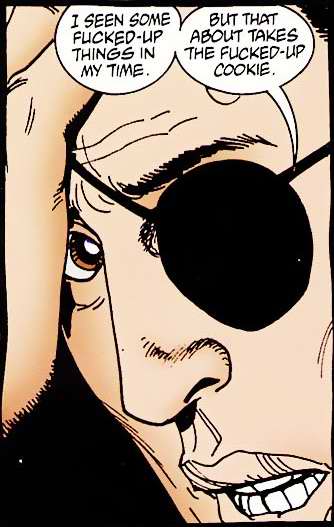
The basic plot is this: an angel and a demon come together and conceive a child; when the child is born it is immediately expelled from Heaven, and God vanishes from His throne. Genesis (the child) plummets to earth and is ‘united’ with Jesse Custer, a preacher (probably Episcopalian 😉 who was raised by some rabid and violent fundamentalists in the Deep South of the United States. You could say he has some problems with his faith… However, once Genesis is united with him, he gains the Word – the power to command people to do whatever he tells them. Through various adventures involving the Priory of Sion and his best friend, an Irish vampire, he ends up producing a confrontation between God and the Angel of Death. God, of course, isn’t the God that a ‘normal’ Christian would recognise – God is schizophrenic, in the popular sense, in that there is sometimes a raging Old Testament father figure full of righteous anger, and sometimes there is a radiant New Testament figure seemingly all sweetness and light. The end of the tale is the death of God – and the continuance of the world without Him, seemingly all the better for it.

Ennis grew up in Northern Ireland, not a place where balanced Christian thinking has been much in evidence, and there is clearly a kinship between the God in ‘Preacher’ and the attitudes of someone like Ian Paisley. I had hoped that there would be something theologically creative at the end – that was what kept me reading – along the lines of Genesis becoming a renewed God, essentially a retelling of the Christian story but in a modern idiom. Instead, Preacher is profoundly atheistic, and is in fact much more of a story about the importance of friendship than anything about theology. It remains deeply memorable, and the set-up I think is wonderful, but in the end there is little engagement with ‘mainstream’ Christianity – Christians within it are portrayed as either fundamentalist fascists or as idiots, and the ethics that are vindicated are those of the western, ie righteous violence.
Now, in the face of such a sustained and offensive criticism – how should a Christian react? Should a Christian shun any contact with such writing, with a view to avoiding ‘contamination’ from its blasphemy? My reading of Christianity, influenced from what I know of the work of René Girard, (partially mediated via James Alison) is rather the opposite, and that the degree of our ‘offense taking’ is the degree to which we remain to be converted to the gospel.

A key word in Girard’s analysis is skandalon (see the analysis here). It means the taking of offence, seeing something as shocking or blasphemous. As part of his anthropology, Girard argues that scandal is contagious and reproduces itself across a society, forming a major way in which a society polices its own customs. (In MoQ terms it is the most important social level pattern of value). The practices of societies are founded in sacred violence and scapegoating – in other words, societies reinforce their identity by choosing a person or group as the ‘cause’ of all their problems (think Jews in 1930’s Germany) and the society achieves a sense of unity by combining against that person or group, expelling them violently from their midst, and then telling a religious mythology justifying their actions. This practice persists over time, for the society is never able to completely eradicate tensions within itself, due to the maintenance of rivalrous desire, when one person wants what another person has.
Girard describes this contagion of scandal as the way of the world, and sees the Satan, the ‘lord of this world’ as that force which seeks to reproduce scandal, the taking of offence – for it is in the shared nature of the offence taking that the social solidarity is affirmed and reinforced. A society has a vested interest in ensuring the maintenance of scandal, for that is how the society itself is maintained. What such a society cannot accept is the continued existence of the source of scandal.
I believe this can be seen rather clearly in the case of the cartoons published by Jyllands-Posten. When they were first published, nobody in particular took offence – they were even reproduced by an Egyptian newspaper! Yet certain authorities have a vested interest in shoring up the unity of Islamic societies over against the West – the West being scapegoated as the source of the problems (internal tensions) experienced in Muslim countries. Thus it is Islamic sources which seek to generate a sense of scandal about the cartoons – to great success.
Christianity, however, begins with the scandal of the cross. That is, in the story of Jesus we have the unmasking of this process – a scapegoat who isn’t simply a victim, but one who is cognisant of this process and who forgives those who take part in it. In other words, a victim who does not take offence. This “non-taking of offence” is central to Jesus’ entire ministry – indeed, he is regularly criticised for eating with sinners and tax collectors, and memorably criticises the religious authorities saying that the prostitutes will get to heaven before them! Through not taking offence, through not seeing religious pieties as things to be defended, Jesus changes the social dynamics and enables a non-violent reconciliation with the excluded to take place. That is the essence of the Kingdom – an unmasking of this process of scandal, scapegoating and violence, in order that a new common life, not built upon these elements, can come into being.
Thus, for a Christian, it is wrong to take offence. To take offence is to play the devil’s games, to enter into antagonism between the ‘righteous’ and the ‘unrighteous’, the ‘sinner’ and the ‘saved’. In letting go of any sense of offence, one is released from the mythological pressures embedded in all stories of ‘them and us’, and is set free to become the sort of person that God originally intended – living in peace and loving the neighbour. This is what lies behind the striking language in Matthew’s gospel (5:29, where Jesus commands us to pluck out our eyes if it “causes us to sin” – language taken up by a great many moralists seeking violent self-harm, as it is, of course, to scapegoat a part of oneself). The original language used in Greek, however, is related to this word skandalon and the passage means ‘if your eye is scandalized, pluck it out’ – in other words, do not see offence.
This I find profoundly helpful, in terms of guiding my engagement and interest in the world. We are not to seek to preserve some sort of moral purity – that runs counter to Jesus’ own well documented practice. Nor are we to protest at being offended. If God does not take offence at the murder of his Son, how can we take offence at anything milder?
The lesson I take from Girard and ‘Preacher’ is that the Christian community must understand why it is seen in such negative terms, in order to move more completely into the Kingdom itself. Paradoxically, it is precisely because of this bias against ‘offence’ embedded in Christianity from the beginning that Western society has grown up with this remarkable notion of free speech and free enquiry, which is what is now at stake in the confrontation with the Islamists. It is the unmasking of the sociological processes of scapegoating and sacred violence by Jesus on the cross that fundamentally enables the fruits of Western society that we presently enjoy – including, not least of all, modern science. Girard puts it well: “The invention of science is not the reason that there are no longer witch-hunts, but the fact that there are no longer witch-hunts is the reason that science has been invented. The scientific spirit … is a by-product of the profound action of the Gospel text.”
Western civilisation is under threat and it is worth defending, but not by being offended by those who hate it, whether the Islamists, or delinquents like Andres Serrano:

The Learning Church process on the Creeds has now come to a conclusion, and I feel that it has been one of the most beneficial that we have had so far, not in the sense of immediate pleasure, but in terms of long term impact.
I began this last session with two questions: hands up if you
a) think we should say the creed on a Sunday morning (about 2/3 yes)
b) fully understand and accept the creed (about 1/2 yes).
That gave me a real ‘temperature check’ on the overall sense of the group, about 35 strong. I explained my own answers (yes and no – the word ‘virgin’ being my sticking point, as you’re all aware 😉
Lots of challenging discussion eventually ensued, with one question in particular staying in my mind: “What difference does it make if you confess Jesus as divine” – but I’ll pursue that more in the next sequence, which is on other faiths.
I tried to argue strongly, in this final session, for the claim that a) truth was independent of our own choices (“heresies” comes from the word meaning ‘choice’ in Greek; the Creed is about insisting on a truth which is independent of our own views on the subject). This seems to me essential to Christianity – and something distinctive about Christianity as compared to other religions, and linked to the how and why of science being born out of Christian womb, to do with a fundamental trust in the reliability of the natural world (reflecting the reliability of a Creator behind it).
This assertion of truth, combined with the assertion that Jesus IS the truth (ie the reality of the world expressed in human flesh) lies at the centre of my own faith: a very Anglican insistence on the reality of the Incarnation, along the lines of John 1. I also realise that when, in the classes, I used the language of ‘submission’ to the truth – which I do see as a hallmark of Christian faith – I had my own experience in the background, of being called to a vocation which I absolutely did not want to enter into, and yet, once submitted to, that vocation becomes precisely the source of the peace which the world cannot give, in that I am now much more truly myself than I was when I was the person who did not want to be ordained. The call to be ordained lies more deeply in me than my own power or sense of choice.
This applies more broadly, I believe, in the sense that for all of us, full human fulfilment, ie the becoming of who we are, depends upon a right understanding, acceptance and integration into ‘the way the world really is’. A different way of saying this – but one which I think ends up saying the same thing – is that the pursuit of truth is non-negotiable. We have to pursue the truth wherever it leads, for to shy away from the truth, to shy away from something which may seem unpleasant or unattractive, is to shy away from precisely that fullness of life which we are called into. The truth is what sets us free, and we cannot turn away from it.
Which is the context for my losing my temper recently, when I was accused of intellectual cowardice and running away from open discussion (on the MoQ discussion pages – if I can get a specific link to what I said I’ll put it here). It’s an extremely rare event (although it’s not as rare as it used to be, and that makes me wonder what is going on) and it has caused me a fair deal of soul searching and reflection.
The question of anger is an odd one for Christians, simply because Jesus is shown as being angry on a number of occasions (most obviously when he drives out the traders from the temple). I preached on a text from the letter of James a couple of weeks ago: “My dear brothers, take note of this: Everyone should be quick to listen, slow to speak and slow to become angry, for man’s anger does not bring about the righteous life that God desires.”
Anger is something which indicates a wrong, an injustice – but it doesn’t, of itself, say whether the wrong is in us or in another – hence we must be slow to anger. Yet we are not called to allow injustice to continue – we have to act, but we do have to act in a considered fashion, because anger doesn’t bring about righteousness.
It’s a difficult thing. Most of the time my own emotions are kept tied up, but perhaps I’m realising that this is not always for the best – that I do need to let my own specific thoughts and feelings come out. I certainly felt much better – ‘cleaner’ – having vented my spleen. And I am certain that it qualifies as ‘slow to anger’ – it had been building for over five years!!!
At Morning Prayer today we had Psalm 123, from which I drew comfort:
“Have mercy on us Lord, have mercy on us,
for we have endured much contempt.
We have endured much ridicule from the proud,
much contempt from the arrogant.”
Mentioned in the first paragraph no less (and at the end).
Update: I have also now been asked by the BBC and Sky to take part in TV audience discussions; the Essex County Standard are running a follow-on piece, for which they sent a photographer(!), and BBC Radio Essex want to do an interview. (Update: went out at 8:10am Thursday 23 February. My Mum had a nice birthday surprise, hearing her son on the radio :o)
I think this might add up to more than fifteen minutes. I wonder what that is going to do to my karma and how I’m going to have to make up the difference.
Update 3: quoted in East Anglian Daily Times article here.
Update 4: interviewed by the Daily Mail today – longest interview yet, it’ll be interesting to see what actually makes it in. I can’t help thinking that this is getting a bit bizarre….
Update 5: apparently the Daily Mail article is going in tomorrow – I’ll link to it here if possible – but today I’ve also had to turn down BBC TV who wanted me to do something for a programme to go out on Saturday. Odd, odd, odd. Who cares what a rural vicar thinks?
Stuart Staniford is my hero. Another astonishingly good analysis from him here, but this one looking not at Peak Oil but at sea level rise.
Bottom line – the sea level rise will happen more swiftly than expected, and be larger.
Which means for Mersea residents – much less reliable use of the Strood, beginning now. And probably no use of the Strood, in a couple of decades or so. And the bottom of the Lane will be unliveable. I wonder if where I live will become beach front property? (We’re about 10-15 feet above high tide level, I’d guess)
Ho hum.