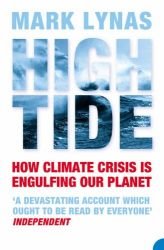
High Tide (Mark Lynas)


Writing about the zombies in the last post reminded me that I hadn’t written up this book, which I read a couple of months ago. I was a little disappointed with it, in that it had a lot of very interesting information and reportage, but the writing itself didn’t engage. That being said, I do think it is a book which we should all read, and the argument seems largely incontrovertible. The planet is warming; sea levels are going to rise.

The point about the zombies was this: consider the city of Lima in Peru. Virtally all of its fresh water comes from the glacier which is rapidly melting (and the inhabitants have been drinking the meltwater). When that process comes to an end in the next decade or so, there will be ten million people without water for six months a year. They will move because, to put it in the words of Darth Cheney, the human way of life is non-negotiable. They will then migrate to where water is available.

There will be many situations like this. They will cascade, like dominoes, each separate area will negatively reinforce the others. It has already started in Africa, in Zimbabwe and Darfur.

I believe that it is too late to prevent the global warming that is already in train. Peak Oil itself will “solve” the emissions problem; eventually the carbon emissions will come down to virtually zero, but by then the damage will have been done. I think we are facing a decade or two of continuous low-level warfare, with the possibility of larger ones breaking out every so often.

What do you do if you can’t get water to drink? Roll over and die? Some will, but those who are prone to aggression – young males – will make every effort to take water from those who have it. Guess where the most young males are located?
TBTM20060418


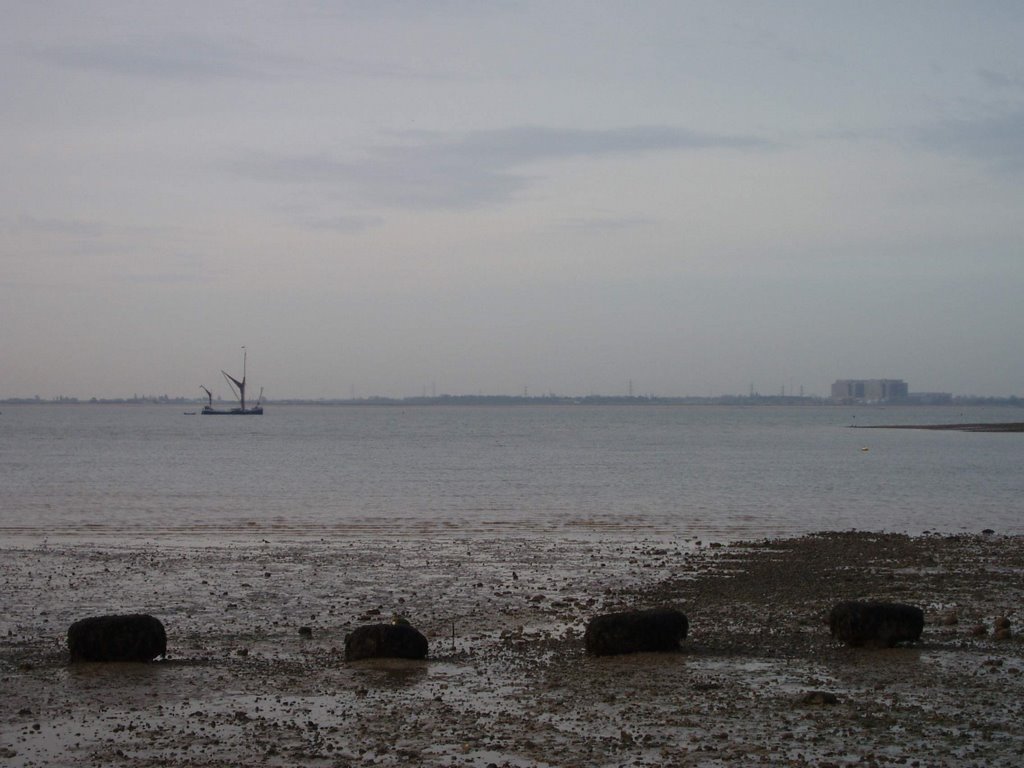
A Thames Sailing Barge has moored a little way off the island. This is not an uncommon sight, and it is a sight that I always find moving and gratifying – for the simple reason that I spent some formative years living on one, moored some eight miles up river from here. My father told me that for a long time it was the most efficient method of transport, as the barge could be sailed by one man and a boy, and the tonnage carried was very impressive. You could say that it had an outstandingly good EROEI.

In the background, in case I haven’t mentioned it before, is Bradwell Nuclear Power Station, now being decommissioned. I think that nuclear power in some form does have a future, but not the way originally planned. Quite a contrast to ponder. The technological future recedes into the past, the tried and tested come back to life.

Random stuff

Got rid of the flu but now seem to have succumbed to a cold: I feel mentally shot to pieces at the moment – not the best place to be at the beginning of holy week 🙁

But I’m sure I’ll recover slowly. Monday’s are always the ‘down day’ after the weekend, and the most strenuous thing on my plate today is preparing some compline addresses – I’m going to expand on my Orthodoxy post over the next three evenings.

In the meantime, this made me smile (HT Chrisendom), as did this for very different reasons.

And Matt Kundert is sustaining a very hiqh Quality output of MoQ related thoughts on his blog, and this reading of Pirsig’s Lila is remarkably fruitful. You’ll hear more of that in due course.

Oh yes, and on the Peak Oil front, this is worth glancing at. Key quote: “The oil industry has for several years claimed that the production from existing fields is declining at around 5 % per year or a decrease in production of about 4 mbpd each year. Adding the increase in demand and the decline we get that an extra 27 mbpd is needed in new capacity in the next 5 years” – is that going to be found? No. Buckle your seatbelt Dorothy, because Kansas is going bye-bye.

Apocalypse not

Have a read of this. Which, with a few caveats, I agree with. I get more and more pessimistic about the economic effects, and more and more optimistic about the social and cultural effects of Peak Oil.

UPDATE: good discussion of the paper at the Oil Drum here.

2.6mbd

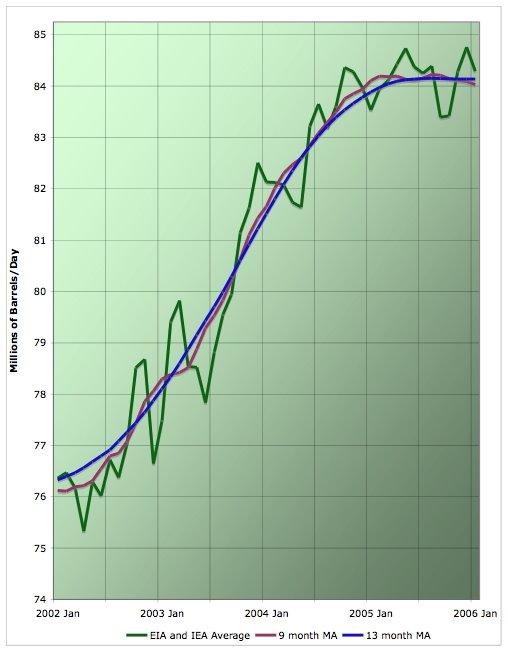
2.6mbd (million barrels a day) is how much new capacity (new oil fields, effectively) has been brought on stream by the oil industry in 2005. That’s significant in the context of an annual supply of 85mbd last year. You might think this means that the situation is rosy. It’s not – because the declines in existing production (ie peak oil in various separate fields) completely offset this increase, meaning that in 2005 there was effectively NO increase in the oil supply. Here’s one of Stuart Staniford’s helpful graphs:

This doesn’t mean that the present rate of production won’t increase. But if we reach 90mbd I’ll eat my hat.

Impact of sea level rise

Got this picture from the Daily Telegraph this morning. Ignore the inset, from what I understand the melting of the East Antarctic ice sheet is radically unlikely. But the main picture is highly plausible, from all the information coming through about Greenland etc. Parts of Mersea will still be OK, but a lot will not.

Great article in Salon about Peak Oil

I particularly liked this: “I think that we can adapt, but our adapting may not be so much technological, as sociological, and maybe even spiritual,” Robinson says. “It really comes down to the question of the place that we see for ourselves in the world and what we need in order to live a meaningful life. For quite a while now, a meaningful life in America has meant acquisition of things and cheap energy, and we associate that with freedom. We do not see that it’s really a form of dependence and slavery.”

Eggsackly.

Full article available here – you’ll have to watch a short advertisement to read the whole thing.

Wow

The British Ambassador to the United States discusses the energy crisis here.

Quote:
“…the supplies of oil on which we depend are finite. Global oil production is apparently nearing its peak. Although there is intense debate about exactly when this will happen – something Daniel Yergin discusses in the Foreign Affairs article I referred to earlier – current estimates seem to be converging on some point between 2010 and 2020. Oil itself will never run out – as the saying goes, “the stone age did not end because of a lack of stones.” But the unavoidable fact is that the economics of pumping it in future are uncertain. One of the most intriguing things about this debate is that it is happening at all. It is extraordinary that a century into the age of oil, with the global economy dependent on $3 trillion worth of this black liquid each year, we don’t even know how much is left.

The International Energy Agency predicts that, if we do nothing, global oil demand will reach 121 million barrels per day by 2030, up from 85 million barrels today. That will require increasing production by 37 million barrels per day over the next 25 years, of which 25 million barrels per day has yet to be discovered. That is, we’ll have to find four petroleum systems that are each the size of the North Sea.

Is this realistic? Production from existing fields is dropping at about 5% per year. Only one barrel of oil is now being discovered for every four consumed. Globally, the discovery rate of untapped oil peaked in the late 1960s. Over the past decade, oil production has been falling in 33 of the world’s 48 largest oil producing countries, including six of the 11 members of OPEC. How then will we meet the soaring demand that the growing global economy will require?

If someone that well embedded in the political establishment is aware of the problem, you can be certain that the governing class as a whole knows what is coming.

Why aren’t they doing their damnedest to make people wake up? Please tell me the conspiracy theories aren’t true…

Strangely enough, I am feeling more and more optimistic about coping with the Peak. All the doomer analysis I read makes the mistake of ignoring what MoQers call ‘Dynamic Quality’, ie that which cannot be foreseen, including human responses to a crisis. I believe that we will pull through. It will be painful – at least a major recession in Europe, probably a major depression in the US, worse in the rest of the world – but we will get through it. The sooner we start to prepare, though, the better off we will be.