Love the machine

Just finished watching series one of Battlestar Galactica. I’m impressed. Much more going on than I was expecting, particuarly in the sphere of theology. I’m intrigued to see where they go with the ‘love of god’ theme, which seems to be playing a great part in the plot.

It is reminding me of two things. The first is the Matrix trilogy, and the peace made between the matrix and humanity. The second is Pirsig’s Zen and the Art of Motorcycle Maintenance – that the Buddha is found in the pistons of an engine just as easily as in the flowers of a lotus petal.

In other words, I think there is a message here, coming through the collective unconscious, prompted by the Holy Spirit, about a reconciliation between humanity and technology, in order to move forward.

Having also finished book three of my ‘Peak Oil’ collection (full discussion tomorrow) the future survivability of human civilisation is on my mind.

“We are waiting not for a Godot, but for another – doubtless very different – St Benedict”

Fear and trembling is the first order of the day

Came across this excellent article, written before the invasion of Iraq, describing our present situation, and what is at stake. I am greatly taken by his analysis.

“We must take a hard look at every idea we hold dear and ask, Does this idea even fit any more? And does it any longer make sense to speak of conservatives in a world in which a catastrophic change of some kind looms, or liberals when it is the core liberal values of all of us – even the most conservative – that are being threatened?

Once the world-historical magnitude of the risk is understood, it is possible for men of good will to differ profoundly over the wisdom of this or that particular response – and not only possible, but necessary. But this must be done in a climate free of pettiness and personalities: the cult of naïve cynicism – that oxymoron that characterizes so much of what passes today for intellectual sophistication – must be dismantled and as soon as possible if we are to make our response as intelligent and as creative as it must and can be. To call prudence appeasement is wrong. But to call the United States’ response a bid for empire is simply silly.

No one’s crystal ball is in such good shape that they can afford to be too vehement in denouncing those who disagree with them. Fear and trembling is the first order of the day, both on the part of those who counsel action and those who do not.”

The great dislocation

A post about running out of oil, and the consequences.

After reading Brian Appleyard’s comment piece on October 16 I bought a few books that came up from a browse on Amazon, and have now read two: Kenneth Deffeyes’ ‘Beyond Oil; the view from Hubbert’s Peak’, and Richard Heinberg’s ‘The Party’s Over – Oil, War and the Fate of Industrial Societies’. I have two more to read (one linking the oil crisis to wider problems, one looking at an investment strategy for when oil becomes significantly more expensive) but I think I have the gist of the issue.

This is the key point:
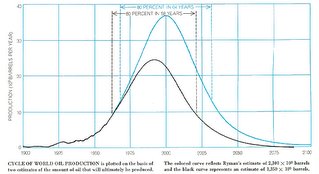
And there are good wikipedia articles here and here. As you can imagine, there’s lots of stuff on the web, which I have just begun to explore.

My reaction to the two books was very distinct. The Deffreyes’ book is very calm and considered, and Deffeyes has a very self-deprecating sense of humour which comes across well. He’s a retired professor of geology, and his book is a very thorough analysis of the geophysics of petroleum production, Hubbert’s Peak, and the viability of alternatives to oil. I had previously accepted a ‘free market’ analysis of the oil question, ie that oil will never run out, it will simply become more expensive. I am now persuaded that the reality is more complicated than that; specifically, that the consequences of ‘more expensive’ – given human nature’s tendency to short sightedness – are likely to be grave.

The Heinberg book assumes the truth of Deffeyes’ argument, and explores the wider implications for industrial society. Heinberg irritated me greatly; although I knew nothing about him before beginning to read, it rapidly became clear that he accepts a Chomsky-ish analysis of the world, whereby all ‘Rightist’ thinking is driven simply by the urge for self-aggrandisement, and this skews his analysis. For example, he has a brief discussion of money, which he argues is a ‘creation’ of central bankers representing debt – and that therefore the financial system is ultimately untenable. This is simply false. Money is two things: a store of value, and a medium of exchange. He needs to read Hernando de Soto’s book on Capital (I’ll copy in something on that which I’ve written previously for the MoQ site).

So Heinberg’s wider analysis was hampered, for me, by his stridently left-wing perspective. He didn’t seem content to marshall facts; he had to imply a moralistic rebuke to western patterns of life. I think that is for the reader to discern.

However, he did persuade me of certain points:
– oil, and to a lesser extent gas, have particularly beneficial properties as a store of energy, which cannot be replicated by other fuels, eg hydrogen (which is not a plausible energy source);
– therefore, the era of mass use of the automobile is almost certainly over (even if we all had electric cars the electricity would need to be generated, and without the fossil fuels that becomes exceptionally difficult);
– wind power is the most effective alternative;
– there is a serious question about the ‘carrying capacity’ of the earth, in terms of how many people can be supported with food, given the dependence of modern agriculture on petro-chemical products;
– there are likely to be severe and increasing ‘resource wars’ as the oil runs out over the next decade or two (or perhaps it has already started).

(He didn’t convince me that nuclear power was irrelevant; I think nuclear power could have a significant role to play in easing the transition, even if the long-term answer has to emphasise renewable energy.)

Hence the title of this post: ‘the great dislocation’. It now seems highly plausible that the political inertia and denial of the run down of oil resources will lead to a catastrophic switch to a lower energy system, rather than a smooth transition from one to the other (which, I’m optimistic, I believe would be possible if we generated sufficient political will). [NB I’m using ‘catastrophic’ there in a sense more technical than melodramatic.]

We do have time, but not a lot. It would be prudent to start setting up our lives, so far as possible, to minimise the use of oil and oil products – that’s the next thing to start exploring.

All this and I haven’t mentioned global warming….

Late addition: I also get irritated by Simon Jenkins, but this is worth reading.

Food for pessimistic thought

I’ve always enjoyed reading Bryan Appleyard – his ‘Understanding the Present’ is, I think, one of the best simple introductions to understanding science and what science can and cannot do.

In today’s Sunday Times is a long, good and sobering article about the various oil-shocks that are coming, amongst other things. Well worth a read.

First you laugh, and then you get worried

Have a look at this.

The worry, of course, being that such people are not so far removed from those with the capacity to bring armageddon into being.

For the record, I’m pretty certain that Christ won’t return in my lifetime. Call it a direct revelation from God if you like, but it’s more a pondering on the fact that if St Paul got it wrong in Thessalonians, how come any one today is so arrogant to think that they can predict or discern when it will be? About that day or hour nobody knows, and all that….

A second flash of lightning

The first flash of lightning was 9/11. It revealed what had been hidden, and the nature of the conflict.

The second flash of lightning is Katrina. It revealed what is at stake, and the way in which the problems will work themselves out. (You could say, in Britain, that the fuel protests were the first writings on the wall).

I’m hugely influenced by this idea.

A storm is coming. Be prepared.

In particular, be prepared to do without petrol, and the consequences of petrol being scarce or highly expensive – like shortages in supermarkets.

Sometimes I think I’m a complete loon for thinking these things. And I would dearly love to be wrong. But I’ve been thinking them for a good four years now; nothing yet has been evidence against it; and there has been a steady accumulation of evidence in its favour.

“The actual outlook is very dark, and any serious thought should start from that fact.” (George Orwell)

The loss that touches everything

Titus one nine pointed me to this paper from Walter Brueggemann (the great bible teacher, if you didn’t know him already). Great stuff:

“The loss, now among us, that touches everything public and personal for everyone, conservative and liberal alike, includes:

• the failure of the old social fabric, now deeply in jeopardy;
• the failure of the old consensus of intellectual certitudes;
• the failure of old patterns of privilege and domination that we count on;
• the failure of economic viability–except for the privileged few–so that
“down-sizing” of claims and possibilities goes on everywhere.

So now we–together–must engage in what ancient Jews did in Babylon, and what ancient Christians did in Jerusalem and in Galilee: embrace the loss that is more than can be imagined. We are the people who know loss best because it is definitional in both our traditions. We are the people who know best what it is like to give up what is over. We are the ones who are entrusted with resources to help our communities and our society move beyond the loss.

Now, as then, there are some who engage in denial and nostalgia, imagining that not much is happening, that the loss is not deep, not permanent. . . except that

Jerusalem really was gone;
Jesus really was dead;
old patterns really are over: no denial; no nostalgia.

Now, as then, there are some who engage in fantasy and in irresponsible private actions, out of touch with social reality. But then–get this!–some, in the loss of Jerusalem, and some, in the death of Jesus, engaged in massively buoyant acts of recommitment to the future. It is that massive, buoyant act of commitment to the future that is our proper agenda and our proper topic. And here I reflect with you on that agenda.”