
This was quite fun, with some interesting conjecture about where genetic research might take us in the proverbial ‘near future’. A very entertaining – because mindless – swipe at environmentalism as well.
Author Archives: Elizaphanian

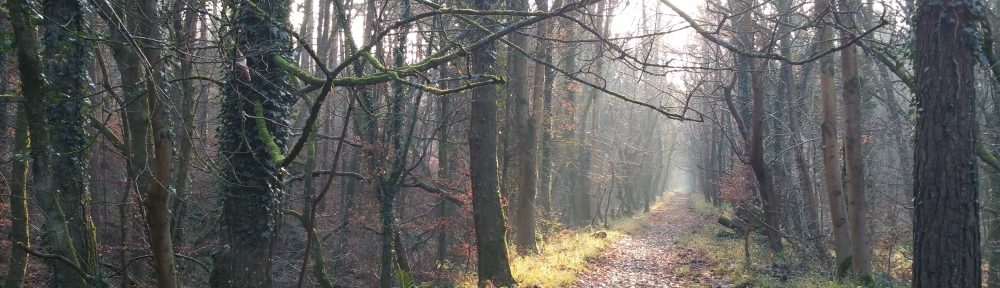
Trees

We’ve been away for a few days, ringing in the New Year with – amongst other delights – some 100 year old port! Lots of posts coming today.
TBTM20080102

A foul stinker of a morning.
TBTM20071230

Forgot to post this on the day.
So that was 2007
A year which began in the most wonderful manner.
The year I outlined Let us Be Human, which contains anything that I might have of significance to communicate to the world.
Also the year in which I worked through a number of my issues about evangelicalism – which has changed me in some ways I haven’t yet fully understood.
The year I joined a gym, at last – and put on a lot of weight whilst simultaneously lowering my body fat index. I also grew my pony-tail again – which I haven’t had since 1991 or so. My brother thinks it makes me look like Francis Rossi….
A year in which I calmed down in many ways (some probably not apparent to the outside world yet), especially with regard to church. My decision to lay George Herbert to rest has a lot to do with that.
A year in which my musical re-awakening proceeded apace, which was creatively cathartic. That latter post is one of the ones I’m most proud of writing – as was this one. I think those writings are what of most permanent value from this blog – even if only for me!
The year I attended a festival for the first time.
I read lots of books.
I watched lots of film and TV series (including Dexter which I greatly enjoyed and will do a proper write up of soon).
A year our eldest decided that he actively wanted to go to school, so we gave up on homeschooling – not without reservations.
A year of continuing to read lots of blogs – I’m now about 18 months behind on my reading of the Times Literary Supplement!! My actual blogroll is distinctly different to that listed on this page – I just haven’t had a chance to update yet. In particular, the blogs I read have continued to shift away from the political and towards the Biblical. I have most especially enjoyed meeting some fellow bloggers in the flesh – and I hope to continue to meet more as time goes on.
And, of course, a year in which my photography moved on a stage.
The marginality of the Virgin Birth (2): Doctrine
This was going to be in two parts – Scripture and Doctrine – but I realise that the latter has many more elements in it that I would like to unpick, and I think a sequence of short posts spread over time will be more helpful. So there will be another five or six after this one.
What are the most important doctrines in the Christian faith? I would say the following are the most central and distinctive:
1. The resurrection – the unique event, incomparable, sui generis – upon which all else rests. Without it our faith is in vain, with it the world turns around and we are free. Sin is conquered, liberty is proclaimed to the captives. Et cetera.
2. The incarnation – a consequence of the resurrection, whereby Jesus of Nazareth is proclaimed Son of God in power by his resurrection from the dead. The Word became flesh and dwelt among us. The purpose of all creation, that through which the entire cosmos is formed and led – this has come amongst us, full of grace and truth. The primary revelation of the nature of God. That which cannot be reasoned or deduced – our eyes are opened from the outside – God comes to us and shows us the light. Thus, incarnation includes salvation – or (following Finlan) theosis is more foundational than atonement – and, I would argue, language of the Fall belongs as a subset of this doctrine, rather than independently.
3. The Trinitarian nature of God – that God is found in relationship – that we are invited into that relationship which exists apart from our own desires and understandings, and that in that relationship we find our most authentic and telic existence.
4. The doctrine of creation – that the world and all that is in it is created by this triune God – that we are creatures dependent upon the eternal sustenance of the Creator – we are held in being, held up by love.
Seems to me that these are the central and most distinctive Christian doctrines. In what way does the notion of the Virgin Birth affirm them, or deny them? Historically the link has been with the doctrine of the Incarnation, which is what I’m going to focus in on in more detail with future posts. But I would say that at most the Virgin Birth helps to affirm Incarnation, but has nothing to do with the others – and even that helpful role is now open to question.
What makes me angry with (some) atheists
Scott g asked me why I lose calm when discussing matters related to atheism, which I’ve been pondering. At root I don’t agree that it isn’t about praxis, although I accept that the link is not direct.
I think there are two sorts of atheist criticism, and one of them riles me, the other doesn’t at all (in fact I find it rather congenial – oops, there might be more on that another time).
The first sort I associate with Dawkins and his ilk, and it is by far the most common sort that I encounter (admittedly this might be triggered by people discovering who I am and what I do). This tends towards supercilious condescension (The God Delusion etc) and is convinced of its own intellectual superiority. This riles me because for various reasons I see it as not only intellectually inadequate but manifestly inadequate; that is, any fair minded investigation of the debate would undoubtedly consider the Dawkins critique to be not just false but foolish too (think of Terry Eagleton’s famous evisceration of that book). In other words, what engages me here is a conviction that the truth matters – and these sorts of atheists seem not to care about truth.
Now the second sort of atheist is rather different to this – and in fact, the variety of this second sort is much greater and more interesting than the uniformity of the first sort. Perhaps a better label would be ‘non-Christian’ rather than atheist, because I would include people with all sorts of diverse understandings here, eg Buddhists, pragmatists, MoQists and so on. Such people can criticise Christian understandings much more radically than the Dawkins-style fulminations because they are a) more educated and understanding of mainstream Christian thought, and b) they accept the reality and necessity for rejecting science as the primary boundary marker for knowledge and wisdom. In other words this second sort of ‘atheist’ is living in the same world that I’m living in, and we can have all sorts of productive conversations – and we do.
Really what my “thresholds” were about were fencing off the first sorts of atheists; or, perhaps a bit more defensible, they are ways for me to work out what sort of atheist I am engaging with. I really enjoy and value the conversations I have with the second sort, but not the first, which I find frustrating. Now that is a spiritual issue, because I don’t think that this reaction of frustration and anger is a defensible one; it’s a fault in me. Hence I need to try and cultivate my inner calm.
TBTE20071229

In lieu of a TBTM, and in honour of a lazy Sunday morning 🙂
Paris

My beloved thought that I was down and in need of a boost, so took me off for a whirlwind trip to Paris, leaving boys with Granny (thanks Granny!) and just the little girl for company. The above photo was the first one I took, just after walking out of our hotel door. I hadn’t changed the setting away from monochrome, but I quite like the result.
 On the ‘allee des cygnes’.

Doing my usual thing. Not wondering ‘where’s the beach’…

In our walks around the city we were very struck by the passionate intensity of the public sculpture – quite a contrast to that on display in London.

My wife is a big Rodin fan.

The French love their straight lines.

Our Lady of Paris.

On the way home.
The Tower this morning

Strictly speaking, it was yesterday morning…. (grin)