For a bit more on my view (mentioning some of the art he references) see this old post from 2006, about the skandalon.
(Source: http://www.youtube.com/)


For a bit more on my view (mentioning some of the art he references) see this old post from 2006, about the skandalon.

So: this is the global temperature trend of the last fifteen years. It is downwards. (Found here)
Now, in and of itself, that doesn’t mean very much – it could all be part of the natural fluctuation within an overall increasing trend, etc etc blah blah blah. (Although, obviously, the longer it continues, the more difficult the ‘mainstream consensus’ will find it to brush things away).
However, what I want to compare and contrast this graph with, is this one, showing use of fuels through the twentieth century (from Gail Tverberg).
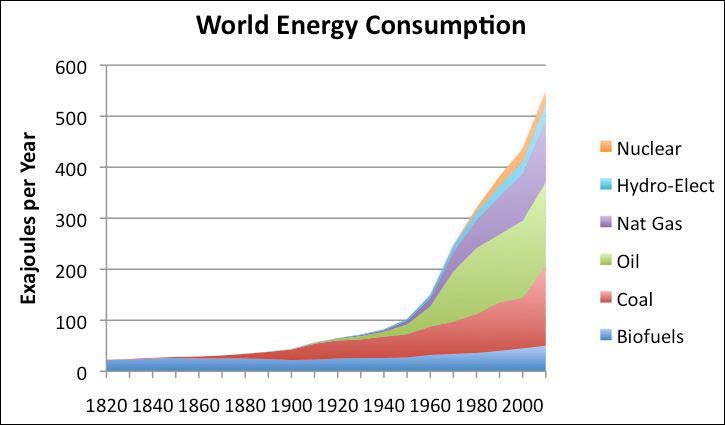
Notice how the use of fossil fuels (=oil) really kicked off after the Second World War and that we are now using some four times as much per year as then. Now it occurs to me that if the relationship between the use of fossil fuels and the temperature of the earth was in any way a direct one, then we would be observing a similar acceleration in the year on year increase of temperature as can be seen in the use of fossil fuels. What we observe instead is a contra-indication. Not only is there no acceleration of the increase, there isn’t even an increase!
Clearly, carbon dioxide is only one factor in a chaotic system, and there simply isn’t a direct and linear relationship between the increase of CO2 in the atmosphere and global temperature change. That’s just a pesky little fact.
The interesting question, to my mind, is about how far the increase in temperature in the second half of the twentieth century is anomalous when compared to other periods of history – eg, when compared to the trend since 1700, or the trend since about 1800, or the trend since about 3000 BC. This, however, leads us into Hockey Stick territory – and it explains why that remains such a totem. If the Hockey Stick is correct, then the acceleration can be (just about) found. Yet if the Hockey Stick is fraudulent – which I believe it to be – then this is some strong empirical evidence running against the CAGW hypothesis. I shall maintain my watching brief.
So: this is the global temperature trend of the last fifteen years. It is downwards. (Found here)
Now, in and of itself, that doesn’t mean very much – it could all be part of the natural fluctuation within an overall increasing trend, etc etc blah blah blah. (Although, obviously, the longer it continues, the more difficult the ‘mainstream consensus’ will find it to brush things away).
However, what I want to compare and contrast this graph with, is this one, showing use of fuels through the twentieth century (from Gail Tverberg).
Notice how the use of fossil fuels (=oil) really kicked off after the Second World War and that we are now using some four times as much per year as then. Now it occurs to me that if the relationship between the use of fossil fuels and the temperature of the earth was in any way a direct one, then we would be observing a similar acceleration in the year on year increase of temperature as can be seen in the use of fossil fuels. What we observe instead is a contra-indication. Not only is there no acceleration of the increase, there isn’t even an increase!
Clearly, carbon dioxide is only one factor in a chaotic system, and there simply isn’t a direct and linear relationship between the increase of CO2 in the atmosphere and global temperature change. That’s just a pesky little fact.
The interesting question, to my mind, is about how far the increase in temperature in the second half of the twentieth century is anomalous when compared to other periods of history – eg, when compared to the trend since 1700, or the trend since about 1800, or the trend since about 3000 BC. This, however, leads us into Hockey Stick territory – and it explains why that remains such a totem. If the Hockey Stick is correct, then the acceleration can be (just about) found. Yet if the Hockey Stick is fraudulent – which I believe it to be – then this is some strong empirical evidence running against the CAGW hypothesis. I shall maintain my watching brief.
One of the things which the recent death of Neil Armstrong brought to mind is the way in which the 20th century profoundly altered our understanding of ourselves and our place in the cosmos. The beginning of the film ‘Contact’ provoked awe when I first watched it, on a trip to Boston in 1997. It is the ultimate in ‘pull-back shots’ (you can find it on YouTube, search for ‘Contact opening scene’), beginning from the surface of the earth and just going back, and back, and back… and back. Out of the solar system, past the heliosphere, through the Milky Way, beyond the point where our galaxy is just a small dot in a haze of other galaxies. I had thought that I had a good sense for the scale of the universe, but when I lost my sense of depth about three-quarters of the way through the sequence, I realised that I had been deluding myself. The sense of scale that we need to try to comprehend when we consider our position in the universe is quite possibly unattainable to the human mind. Our Galaxy, the Milky Way, has some 400 billion stars. There may be 125 billion such galaxies in the universe. There are probably more stars than there are grains of sand on earth. I find these numbers meaninglessly large – but I’m not sure that the existential issue is any different from when the Psalmist wrote “When I consider thy heavens, the work of thy fingers, the moon and the stars, which thou hast ordained; What is man, that thou art mindful of him?”
The Christian understanding of the world was born in an environment radically different to the one that we inhabit today. As well as the difference in size of the universe that we are living in, there is a difference in the scale of time of comparable scale. Whereas when the church was getting established, it was considered that the world was created, in roughly the form it has now, some few thousand years ago – and it’s end would be a similar number of years in the future – we now consider that in fact the earth was created some 4.6 billion years ago, the universe perhaps some 15 billion years ago, and we do not have any conception of when it will end, if indeed that question has meaning. I often ponder what some of the implications are for Christian faith. For in traditional terms, Christians look forward to the resurrection of the dead on the last day. This says something very important about our bodily future – that our existence as embodied beings now will somehow be recognised on that last day. Also in traditional terms, that last day will come after the apocalypse, when the last trump shall sound, the anti-christ shall be overthrown and Jesus will return to judge the living and the dead.
This hope or expectation of a last judgement is something which has been of great comfort to many believers over the years, and I believe it says something profoundly true, not least about social justice. What I would say, however, is that it is not something which wholly grips me. My point is to do with the ‘background drama’ against which we might understand the story of Jesus of Nazareth. The early church placed that story in the setting of their culture, and we must do the same. Our culture has radically changed its conception of time and space, and our understanding of the significance of Jesus must change too. It is rather as if we were watching a Punch and Judy show, and we were caught up in the drama, and that small stage bounded our world – and then suddenly we were pulled back to see that this stage was placed in the centre circle at Wembley Stadium. At this point the story just doesn’t have the same imaginative impact any more. Then we are pulled back to a satellite orbiting above London, and really the question of what is going on in the Punch and Judy show on some grass in North West London has to do something really rather remarkable if it is going to attract our attention. Then we pull back… and pull back.
It is sometimes said that we cannot be Christians any longer, for the story of Christianity is a story that is inevitably tied in with an understanding of the world that has been rejected – an understanding which is based in a very small world, this earth, in a cosmos which is unimaginably huge. This is called the geocentric objection, for it is based on the rejection of the idea that the earth is the centre of the universe. How can anything which happens in our world have cosmic significance? (I remember once reading about someone who had calculated what proportion of the known cosmos could conceivably have been affected by the resurrection, ie, if the ‘information’ of the resurrection travelled out in every direction from Easter morning at the speed of light, what proportion of the cosmos has now been reached? The answer is a remarkably small proportion.)
For me, this criticism begins in the wrong place. It first of all buys into a ‘supernatural’ conception of how God works, that is, that God intervenes in an already existing process, rather than the orthodox conception which is that God is eternally sustaining that process, so the idea of ‘intervention’ makes no sense. (Think about the diffference between winding up a clockwork mechanism and letting in run, and playing a piece of music – God’s creation is like the latter, not the former). More significantly, it doesn’t take seriously the religious claim about Jesus’ humanity; in other words, as a criticism of Christianity, it only makes sense as a criticism of pseudo-Christianity, one which sees Jesus’ humanity as a mere appearance, so Jesus was not human in the way that we are human.
The Christian claim starts from an opposite place. Jesus was a human being, but a human being of a particular sort. Just as Adam and Eve were made in the image of God, so too are all human beings. Yet through sin, we have obscured this image in us. In Jesus there is no sin, so in Jesus we see a human being in whom the image of God is revealed without distortion – and thus, in Jesus, we can see the nature of God revealed. So Jesus shows us both what it means to be human – and what is the nature of God. This is what is meant by the Christian doctrine of the incarnation, that God is revealed in human form.
The reason why I believe this to be an answer to the geocentric objection is because it roots our understanding of God in our understanding of ourselves, or, put differently, it states that for as long as there are human beings, Jesus will show us the nature of God. The particular clothing in which the story of Jesus is dressed – such as the language of the ascension, Jesus rising bodily into heaven – may not be essential to the story. The essential story is of a human being who was given over completely to love; to the love of God and to the love of neighbour; who as a result came into conflict with the governing authorities and was executed by them; but who was raised and justified by God on the third day, thereby demonstrating his divinity and establishing the Church, to follow the path that he had forged – to be a Christian is to take that story, that dream, and build a life around it. Doing this will remain possible for as long as we remain human, no matter how far we travel, and no matter what dimensions our imaginations are engaged in.
the idea that the solution is to use the full weight of the state against whe weakest and most disadvantaged individuals in the conundrum, is not one any decent person should entertain.
“The more people who know about this, the better off we will all be.”
Well worth twelve and a half minutes of your time.
I think that the reason reality is that way – that it is in some ultimate sense merciful as well as being a set of physical processes all running along on their own without hope of appeal, all the way up from quantum mechanics to the relative velocity of galaxies by way of “blundering, low and horridly cruel” biology (Darwin) – is that the universe is sustained by a continual and infinitely patient act of love. I think that love keeps it in being. I think that I don’t have to posit some corny interventionist prod from a meddling sky-fairy to account for my merciful ability to notice things a little better, when God is continually present everywhere anyway, undemonstratively underlying all cafés, all cassettes, all composers.
That’s what I think.
Nice to see that Ambrose Evans-Pritchard continues to write better-informed analyses than many of his colleagues at the Telegraph – and even more that he is saying the same thing as I did in my last Courier article. This is the key point, as portrayed by Colin Campbell back in 2006:

The recession – the great dislocation – will not stop until we either replace oil-based transport or learn to do without it. I expect us to be arguing along these lines for some years yet.
Amidst all the national celebrations associated with a wonderful Olympics, I doubt that many people will have been following the financial news quite so closely. The Bank of England has indicated that it is going to continue with its policy of ‘Quantitative Easing’ (which is a technical euphemism for ‘printing money’). I’d like with this article to explain why that policy has not been working – and why it will not work – and link it in to an update on one of my perennial themes, of Peak Oil.
We live in an economy that has largely been dependent upon growing consumption. The more we spend, the more people are employed making things on which we can spend, and those employed people can spend their earnings on more such things, making more employment in turn, and so on. In other words, every pound that we spend then circulates in the economy and helps it to grow. Over the last several decades, this expenditure from earned income has been significantly supplemented by finance from another source – debt. So, if we imagine the economy to be like a balloon, what has happened is that, for a time, the air being blown into the balloon by our own lungs has been supplemented by air being blown in by an extra pump – and the balloon has therefore grown much further and faster.
The trouble is that this ‘over-inflation’ was a financial bubble, and the bubble has now burst. As a result of the financial crisis starting in 2008 the supply of credit into the economy – that is, the source of air from the pump – has been taken away. Worse than this, because the costs of that extra pump still have to be paid for, some of the air from our own lungs – that is, a significant part of our own spending power – is now being diverted from blowing up the balloon (growing the economy) to paying down accumulated debts. Those accumulated debts represent a hole in the balloon, and the balloon is not going to start being pumped up again until those debts have fallen to a more manageable level.
That is why the Bank’s policy of Quantitative Easting is not working, nor is it likely to. The extra money that the Bank is providing – which it hopes is going to enable the High Street banks to start lending again, and thus get the economy ‘blowing up’ once more – is simply being used to pay down and manage existing debt – that is, it is paying for the previous use of the extra pump, it is not actually pumping more air into the balloon itself. In other words, the Bank of England is engaged in a vast exercise of blowing air into a burst balloon, and that will be pointless until the balloon itself is fixed.
I am sceptical as to whether it is actually possible for the balloon to be fixed at all, and that is because of the impact of Peak Oil on our economies. Whilst the specifics of our present economic distress are all tied up with the financial world – the excess of debt most of all – what is not commonly appreciated is the role of energy in the economic system. That is, the great majority of previous recessions were triggered by an energy crisis, and our present on-going recession is no different. It was the massive run-up in oil prices beginning in 2005 that provided the pin which popped the balloon – and it is the continued high cost of oil which has placed a limit on how far the balloon of our economy is going to be able to grow.
This is an image from one of the very first articles I read about Peak Oil, back in 2006, and I see it as one that has more and more relevance as we advance into an economic context dominated by expensive energy.
Notice that the oil price in 2006 was just breaching $70 a barrel – and that in 2008 it reached a high of almost $150 a barrel (it is presently $100-$120 a barrel, dependent on source). Each time the economy begins to recover, and demand picks up again – each time that air is pushed into the balloon – the price of oil will rise far enough to choke off that recovery. It is a simple application of supply and demand. According to the International Energy Agency Peak Oil – that is, the high-point of oil production – was reached in 2006. There has not been any significant increase in the production of conventional crude oil since then. The upshot is that we will never again have access to large quantities of cheap and easily obtainable oil. As the supply is fixed (and will diminish) the demand for oil can only be met by an increase in the price – essentially, the different economies of the world are bidding against each other for access to this commodity (the same thing will apply to gas, but with a 20-25 year delay, as Peak Gas will strike after Peak Oil).
So we are in a situation where we have two significant constraints on reviving our economy. The first is the residue of debt built up in previous decades, which will have to be paid down before the economy, in purely financial terms, is able to recover. The second is that we have shifted from an environment where energy was cheap and easy to obtain into one where energy is expensive and difficult to obtain – and we have only just begun to experience the implications of that shift.
Our best hope is that the economy is enabled to move sideways for a generation, and that during that time our political leadership takes the far-sighted decisions needed to position the country for the transformed economic environment that we shall be living in. There is a very great deal that could be done (in local terms it is called ‘Transition Town’)… but I’m not holding my breath.