Read this on the context for the remarks about Israel by the president of Iran.
Chilling. Something to be aware of. Would anyone blame the Israelis if they act militarily against the Iranian nuclear programme?
Read this on the context for the remarks about Israel by the president of Iran.
Chilling. Something to be aware of. Would anyone blame the Israelis if they act militarily against the Iranian nuclear programme?
One of my favourite (living) theologians now has his own website here.
This is what the LORD Almighty says: Once again men and women of ripe old age will sit in the streets of Jerusalem, each with cane in hand because of his age. The city streets will be filled with boys and girls playing there.
(Zechariah 8 4-5)
Something worth hoping for.
This is what the LORD Almighty says: Once again men and women of ripe old age will sit in the streets of Jerusalem, each with cane in hand because of his age. The city streets will be filled with boys and girls playing there.
(Zechariah 8 4-5)
Something worth hoping for.
A post (originally sent to the MoQ list) about the nature of capitalism, setting out my views. A good website for Hernando de Soto is here.
A few book references first; if you read these you’ll get most of the background to my understanding. Most important: Hernando de Soto’s “The Mystery of Capital”, which I think is simply essential to any informed debate on this topic, and which I’ll be drawing on explicitly below. Second, David Landes’ “The Wealth and Poverty of Nations”. Thirdly, Bjorn Lomborg’s ‘The Skeptical Environmentalist”, especially Part 2 on Human Welfare. There are others, but they are the ones I rely on most.
I’d like to use De Soto to sketch out a framework for looking at the Quality of Capitalism. De Soto employs an analogy early on in his book: think of a lake. It could be looked at by a naturalist, and the beauty appreciated. It could be looked at by a sportsman, and the possibilities for recreation considered. If it is looked at by an engineer or a physicist, however, then the potential for installing a dam might be examined. That is, in the body of water that is the lake there is a _potential_ for energy which is currently being ignored. By the application of certain technology and machinery (e.g. a dam with turbines etc) that potential energy can be turned into something usable, and various possibilities flow from that. The potential energy is ‘fixed’ into a certain form, e.g. electric current, and then activities can be developed which derive from that fixed form. De Soto’s point is that capitalism is the equivalent of the dam. In other words, capitalism is that application of human ingenuity which releases the potential that would otherwise be locked up, and which generates new fixed forms of energy which can be used in other ways.
So what is ‘capital’? De Soto argues that although it is often confused with money (cash), this is a mistake. He writes, “What I take from [Adam Smith] is that capital is not the accumulated stock of assets but the potential it holds to deploy new production”. In other words, to refer to the earlier image, capital is not the water, it is the possibility of electricity. Money is the facilitator of transactions, but “is not itself the progenitor of additional production”. So money, or, more widely, any form of wealth or asset (land, housing, machinery, whatever), none of these are ‘capital’ in the sense which De Soto is describing.
The essential point is that for any of these assets to become capital, they must be ‘fixed’ by a legal process of property rights, and it is this legal process which is the heart of capitalism. It is this legal process which is the equivalent of the dam on the lake, which allows for the potential energy locked up in that body of water to be accessed and deployed in various creative ways. So, whatever assets there may be, unless there is a conversion process, it is not possible to speak of ‘capital’, nor is it possible to speak of capitalism.
Now the key step in the argument, and the natural link in with the MoQ, comes when De Soto is describing ‘the codes of conduct that govern the use and transfer of assets’, in other words, the formal property systems that have developed in the West. He writes, “Formal property records and titles thus represent our shared concept of what is economically meaningful about any asset. They capture and organise all the relevant information required to conceptualize the potential value of an asset and so allow us to control it. Property is the realm where we identify and explore assets, combine them and link them to other assets. The formal property system is capital’s
hydroelectric plant. This is the place where capital is born.”
De Soto goes on to identify six ways in which this legal process enables capitalism to function:
1. The economic potential of any asset is ‘fixed’ by the abstraction involved (as described above);
2. Various elements of dispersed information are integrated into a single, formal, representational system;
3. It makes individual people accountable to an impersonal process of adjudication, rather than local and customary relationships;
4. Crucially, the abstractions are fungible, that is, “unlike physical assets, representations are easily combined, divided, mobilised and used to stimulate business deals”. The process of abstraction allows all sorts of creativity to apply;
5. It enabled a network of individual actors to relate within a reliable and transparent framework, which “radically improved the flow of communications about assets and their potential [and] enhanced the status of their owners, who became economic agents able to transform assets within a broader network”;
6. Finally, and crucially, it gave a strong and clear protection to the transactions carried out within the system, thereby enabling trust and the proliferation of business.
We can discuss the above in more detail over time, but what I want to emphasise is the way in which De Soto’s characterisation of capitalism parallels Pirsig’s description of different levels. That is, what De Soto is describing is an intellectual level phenomenon, i.e. the abstraction (symbolic representation) of physical, biological or social assets, and the way in which they have ‘gone off on purposes of their own’, generating vast new static patterns of Quality. (Note that this analysis disagrees with Pirsig’s own account of capitalism.)
De Soto’s main point, in fact, is that the problem in Third World countries is not the presence of capitalism, but the absence, in other words, that those countries are still operating at the social level, and it is the absence of the intellectual level phenomenon of capitalism (i.e. the abstract representations of economic assets) which is hindering their economic development. De Soto’s book is an extended argument as to how and why this is the case.
Now, the foregoing is the conceptual analysis of ‘capitalism’, and to summarise, it is my view that capitalism is the intellectual level representation and organisation of economic assets in such a way that new forms of Quality can come into existence. The question might then be – is this the best or the only intellectual level organisation of economic assets?
Leaving aside the question of open-ness to DQ, and associated questions of human rights and liberty etc, (on which Pirsig is reasonably clear IMHO) it seems to be the case that the existence of capitalism has benefited the residents of those nations depending upon it, and it can also be shown to have benefited the population of the world as a whole. The following thoughts (from Lomborg) seem pertinent:
– global GDP per capita, from a base of approximately $400 in pre-history to 1800 is presently around $6000;
– global poverty has diminished: “In the past 50 years poverty has fallen more than in the previous 500” (UN report of 1997) – still much to do, but the situation in developing countries is much better than it was;
– inequality “peaked in the 1960’s [due to historical factors], has been decreasing since then, and is likely to continue to decrease dramatically for the coming century”;
– the proportion of people starving in the world has fallen from 35 percent in 1970 to 18 percent today, and is expected to fall to 12 percent by 2010.
Lomborg’s conclusion is that ‘Things are not everywhere good [he’s mainly concerned with Africa] but they are better than they used to be”. As he puts it, “All in all, pretty incredible progress.”
I’ve wanted, with the above, to provide more of a conceptual background for our discussion, rather than dive immediately into comparative statistics and moral debates about globalisation etc. I’m sure we can come on to those in our forthcoming posts. But I’ll give the last word here to De Soto again, because I agree with it completely:
“I am not a diehard capitalist. I do not view capitalism as a credo. Much more important to me are freedom, compassion for the poor, respect for the social contract and equal opportunity. But for the moment, to achieve those goals, capitalism is the only game in town. It is the only system we know that provides us with the tools required to create massive surplus value. When capital is a success story not only in the West but everywhere, we can move beyond the limits of the physical world and use our minds to soar into the future.”
A post about running out of oil, and the consequences.
After reading Brian Appleyard’s comment piece on October 16 I bought a few books that came up from a browse on Amazon, and have now read two: Kenneth Deffeyes’ ‘Beyond Oil; the view from Hubbert’s Peak’, and Richard Heinberg’s ‘The Party’s Over – Oil, War and the Fate of Industrial Societies’. I have two more to read (one linking the oil crisis to wider problems, one looking at an investment strategy for when oil becomes significantly more expensive) but I think I have the gist of the issue.
This is the key point:
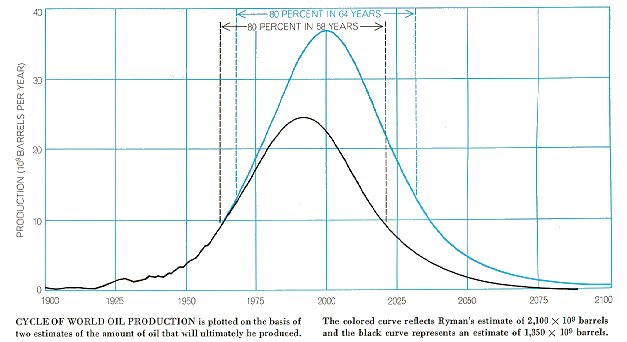
And there are good wikipedia articles here and here. As you can imagine, there’s lots of stuff on the web, which I have just begun to explore.
My reaction to the two books was very distinct. The Deffreyes’ book is very calm and considered, and Deffeyes has a very self-deprecating sense of humour which comes across well. He’s a retired professor of geology, and his book is a very thorough analysis of the geophysics of petroleum production, Hubbert’s Peak, and the viability of alternatives to oil. I had previously accepted a ‘free market’ analysis of the oil question, ie that oil will never run out, it will simply become more expensive. I am now persuaded that the reality is more complicated than that; specifically, that the consequences of ‘more expensive’ – given human nature’s tendency to short sightedness – are likely to be grave.
The Heinberg book assumes the truth of Deffeyes’ argument, and explores the wider implications for industrial society. Heinberg irritated me greatly; although I knew nothing about him before beginning to read, it rapidly became clear that he accepts a Chomsky-ish analysis of the world, whereby all ‘Rightist’ thinking is driven simply by the urge for self-aggrandisement, and this skews his analysis. For example, he has a brief discussion of money, which he argues is a ‘creation’ of central bankers representing debt – and that therefore the financial system is ultimately untenable. This is simply false. Money is two things: a store of value, and a medium of exchange. He needs to read Hernando de Soto’s book on Capital (I’ll copy in something on that which I’ve written previously for the MoQ site).
So Heinberg’s wider analysis was hampered, for me, by his stridently left-wing perspective. He didn’t seem content to marshall facts; he had to imply a moralistic rebuke to western patterns of life. I think that is for the reader to discern.
However, he did persuade me of certain points:
– oil, and to a lesser extent gas, have particularly beneficial properties as a store of energy, which cannot be replicated by other fuels, eg hydrogen (which is not a plausible energy source);
– therefore, the era of mass use of the automobile is almost certainly over (even if we all had electric cars the electricity would need to be generated, and without the fossil fuels that becomes exceptionally difficult);
– wind power is the most effective alternative;
– there is a serious question about the ‘carrying capacity’ of the earth, in terms of how many people can be supported with food, given the dependence of modern agriculture on petro-chemical products;
– there are likely to be severe and increasing ‘resource wars’ as the oil runs out over the next decade or two (or perhaps it has already started).
(He didn’t convince me that nuclear power was irrelevant; I think nuclear power could have a significant role to play in easing the transition, even if the long-term answer has to emphasise renewable energy.)
Hence the title of this post: ‘the great dislocation’. It now seems highly plausible that the political inertia and denial of the run down of oil resources will lead to a catastrophic switch to a lower energy system, rather than a smooth transition from one to the other (which, I’m optimistic, I believe would be possible if we generated sufficient political will). [NB I’m using ‘catastrophic’ there in a sense more technical than melodramatic.]
We do have time, but not a lot. It would be prudent to start setting up our lives, so far as possible, to minimise the use of oil and oil products – that’s the next thing to start exploring.
All this and I haven’t mentioned global warming….
Late addition: I also get irritated by Simon Jenkins, but this is worth reading.
The question about how many are saved (Luke 13 22-30) is a strikingly sharp one. Investigating the answer can lead to one of two opposed problems. Either, as with Jesus’ questioner, there is a sense of being righteous, and therefore a spiritual pride – a pride which Jesus effectively debunks by pointing out how many will come from East and West and North and South into the kingdom – in other words it isn’t just for the Jews.
Or else there is the opposite problem of fear – a fear of being condemned by God, of not coming up to the mark. This is a problem because love and fear are opposites, and this sort of fear is crippling, radically inhibiting the possibility of showing forth love in our world. Which is what we are here for.
I understand that the orthodox explicitly teach that salvation is a mystery that it is unhealthy to spend too much time considering. We have to concentrate on being loving, depending solely on grace, and allowing that love to be demonstrated by our lives. We are to trust and depend solely on the mercy of God. Too much time considering ‘How many are saved?’ ends up with sectarian strife. Something which our Anglican Communion may need to ponder a little further, today especially.
I watched the remake of Battlestar Galactica over the weekend (pilot film), and am now working my way through the series. I was impressed; much more coherent and dramatic than I was expecting, with a lot of nice touches. Clearly a great deal of post-9/11 sensibilities being worked through, but I am intrigued to see where they go with the cylon/human interactions, especially Boomer and similar characters. It doesn’t look like being a simplistic good vs evil story, which is refreshing.
Haven’t managed to watch Serenity yet – maybe this week, assuming that it’s still on show somewhere.
In Pirsig’s Zen and the Art of Motorcycle Maintenance there is a wonderful description of a debate between the narrator and a friend about ‘shim’, which leads to a long philosophical discussion of the difference between ‘classic’ and ‘romantic’ outlooks upon life.
The friend is riding a shiny new BMW motorbike, but the handlebars are slipping. The narrator offers to fix the handlebars with a ‘shim’, ie a piece of metal to be inserted into the handlebar socket. The qualities needed for a ‘shim’ to work are that it should be soft enough to enable the handlebars to be gripped more consistently, without causing rust to build up over time. The narrator has the perfect material to hand – the aluminium from a Coke can. However the friend takes one look at the Coke can and reels with shock – there is no way that a piece of junk is going to be applied to the nice new BMW, so the friend simply ‘copes’ with wobbly handlebars for the rest of the journey.
The narrator draws a distinction from this: he was looking at the underlying properties of the material, ignoring their origin as part of a coke can – this he calls a ‘classic’ perspective. Whereas his friend was going on the surface qualities and ‘feel’ of the Coke can – a ‘romantic’ perspective. It’s not that one is better than the other, both are needed, but it means that sometimes there is a conflict between them, whereby something works wonderfully, but looks bad, or just silly.
Which brings me to my classic hat (which I was reminded of by the Seven Samurai)…

Watched Seven Samurai last week – in the church hall, with a (small) number of parishioners – the trial run for a fortnightly film club. Started with the Kurosawa to establish our credentials as a profoundly serious film society (grin), but the tone should be leavened on a regular basis (we’ve got The Life Aquatic With Steve Zissou coming up next, on Thursday November 3rd at 7:30 if any parishioners are reading this).
Anyhow, the film was marvellous. Could understand why it is seen as one of the greatest action movies ever made. Not sure I have anything distinctive to say about it – it has been analysed to death over the last forty years or so – but one thing that struck me was the beatiful individuality of the faces, example below.
